KEPCO to Announce First Long-Term Distribution Network Plan Next Month
Surge in Distribution Investment Driven by AI and Renewable Energy Expansion
Investment Expected to Exceed 40 Trillion Won Over the Next 15 Years
Growing Demand for DC Distribution... Power Equipment Industry Responds Actively
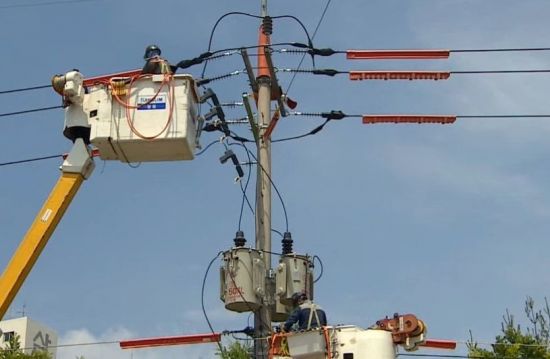 Utility pole with a transformer.
 Photo by YouTube screen capture
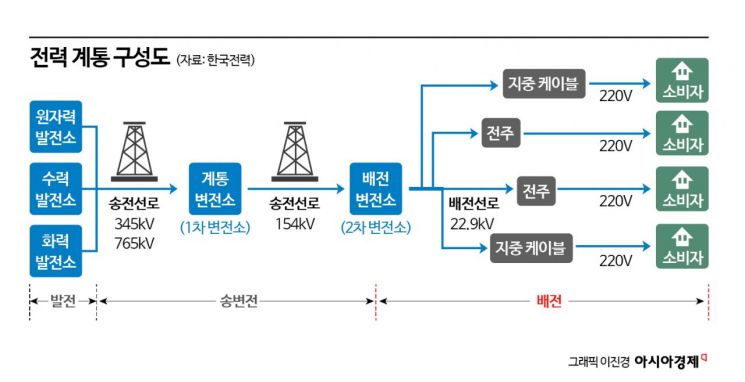
Korea Electric Power Corporation (KEPCO) will announce a long-term distribution network investment plan next month, which will involve an investment of 40 trillion won over the next 15 years. The distribution network is the final stage in the supply of electricity, delivering power produced at power plants to homes and industrial sites. As electricity demand surges due to the spread of AI and the increase in renewable energy, KEPCO has decided to strengthen the distribution network. Following the boom in the ultra-high voltage transformer market, industry experts predict that the power equipment sector will continue to thrive.
According to the power industry on July 22, KEPCO is expected to officially announce its first long-term distribution network investment plan based on the Special Act on the Promotion of Distributed Energy as early as next month. A KEPCO official stated, "The long-term distribution plan is scheduled to be approved by the board of directors in July, reported to the Ministry of Trade, Industry and Energy in August, and then released to the public."
The Distributed Energy Act requires distribution operators (KEPCO) to submit plans for expanding and operating the distribution network necessary to accommodate distributed energy to the Minister of Trade, Industry and Energy. This year, the plan will include a five-year expansion roadmap for the distribution network through 2028.
Industry insiders estimate that, including this plan, the investment required to expand the distribution network over the next 15 years will reach between 40 trillion and 50 trillion won. A senior official from the Ministry of Trade, Industry and Energy said, "In the 11th Long-Term Transmission and Transformation Facility Plan (2024?2038), we projected 73 trillion won in investments for the transmission and transformation network. Investment in the distribution network will also increase proportionally," adding, "It is expected to be at least 40 trillion won."
The power industry believes that, due to rising construction costs, future investments could approach 50 trillion won. Several trillion won in investment is expected just for the upcoming five-year distribution network plan.
The need for large-scale investment in the distribution network arises not only because renewable energy is increasing, but also because overall electricity usage is growing significantly. In particular, the rapid expansion of AI technology has caused a sharp increase in electricity consumption by high-performance semiconductors and data centers, making it necessary to have a power grid capable of supplying more electricity reliably. By shifting to a system in which electricity is consumed closer to where it is produced, the burden on transmission lines can be reduced, and regional supply-demand imbalances and electricity price gaps can also be alleviated.
Among renewable energy facilities, those with a capacity of 40 megawatts (MW) or less are connected to the 22.9 kilovolt (kV) distribution network, rather than the transmission network, to deliver electricity. As the number of such facilities increases, demand for the distribution network also rises. The expansion of the "local production, local consumption" (jisanjiso) model, in which electricity is consumed in the same area where it is produced, is part of this trend.
Additionally, as devices that use direct current (DC) electricity, such as solar power systems and energy storage systems (ESS), become more common, and as data centers using large-scale DC power increase, the need to convert the distribution network to a DC system is also growing.
Companies in the wire and power equipment sectors are expressing optimism about this emerging market. An LS Electric official said, "We expect that the expansion of renewable energy, the resulting increase in DC loads, and the implementation of the Distributed Energy Act will increase the need for DC distribution." A spokesperson for Taihan Electric Wire also stated, "Not only will related demand increase, but standards will also be established."
© The Asia Business Daily(www.asiae.co.kr). All rights reserved.
![Clutching a Stolen Dior Bag, Saying "I Hate Being Poor but Real"... The Grotesque Con of a "Human Knockoff" [Slate]](https://cwcontent.asiae.co.kr/asiaresize/183/2026021902243444107_1771435474.jpg)















