All Clear for Uranium, Radioactive Cesium, and Heavy Metals
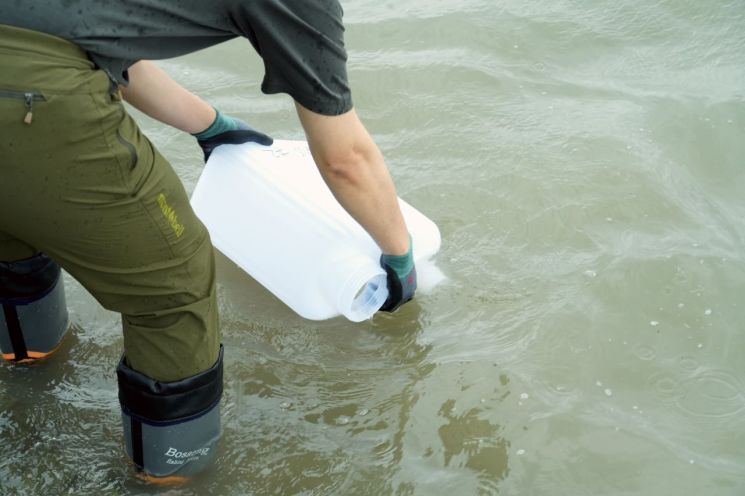 The Nuclear Safety and Security Commission announced on the 4th that it dispatched experts from the Korea Institute of Nuclear Safety (KINS) to Ganghwa Island to collect samples in response to recent concerns regarding wastewater from the North Korean Pyongsan uranium refining plant.
 Sampling was conducted at six locations on that day, and the samples were transferred to the KINS laboratory for detailed analysis of cesium, uranium, and heavy metal contamination.
The photo shows a KINS expert collecting samples on Ganghwa Island on July 4, 2025. Photo by Yonhap News.
The government announced on July 18, 2025, that it had found "no abnormalities" following a joint special investigation conducted by relevant ministries since July 4 to assess the impact of radioactive and heavy metal contamination in domestic waters and rivers, in response to recent concerns regarding wastewater from the North Korean Pyongsan uranium refining plant.
The Nuclear Safety and Security Commission, the Ministry of Oceans and Fisheries, and the Ministry of Environment collected samples from a total of 10 locations, including Ganghwa Island and the Han River estuary, which are closest to the Yesong River estuary flowing from North Korea. They analyzed two types of radionuclides, including uranium, and five types of heavy metals. The results confirmed that there were no abnormalities in uranium, radioactive cesium, or any of the five heavy metals.
First, an analysis of uranium concentrations in seawater collected from six locations in the Ganghwa and Gimpo areas adjacent to the lower Yesong River showed levels that were either lower than or similar to those observed in 2019, a year when no unusual findings were reported. Additional analysis of uranium concentrations at two sites in the Han River and Imjin River estuaries and two sites along the Incheon coast, compared to reference sites from 2019 (the West Sea coast and Han River), also revealed no significant differences.

In addition, radioactive cesium at all sampling sites was found to be below the minimum detectable activity (MDA) or lower than levels measured in the West Sea over the past five years. The MDA refers to the minimum level of radioactivity that can be detected, which is determined by measurement conditions such as the performance of the radiation detector, sample volume, recovery rate, and measurement time.
For all sampling sites, levels of heavy metals were either below the environmental standards set by the Framework Act on Environmental Policy and the marine environmental standards established by the Act on the Conservation and Utilization of the Marine Environment, or were not detected at all.
The government stated that it will maintain a monthly regular monitoring system for the seven key sites included in this investigation for the time being. It also announced plans to continue operating an inter-ministerial consultative body to actively respond to any concerns at the government-wide level.
© The Asia Business Daily(www.asiae.co.kr). All rights reserved.
![Clutching a Stolen Dior Bag, Saying "I Hate Being Poor but Real"... The Grotesque Con of a "Human Knockoff" [Slate]](https://cwcontent.asiae.co.kr/asiaresize/183/2026021902243444107_1771435474.jpg)
















