Hilma af Klint's First Retrospective in Korea
"Hilma af Klint: Appropriate Summoning"
139 Works Including Paintings and Drawings on Display
Kept Private for 20 Years After Her Death... Spotlighted After a Century
An Exhibition Emphasizing the "Weight of Summoning" Over Simple Consumption
A female artist regarded as the origin of abstract art, a figure who deliberately kept her works hidden for 20 years after her death, and a believer who, due to her deep immersion in Theosophy (a religious philosophy that seeks enlightenment through revelation), considered her artistic practice as "transcribing from a greater order"...
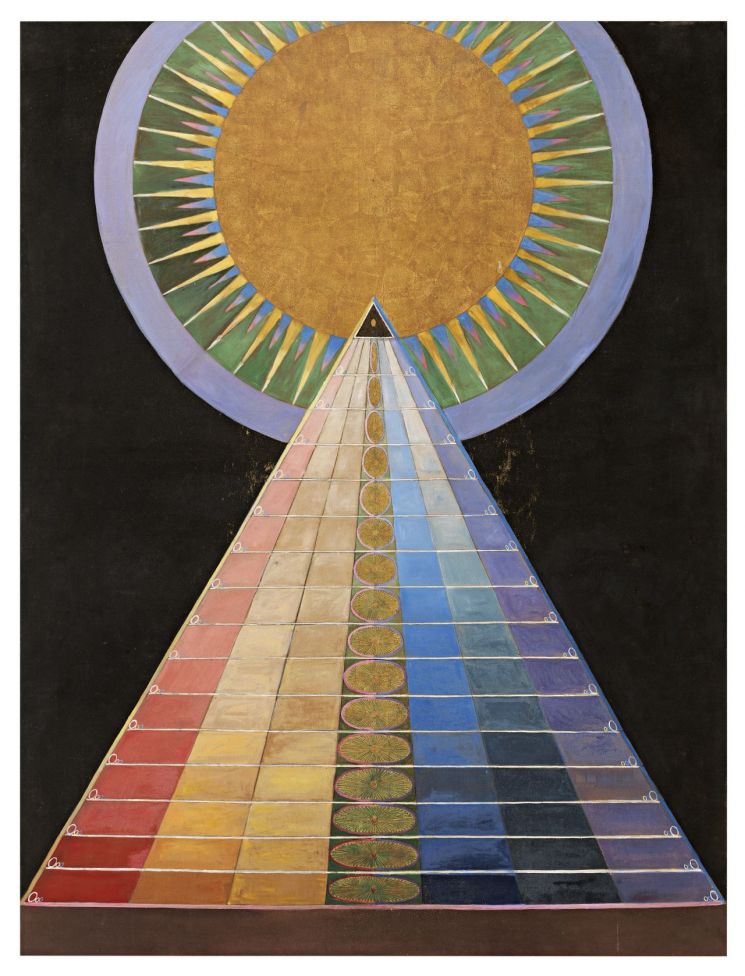
Swedish artist Hilma Af Klint (1862-1944) possessed the symbolic status of being the first abstract painter, yet she remained largely overlooked by the art world for a long time. Her works predated those of abstract masters such as Kandinsky (1866-1944), Malevich (1869-1935), and Mondrian (1872-1944). However, she believed that "the time was not yet right" and chose seclusion. In the past decade, however, she has been newly recognized as a pioneer of abstract art.
On July 17, her first retrospective in Korea, "Hilma Af Klint: Appropriate Summoning," opened at the Busan Museum of Contemporary Art. The exhibition features a total of 139 works, including her major painting series, drawings, and archival materials. While maintaining a chronological framework, the exhibition focuses more on following the artist's thoughts and questions. Rather than simply displaying changes in chronological order, it explores the depth of her artistic philosophy through themes such as Theosophy and feminist art.
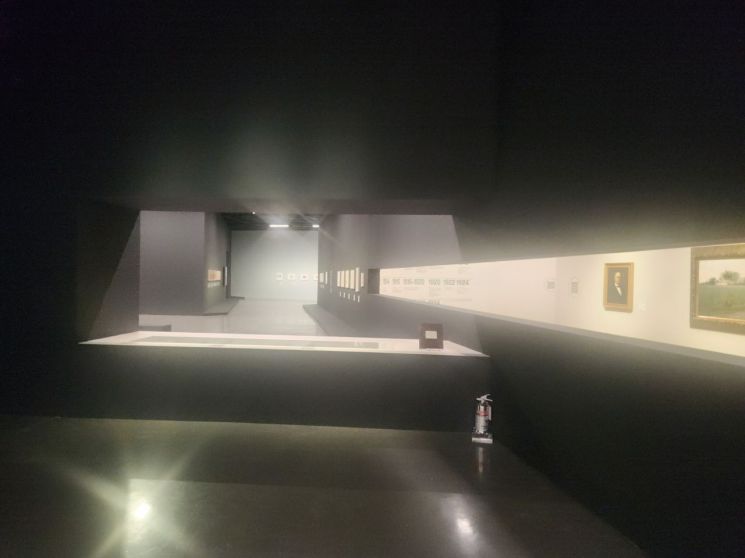 The exhibition space was designed by partially opening the walls to emphasize the connectivity of each area. This is part of a plan to move away from a simple chronological narrative. Photo by Seo Mideum
At a time when formal art education for women was extremely limited, the artist, unusually for a woman of her era, studied art at the Royal Swedish Academy of Fine Arts. Her early works included detailed studies of plants and animals, portraits, and landscapes, but she gradually moved into the realm of abstraction.
The loss of her younger sister at the age of 18 intensified her interest in Theosophy and became a driving force behind her abstract work. Theosophy, a religious-philosophical system that emerged in late 19th-century Europe, emphasized revelation from divine beings. This provided the theoretical background for her works, which sought to express the invisible world through sensation. Curator Choi Sangho, who organized the exhibition, explained, "The artist did not consider painting to be an autonomous act, but rather a process of transcribing from a greater order," adding, "The large number of 'Untitled' works can be interpreted in this context." Most of her work titles consist only of dates and series names, and some were assigned posthumously by researchers or the foundation.
It is said that in 1906, the artist received instructions from an unseen entity to create paintings for a temple. For the next ten years, she devoted herself to this work, completing series such as "Paintings for the Temple," "Parsifal," and "Atom." The exhibition flows from her early paintings, through her exploration of invisible order via Theosophy, to the completion of "Paintings for the Temple," and then introduces series such as "Parsifal" and "Atom" along with related archival materials.
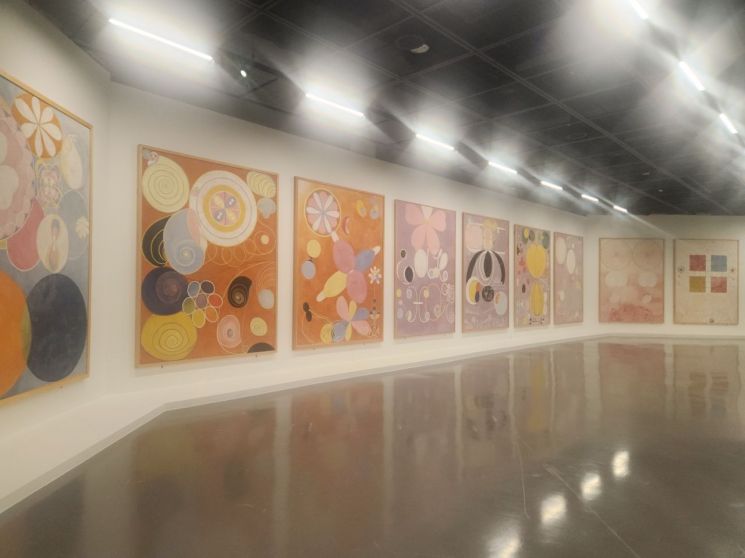 Ten large-scale paintings by Hilma Af Klint, regarded as an attempt to visualize cosmic order and spiritual growth. Photo by Seomideum
The "ten large-scale paintings" that majestically occupy the main hall of the exhibition space are regarded as an attempt to visualize cosmic order and spiritual growth. The paintings feature the artist's distinctive double symbols and symmetrical structures, among which the tree symbolizes the structure of life and its connection to the universe.
During her lifetime, Hilma Af Klint believed her work was ahead of its time and requested in her will that it be sealed for 20 years after her death. Later, 1,200 paintings and more than 100 notebooks were discovered in her nephew's attic and were first revealed to the public at the Los Angeles County Museum of Art (LACMA) in 1986. However, her work did not receive much attention until the 2018 retrospective "Hilma Af Klint: Paintings for the Future" at the Guggenheim Museum in New York drew more than 600,000 visitors, sparking belated but significant interest.
Curator Choi Sangho commented, "Her works, once dismissed as having arrived too early, are now repeatedly invoked under the narrow rhetoric of a genius discovered too late. This exhibition is designed as a time to reflect on the subtle power and responsibility inherent in the act of naming, while guarding against the bias and distortion that can result from hasty summoning."
Kang Seungwan, director of the Busan Museum of Contemporary Art, stated, "By summoning the artist Hilma Af Klint, who lived a century and a half ago, into a 21st-century contemporary art museum, we aim to establish her not as a disconnected figure of the past, but as a presence that reconstructs continuity and perspective with the present. We hope this approach will be meaningful to those who view the exhibition."
The exhibition runs through October 26.
© The Asia Business Daily(www.asiae.co.kr). All rights reserved.



















