"If Rain Boots Fill with Water, They Become Heavy...
Wear Sneakers with Laces"
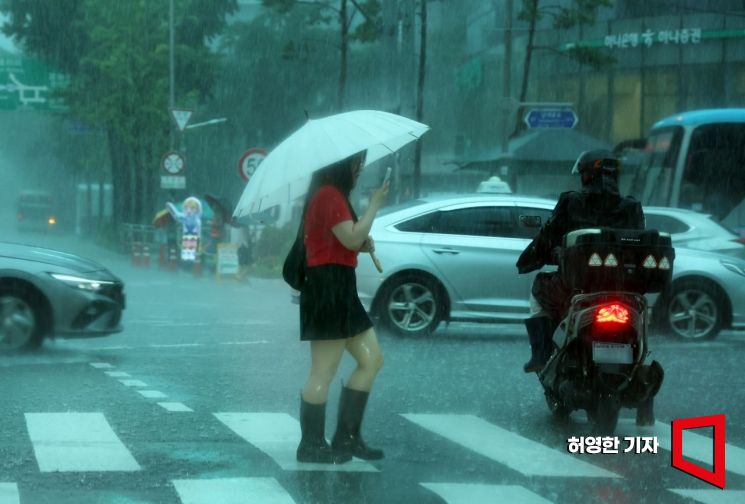
This weekend, strong rain is forecast, and there has been a warning that rain boots, which are typically worn to prevent getting wet, can actually become dangerous during heavy downpours.
On the 17th, various online communities shared an evacuation guideline poster distributed by Japan's NHK, which provides instructions for evacuating during heavy rainfall.
The poster, titled "Precautions to Take When Evacuating on Foot," emphasizes several points: do not wear rain boots, do not enter flooded areas, and evacuate with others rather than alone. In particular, it states that rain boots can become heavy and hinder movement if water gets inside, so sneakers with laces are more suitable for evacuation purposes.
It is known that rain boots can actually become a hazard in situations where water rises suddenly. In July last year, Fuji News Network (FNN) recommended, "To prevent injuries, wear long sleeves, long pants, and sneakers," and advised, "Avoid rain boots, which become heavy and difficult to move in if water enters, as well as sandals that can easily slip off and slippery shoes. Instead of an umbrella, wear a raincoat."
The report continued, "If the water level exceeds an adult's knee (about 50 cm), it may become difficult to walk due to water pressure, so deep water should be avoided." It also warned, "Even shallow water with a current can sweep you off your feet, so you should not enter it."
In August last year, Nippon Television News also cited an explanation from a disaster prevention expert, stating, "It is better not to wear rain boots during flooding or inundation." The expert pointed out, "While rain boots pose no problem during ordinary rain, if flooding is deep enough to submerge the boots, water can enter from the top, making it difficult to walk. The boots themselves also become heavy, increasing the risk of your legs getting stuck, which is dangerous."
The expert further explained, "In such cases, you should choose sneakers that can be tightly tied with laces so they do not come off even in the water."
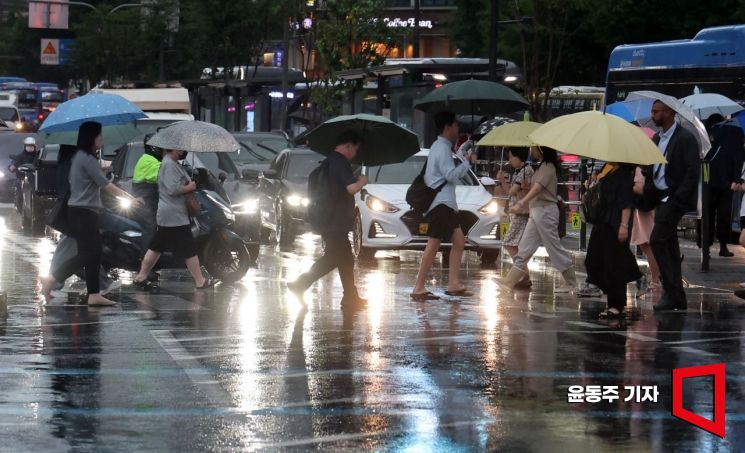 On the 17th, heavy rain fell mainly in the metropolitan and central regions, and citizens passing through Gwanghwamun Intersection in Seoul hurried their steps, armed with umbrellas and rain boots. 2025.07.17 Photo by Yoon Dongju
Since the 16th, heavy rainfall has caused not only flooding of homes and vehicles but also casualties across the country. In Daejeon, Sejong, and South Chungcheong?areas hit by an "extreme downpour that occurs once in 200 years"?flooded roads and homes led to incidents in which three people lost their lives.
In Gwangju and South Jeolla, sudden increases in rainwater resulted in numerous cases of vehicles and drivers being stranded. Subway stations were also flooded, causing service suspensions. In Daegu and North Gyeongsang, more than 140 mm of rain fell, resulting in flooded vehicles and landslides, among other damages.
According to the Korea Meteorological Administration, the rain is expected to continue until the 19th, accompanied by gusts, thunder, and lightning. On the 18th and 19th, Gwangju, South Jeolla, Busan, Ulsan, and South Gyeongsang are forecast to receive 100?200 mm of rain, with some areas (South Jeolla, the southern coast, Jirisan, Busan, Ulsan, and South Gyeongsang) possibly seeing more than 300 mm.
© The Asia Business Daily(www.asiae.co.kr). All rights reserved.
![Clutching a Stolen Dior Bag, Saying "I Hate Being Poor but Real"... The Grotesque Con of a "Human Knockoff" [Slate]](https://cwcontent.asiae.co.kr/asiaresize/183/2026021902243444107_1771435474.jpg)
















