Interpellation...
"Calls for Reform of the Unpaid Legally Mandated Contribution System"
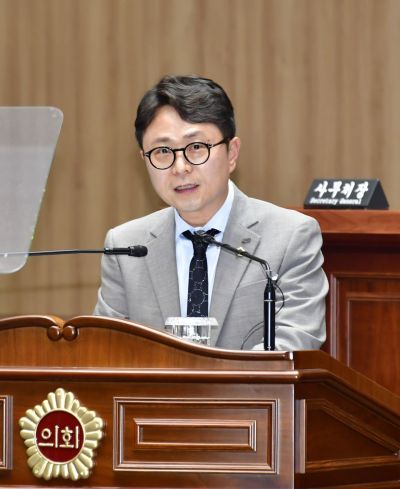
There has been criticism that the recent reform of the recruitment exam system for new teachers at private schools could actually undermine fairness and transparency. Additionally, concerns were raised that the issue of private schools failing to pay their legally mandated contributions remains unresolved, prompting calls for more proactive administrative measures from the Office of Education.
On July 17, Sooki Park, a member of the Gwangju City Council (Democratic Party of Korea, Gwangsan District 5), pointed out during the 334th temporary session of the council that the Gwangju Metropolitan Office of Education recently eliminated the regulation requiring that at least 20% of the first-round written exam scores?administered and managed by the Office?be reflected in the recruitment process for private school teachers. Park stated, "If objective evaluation mechanisms disappear, we cannot rule out the possibility of unfair hiring."
Park further criticized, "While public schools are required to reflect 50% of the written exam scores, private schools can now choose to reflect 0%. As a result, a structure where hiring is possible based solely on teaching demonstrations and interviews could undermine both the fairness and equity that the system was originally intended to promote."
She especially expressed concern, stating, "The Office of Education could face criticism for failing to defend even the minimum standards of fairness, being swayed by the argument for private school autonomy."
In response, Superintendent Jungseon Lee said, "We will strive to ensure public accountability by increasing the proportion of external committee members in the second and third rounds of exams and by providing procedural guidelines."
However, Park countered, "The actual authority for the second and third evaluations lies with the private schools, and with external committee members making up only one-third, the evaluation structure remains under the influence of those with autonomy, making it difficult to resolve concerns."
She went on to point out that the problem of private schools failing to pay their legally mandated contributions remains unresolved. Park stated, "The average payment rate among private schools in Gwangju is only 30%, with as many as six schools paying nothing at all. How can citizens be expected to accept such a structure?"
Park argued, "The incentive and penalty system implemented by the Office of Education has limited effectiveness," and proposed the following alternatives: differentiated financial support based on payment rates; stronger sanctions such as suspending facility funding and restricting board appointments in cases of long-term non-payment; and the introduction of a model private school certification system and a public disclosure system for payment rates.
In response, Education Bureau Director Kisang Baek stated, "We currently provide an annual incentive of 5 million won for 100% payment of legally mandated contributions, and apply penalties by reducing a certain percentage of standard operating expenses according to the non-payment rate. Going forward, we need to further subdivide the payment brackets and strengthen practical incentives to encourage payment."
Meanwhile, Park emphasized, "Even now, an official discussion table should be established so that citizens can feel the Office of Education is committed to resolving these issues," adding, "A proactive change in attitude by the Office of Education is needed regarding both the recruitment of private school teachers and the issue of legally mandated contributions."
© The Asia Business Daily(www.asiae.co.kr). All rights reserved.
![Clutching a Stolen Dior Bag, Saying "I Hate Being Poor but Real"... The Grotesque Con of a "Human Knockoff" [Slate]](https://cwcontent.asiae.co.kr/asiaresize/183/2026021902243444107_1771435474.jpg)















