Confirmation Hearing for Deputy Prime Minister for Economy Nominee
"Considering Separate Taxation for Dividend Income"
"Pushing for Establishment of AI Bureau to Oversee 100 Trillion Won in Investments"
Agrees to Separating Budget Functions of the Ministry of Economy and Finance
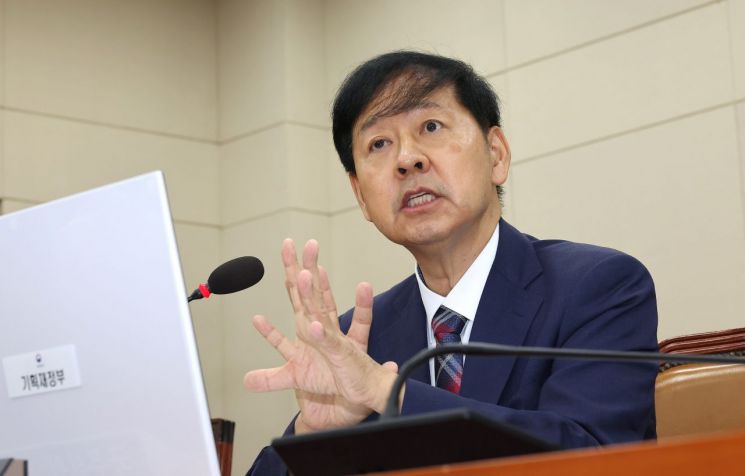
On July 17, nominee for Deputy Prime Minister for Economy and Minister of Economy and Finance Koo Yooncheol stated that corporate tax revenues have decreased by as much as 40% over the past two years, and announced that he would consider restoring the corporate tax rates that were lowered during the previous Yoon Suk Yeol administration. He also said that he would review the introduction of separate taxation for dividend income as a measure to address the so-called Korea Discount in the Korean stock market.
At the National Assembly Strategy and Finance Committee confirmation hearing held that day, Koo responded to a question from Oh Ki-hyung, a member of the Democratic Party, who asked whether he was considering restoring the corporate tax rate to its previous level. Koo said, "I will actively review the issue, considering factors such as ability-to-pay taxation (taxation according to the taxpayer's ability to pay) and its effects."
Koo explained, "I believe the Yoon administration expected that cutting taxes would lead to increased corporate investment, creating a virtuous cycle. However, upon reviewing tax revenues, I found that national tax revenue decreased from 396 trillion won in 2022 to 337 trillion won in 2024, and corporate tax revenues dropped by 40%, from 100 trillion won in 2022 to 60 trillion won last year. This has led to a decline in growth, consumption, and investment."
Currently, the top corporate tax rate in Korea is 24% (26.4% including local taxes). The Yoon administration lowered the rate by one percentage point in the 2022 tax law revision, but a slump in the semiconductor industry and a sharp decline in listed companies' operating profits led to a shortfall of tens of trillions of won in corporate tax revenue in 2023 and 2024.
Regarding the need to restore the securities transaction tax, Koo said, "I will actively review it." The securities transaction tax rate was lowered from 0.2% last year to 0.18% this year. The securities transaction tax had been on track for abolition, premised on the introduction of a financial investment income tax, but as the introduction of the financial investment income tax failed, there have been calls to revise the plan to lower the securities transaction tax.
Koo emphasized, "We must secure the resources needed for a true transformation of the Republic of Korea from somewhere," and added, "I will comprehensively review the effects of tax cut policies."
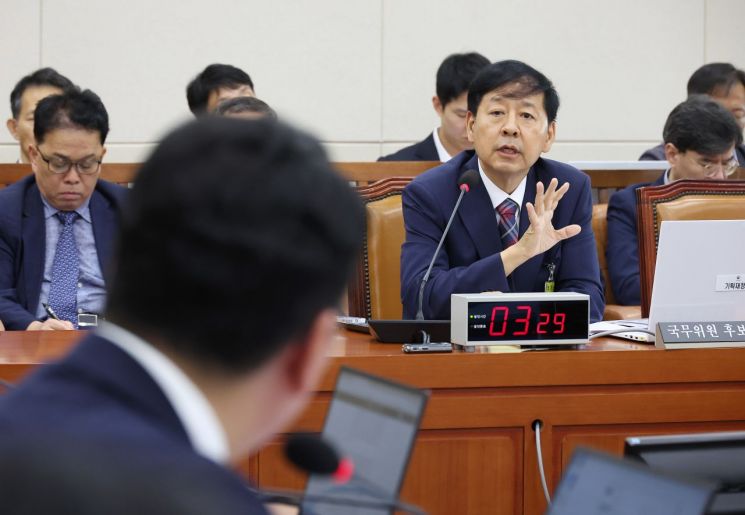
Other ruling party lawmakers also called for measures to rebuild the collapsed tax revenue base. In response to a request from Ahn Dogeol, a member of the Democratic Party, to rationalize the tangled tax system and administration, Koo replied, "When managing the tax system, it is necessary to ensure that those who can bear the burden do so, while reducing the burden on vulnerable groups. I will review the overall tax system in that direction."
Koo also stated that he would consider the introduction of separate taxation for dividend income as one of the measures to resolve the Korea Discount. In a written response submitted earlier, Koo mentioned, "To advance the capital market and support asset building for the public, tax support measures are needed to encourage companies to increase dividends."
In response to criticism from Cha Kyugeun, a member of the Rebuilding Korea Innovation Party, that separate taxation for dividend income could amount to a self-defeating move that would tie the hands of the Lee Jaemyung administration by serving as a tax cut for the wealthy, Koo answered, "I will comprehensively review issues that have been raised in the past."
When Jin Sungjoon, a member of the Democratic Party, pointed out the need to introduce a domestic production promotion tax system similar to Japan's, Koo responded, "Since the hollowing out of domestic manufacturing is occurring, I will actively review it," and added, "I will study whether a virtuous cycle can be created in which production and consumption take place domestically, thereby creating jobs in Korea."
Jin also said, "Although our country provides many tax credits for research and development (R&D) and investment, there are questions about their effectiveness," and suggested, "In some cases, we should boldly consider refunds for local businesses."
Koo also expressed his intention to establish a new Artificial Intelligence (AI) Bureau, which was a presidential campaign pledge of President Lee Jaemyung. He said, "If I am appointed as Minister of Economy and Finance, I will restructure existing bureaus and establish an AI Bureau."
In his opening statement, Koo said, "We will apply AI to existing key industries such as petrochemicals and automobiles to advance them, and take a new approach to foster cutting-edge strategic industries such as quantum, space, bio, energy, K-culture, and defense by integrating AI technology and nurturing them as super-innovative industries."
On the proposal to separate the budget function of the Ministry of Economy and Finance, Koo said, "I agree." Regarding real estate policy, he stated, "We will establish a comprehensive real estate policy that covers Seoul, the metropolitan area, local regions, young people, and foreigners." In response to concerns that foreigners are easily purchasing real estate with more relaxed loan-to-value (LTV) ratios compared to Korean nationals, Koo said, "If necessary, we will prepare comprehensive measures, including LTV regulations," and added, "We will ensure that foreigners do not disrupt our real estate market."
© The Asia Business Daily(www.asiae.co.kr). All rights reserved.


















