Rep. Lim MiAe Proposes Amendments to Family Relationship Registration Act and Immigration Control Act
"As an Adult, I Feel Sorry; As a Politician, I Feel Deep Responsibility"
Legal measures are being pursued in South Korea to provide protection for foreign children who, despite being born in the country, are unable to access benefits such as school enrollment, medical treatment, and vaccinations due to the lack of birth registration. Although these measures do not grant nationality, a bill has been introduced in the National Assembly to support birth registration for foreign children born in South Korea.
On July 17, Lim MiAe, a member of the Democratic Party of Korea, announced at a press conference held in cooperation with the international children’s rights NGO Save the Children that she would be proposing amendments to the Family Relationship Registration Act and the Immigration Control Act to protect foreign children who remain outside the system due to the inability to register their birth.
According to data released by the Board of Audit and Inspection in 2023, there were 4,025 foreign children whose births were not registered between 2015 and 2022. However, Lim’s office estimates that the actual number, including uncounted cases, may reach as high as 20,000.
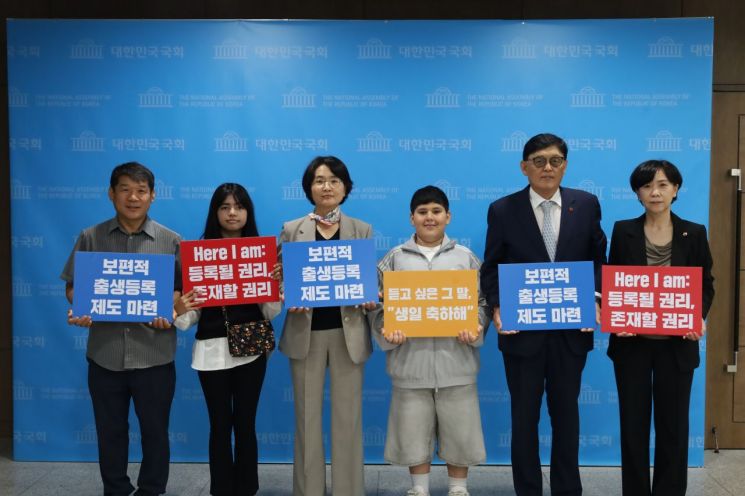
The core issue is that foreign children who are unable to register their birth cannot access social insurance or social security benefits. They also face difficulties in proving their identity, which leaves them without legal protection in everyday life, including school enrollment, medical treatment, and vaccinations. Being left in this institutional blind spot increases their risk of becoming targets of abuse or crime.
To address this issue, Lim is moving forward with amendments to the relevant laws. First, she seeks to introduce a special provision in the Family Relationship Registration Act, which currently limits birth registration to South Korean nationals, to allow for the birth registration of foreign children. This would apply in cases where the parents’ home country does not have an embassy in Korea or where the parents lack legal residency status and therefore cannot report the birth to their home country’s embassy. In addition, she proposes an exception in the Immigration Control Act so that officials responsible for birth registration are not required to report parents’ immigration status, thereby ensuring the birth registration of undocumented foreign children. Currently, foreign children born in South Korea are generally required to have their births registered with their parents’ home country. However, if the parents lack legal residency status, they may avoid registering the birth out of fear that their status will be exposed. The proposed amendments are intended to address this gap.
Kim Gihak, director of Baraka Small Library, who participated in the press conference, stated, “The documentation and costs required for birth registration can be a significant burden for foreign families. Guaranteeing the rights of unregistered children is a universal task for social integration and respect for human rights.” Lim also emphasized that this institutional reform is in line with the United Nations Convention on the Rights of the Child, which the South Korean government has already ratified. The convention stipulates that every child has the right to be officially recognized through registration immediately after birth.
Lim noted, “Since the 19th National Assembly, there have been several attempts to legislate on this issue, but none have succeeded. The children who were unregistered at the time are now living as unregistered adolescents and young adults. The institutional response from the National Assembly has lagged behind the time in which these children have grown up.” She added, “As an adult, I feel sorry, and as a politician, I feel a deep sense of responsibility.”
Meanwhile, Lim’s office clarified that these institutional reforms do not grant South Korean nationality to foreign children. This is because South Korea follows the principle of jus sanguinis, granting nationality based on the parents’ nationality. Birth registration and the acquisition of nationality are separate matters.
© The Asia Business Daily(www.asiae.co.kr). All rights reserved.
![Clutching a Stolen Dior Bag, Saying "I Hate Being Poor but Real"... The Grotesque Con of a "Human Knockoff" [Slate]](https://cwcontent.asiae.co.kr/asiaresize/183/2026021902243444107_1771435474.jpg)















