Reasons for Emphasizing the Hub City Development Strategy and Proportional Regional Recruitment
This Year’s Focus: 'Selection and Concentration' in Regional Economies... First Topic: Online Platforms and the Self-Employed
Sufficient Support Needed for Self-Employed with High Growth Potential... Guiding Natural Career Transitions Also Essential
"The core message of today's symposium is that, in order to overcome the difficult situation facing regional economies, we must focus our capabilities on areas with high growth potential through 'selection and concentration.' This is in line with the hub city-centered development strategy that the Bank of Korea has been advocating."
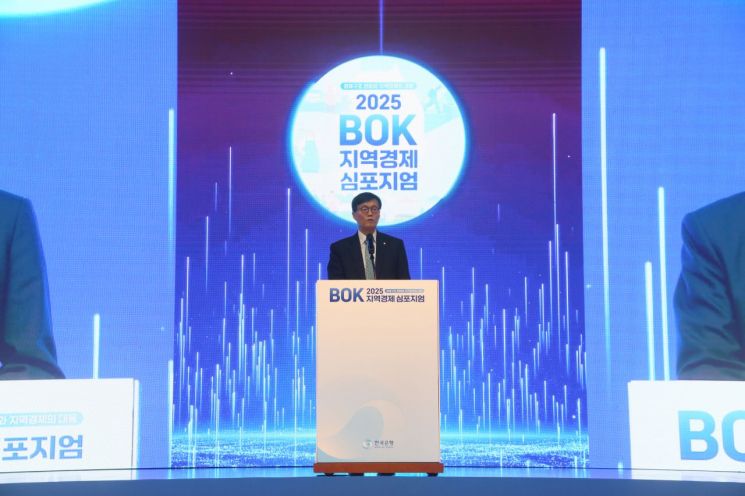 Lee Changyong, Governor of the Bank of Korea, is delivering the opening remarks at the 2025 BOK Regional Economy Symposium opening session held on the 17th at the Kim Daejung Convention Center in Gwangju. Bank of Korea
Lee Changyong, Governor of the Bank of Korea, emphasized this point during his opening remarks at the 2025 BOK Regional Economy Symposium held on the 17th at the Kim Daejung Convention Center in Seo-gu, Gwangju. Governor Lee stated, "Some people say the Bank of Korea should just focus on monetary policy, but in order to conduct effective monetary policy, we must first correctly identify the problems facing our economy. I do not believe that simply setting the interest rate will solve everything," explaining the reason why the Bank has presented regional balanced development plans through structural reform reports.
Governor Lee continued, "Last year, we focused on easing the concentration in the Seoul metropolitan area through the hub city-centered development strategy and the proportional regional recruitment system. This year, from the perspective of 'selection and concentration,' we will discuss the changes facing regional economies and concrete response strategies," adding, "The first topic will be online platforms and the self-employed."
He noted, "Given that the influence of the platform economy is expected to continue, it is desirable for policies for the self-employed to carefully select and fully support those with high growth potential. At the same time, we should strengthen the safety net to help self-employed individuals who have fallen behind in the competition to recover, but in some cases, we must also guide them toward a natural transition to new occupations."
In relation to this, at the symposium, Jung Heewan, Head of the Regional Economic Survey Team at the Bank of Korea's Economic Research Bureau, presented a session titled "The Impact of Online Platform Growth on Regional Self-Employment and Policy Responses." Jung explained, "An analysis of the impact of online platform expansion, focusing on retail and restaurant businesses where the proportion of self-employed is high, showed that polarization has intensified depending on region, store type, and size. There has been a concentration of non-store retailers in the Seoul metropolitan area and a decline of traditional brick-and-mortar retailers in non-metropolitan areas, widening the gap between regions. Within the retail sector, business performance has become polarized depending on size, adoption of online sales, and product composition."
In response to the deterioration of the self-employment sector, the government's expansion of financial support, including credit guarantees and loans, has had positive effects such as increased sales and reduced closure rates, with the effects being greater in non-metropolitan areas. However, by sector, the effects were concentrated among certain groups such as early-stage startups, young entrepreneurs, and small businesses. Jung pointed out, "Support of less than 20 million won and long-term support (four years) had only limited effects," emphasizing, "Given the likelihood that the platform economy will continue to expand in conjunction with digital transformation, support policies for the self-employed should be pursued on two tracks: 'safety net' and 'growth.'"
Financial support should focus on growth policies that help realize potential, providing sufficient support primarily to early-stage startups, young entrepreneurs, and small businesses, while strengthening pre- and post-screening to prevent excessive entrepreneurship and moral hazard. Unemployment insurance should aim to 'protect people,' not just 'protect businesses,' by expanding eligibility and easing benefit requirements to enhance effectiveness.
On the same day, Park Yangsoo, Director of the Sustainable Growth Initiative (SGI) at the Korea Chamber of Commerce and Industry, presented a session titled "A Comprehensive Strategy for Korea's Economic Leap Forward: Mega Sandbox." Park proposed the mega sandbox as a national strategy capable of providing comprehensive solutions, since issues such as low birthrate, regional extinction, carbon neutrality, and fostering high-tech industries are interconnected. The system aims to encourage business relocation and investment by designating specialized industries, supporting energy supply and research and development (R&D), improving university and residential conditions, granting broad regulatory exemptions at the industrial level, and offering fiscal and tax incentives in major hub cities or nearby areas.
Director Park stressed, "Considering the possibility of conflicts with existing regulations during the development of new technologies in advanced and climate industries, and the need for large-scale testing for new industries such as smart cities and autonomous driving, bold, region-specific incentives are necessary." He explained that it is necessary to create a large-scale testbed (mega sandbox) where new technologies and businesses can be freely experimented with by concentrating groundbreaking fiscal support and regulatory easing on specialized industries in major hub cities equipped with a certain level of infrastructure.
© The Asia Business Daily(www.asiae.co.kr). All rights reserved.

















