"After the December 3 military coup, the people fulfilled their roles and responsibilities, restoring constitutional order... This must be specially commemorated"
To prevent industrial accidents: "Quickly recruit about 300 additional labor inspectors"
"Promptly consider granting special judicial police officer status to civil servants"
President Lee Jaemyung has instructed officials to review the possibility of designating Constitution Day as a national holiday. The intention is to use this as an opportunity to reflect on the constitutional principle that the people are the true owners of the nation, and to revisit the spirit of popular sovereignty. Constitution Day commemorates the enactment of the Constitution of the Republic of Korea in 1948. It was designated as a legal holiday in 1949, but was excluded from the list of public holidays in 2007 when it became a "non-holiday national commemoration day."
Additionally, President Lee addressed the ongoing reports of fatal industrial accidents, ordering the rapid recruitment of approximately 300 additional labor inspectors who are directly responsible for industrial safety. He instructed that these inspectors conduct unannounced on-site inspections to ensure that preventive industrial safety measures are being properly implemented. He also directed that, regardless of whether they are local or central government officials, civil servants should be promptly granted special judicial police officer status so they can be deployed to the field as an alternative measure.
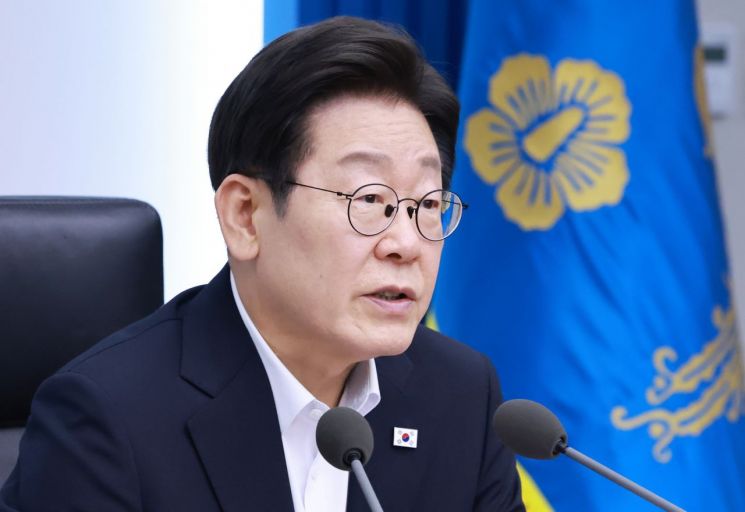
On July 17, during a meeting with senior aides and advisors, President Lee stated, "Constitution Day is currently not a public holiday. While this may have been due to certain policy considerations, after experiencing the December 3 military coup last year, our people truly fulfilled their roles and responsibilities as sovereign citizens, as stipulated by the Constitution, and restored democratic constitutional order." He added, "I believe there is special significance in commemorating Constitution Day, so I would like us to consider making it a holiday."
President Lee further noted, "Among national commemoration days referred to as 'Jeol,' it seems to be the only one that is not a holiday," and added, "I hope this could serve as a meaningful opportunity to revisit the constitutional principle that the people are the true owners of the nation, and to reflect on the spirit of popular sovereignty."
President Lee also urged thorough preparedness in response to the ongoing heavy rainfall. Citing a recent fatal accident in which a worker fell while on the job at POSCO's Gwangyang Steelworks, he emphasized that reports of fatal industrial accidents continue unabated. He reiterated his order to rapidly recruit about 300 labor inspectors to conduct unannounced on-site inspections, and to grant special judicial police officer status to both local and central government officials so they can be dispatched to the field.
President Lee stated, "The foremost duty of the state is to protect the lives and safety of its people." He continued, "While the heavy rainfall nationwide is severe, fortunately there has been no large-scale damage. However, I ask that you ensure thorough safety inspections and emergency responses in areas prone to recurring damage, such as semi-basement residences, underground roadways, underground parking lots, flood-prone river areas, landslide risk zones, and retaining walls, where there is concern for human casualties." He emphasized, "Let me be clear: not even the smallest mistake can be tolerated when it comes to protecting the lives of the people."
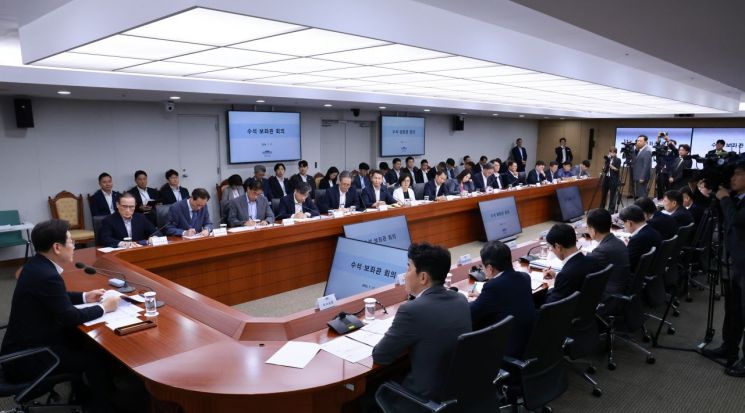
Regarding industrial accidents, President Lee remarked that there are still times when he wonders, "Are such accidents still happening in this way?" He said, "Life is far more precious than money, but it seems that, on the front lines, there is still a tendency to value money over life. In particular, there appears to be a widespread mindset of considering safety as a cost." He continued, "Since this is an issue related to the culture of our society, I hope we can adhere to basic principles. We must swiftly and thoroughly investigate the causes of accidents, promptly check for any deficiencies in safety measures, and hold those responsible strictly accountable for any wrongdoing."
President Lee also pledged that his administration would put an end to the dishonor of having the highest rate of industrial accidents and fatal accidents among OECD countries. He said, "Workplaces, which should be the foundation of our lives, must not become sites of death. To achieve this, realistic measures within the government are necessary." He added, "I ask that we quickly recruit at least about 300 labor inspectors who are directly responsible for industrial safety, and conduct unannounced and regular on-site inspections to ensure preventive industrial safety measures are being properly implemented."
Furthermore, President Lee referred to the recent case in Daejeon, where a mother and her child were found dead about 20 days after their deaths, as an example of the reality of welfare blind spots. He stressed the need to transform the social safety net into a denser "social safety mat" in the long term. President Lee stated, "The social safety net is, after all, a net, so it can have holes through which people fall, and it can be fragile, leading to serious situations in areas we did not anticipate."
In this regard, President Lee said, "I feel a great sense of responsibility for the repeated tragedies. On this issue, our government must move away from passive administration that only responds to applications, and instead, proactively prevent such cases of people falling through the cracks in the safety net by taking active, preemptive measures."
© The Asia Business Daily(www.asiae.co.kr). All rights reserved.
![Clutching a Stolen Dior Bag, Saying "I Hate Being Poor but Real"... The Grotesque Con of a "Human Knockoff" [Slate]](https://cwcontent.asiae.co.kr/asiaresize/183/2026021902243444107_1771435474.jpg)
















