Civil, education, and labor organizations in the Gyeongnam region have called on the new government to guarantee teachers' basic political rights.
On July 17, 22 organizations?including the Gyeongnam branch of the Korean Teachers and Education Workers Union, the Gyeongnam branch of the School Irregular Workers Union, Geoje Education Solidarity, Gyeongnam Women's Association United, Gyeongnam Our Education Community, Gyeongnam Progressive Alliance, Hope for Education Gyeongnam Parents' Association, and the Gyeongnam branch of the Korean Confederation of Trade Unions?held a press conference in the briefing room of the Gyeongnam Office of Education, making this demand.
The organizations, including the Gyeongnam branch of the Korean Teachers and Education Workers Union, stated, "Since the enactment of the Civil Servants Act in 1949, teachers working in educational settings have never been able to fully enjoy their basic political rights, and have long lived while giving up rights that they should rightfully have as citizens."
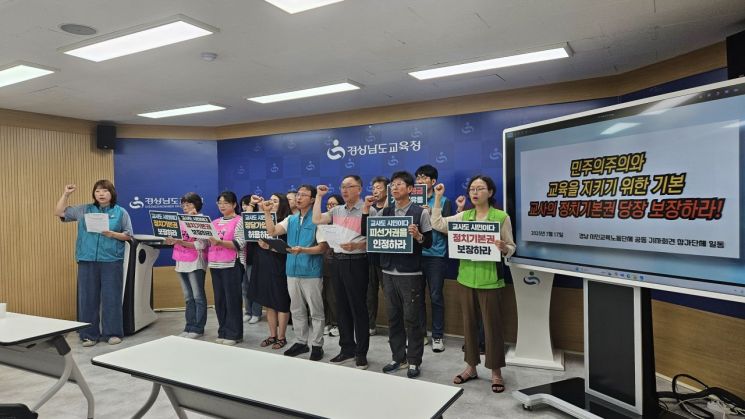 Citizens, education, and labor organizations in the Gyeongnam region, including the Gyeongnam branch of the Korean Teachers and Education Workers Union, are holding a press conference urging the guarantee of teachers' basic political rights. Photo by Lee Seryung
They argued that teachers, as experts in education and school settings, are excluded from the process of establishing education policy.
They said, "Education policies that lack teachers' input are less effective, and the burden falls entirely on students and guardians," adding, "Guaranteeing teacher participation in education policy and actively reflecting teachers' demands is the easiest way to save schools and ensure students' education, but the silence forced upon teachers is preventing this."
They also emphasized that political education and civic education should take place in schools.
The organizations stated, "After last year's illegal martial law by the president, we confirmed how important political and civic education is in schools for the continuation of democracy," and "With far-right forces constantly eyeing schools, the need for teachers to actively engage in political and civic education has become even greater."
They further argued, "How can teachers teach about politics and basic rights they have never even experienced due to a lack of political citizenship?" and added, "Guaranteeing the political neutrality of education under Article 31, Paragraph 4 of the Constitution only creates teachers who remain silent on political issues, which in turn leads to students who are silent about politics."
Accordingly, they called on the Lee Jaemyung administration to guarantee teachers' freedom of political expression, allow the freedom to donate to political funds, permit party membership, and recognize eligibility for election.
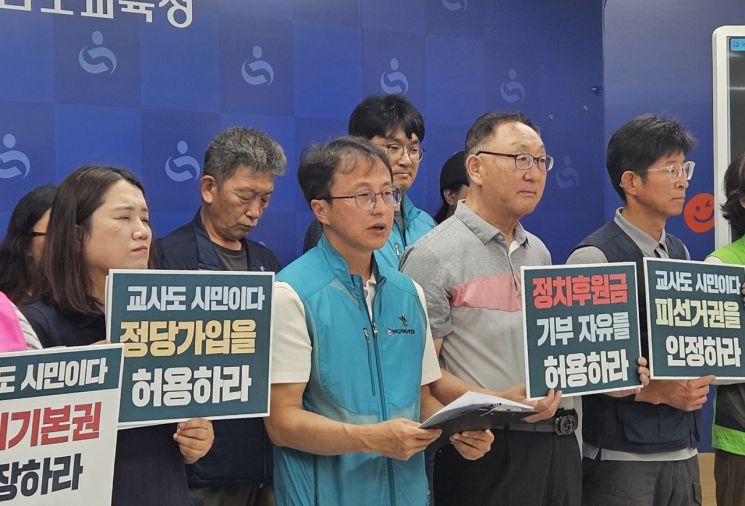 Jisung Kim, head of the Gyeongnam branch of the Korean Teachers and Education Workers Union, is urging the guarantee of teachers' basic political rights. Photo by Seryeong Lee
Teachers' basic political rights are currently restricted under the constitutional principle of political neutrality in education.
This is intended to prevent the formation of biased ideologies among underage students through education, and to ensure that teachers can perform their duties regardless of which political party is in power or the interests of any particular party or faction.
As a result, teachers are required to maintain political neutrality in educational settings, and activities outside of school are also considered part of the implicit curriculum. Therefore, teachers cannot engage in political expression, join or participate in political parties, or conduct election campaigns, except for activities directly related to their professional duties.
Although calls to guarantee teachers' basic political rights have been raised consistently, opinions within the education sector remain divided.
Those in favor argue that basic political rights are rights that all citizens should enjoy, and that teachers, who know the educational field best, should be able to participate directly or indirectly in education policy. They believe that teachers' status as citizens and their roles as educators should be separated.
Opponents argue that underage students are greatly influenced by teachers' words and actions, and that teachers' activities can be seen as implicit educational activities that affect students' character, values, and habits. Therefore, they believe that guaranteeing educational neutrality should take precedence.
Jisung Kim, head of the Gyeongnam branch of the Korean Teachers and Education Workers Union, stated, "Among OECD countries, Korea is the only one that prohibits teachers from engaging in political activities," and added, "We plan to actively pursue activities to guarantee teachers' basic political rights by meeting with members of the National Assembly and facilitating public discussion."
© The Asia Business Daily(www.asiae.co.kr). All rights reserved.
![Clutching a Stolen Dior Bag, Saying "I Hate Being Poor but Real"... The Grotesque Con of a "Human Knockoff" [Slate]](https://cwcontent.asiae.co.kr/asiaresize/183/2026021902243444107_1771435474.jpg)
















