On the Path to a Just Transition
Ⅱ. How Were Conflicts Resolved During the Coal Phase-Out?
Mines Transformed into Parks, Power Plants into Cultural Spaces
Active Use of the EU Just Transition Fund
A wind of just transition is blowing even in Poland, once called the "coal kingdom of Europe." The Polish government has decided to halt coal-fired power generation by 2040 and close all coal mines by 2049. The country is currently pursuing its energy policy (PEP 2040), which aims to reduce the share of coal power generation from 72% in 2019 to below 56% by 2030.
To examine the progress of Poland's just transition, I visited Malta Kleczewska Park on the outskirts of Konin, Wielkopolskie Voivodeship, on the 24th of last month. Konin is a small city located 220 kilometers east of the capital, Warsaw.
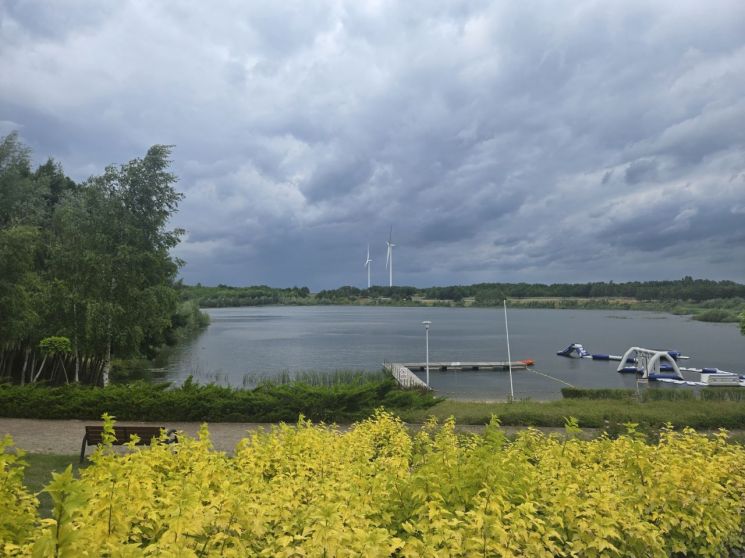 A view of Malta Kleczewska Park in Konin, Poland, visited on the 24th of last month. The 40-meter-deep pit, originally created by lignite mining, has been newly transformed into a reservoir. Photo by Jang Sangdon
This area, once home to a lignite (brown coal) mine that extracted coal near the surface, has now been transformed into a green park with a reservoir. Because lignite is mined by excavating the ground, a huge pit is left behind after extraction. Jepak, the operator of the lignite mine, filled this 40-meter-deep pit with water to create a reservoir and developed the park. A representative from Jepak said, "Look at the ducks over there. Doesn't it look like a natural lake?" and explained, "This park is equipped with water leisure facilities, accommodations, and commercial facilities operated by the local government."
Malta Kleczewska Park has remodeled the changing rooms once used by coal miners into hostels and converted them into restaurants for park visitors. The Jepak representative said, "There are a total of 13 such pits created by lignite mines in this area alone," adding, "Other sites are currently undergoing reforestation, and there are plans to develop them as parks or as resort facilities with dozens of cabins centered around artificial lakes."
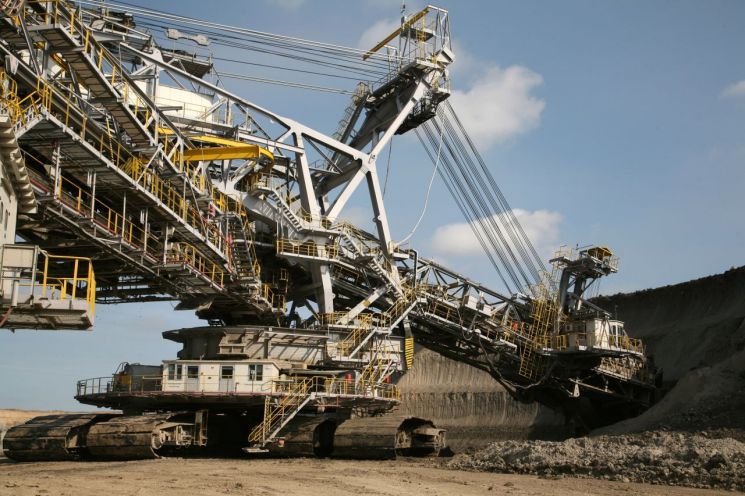
With only one of the dozens of mines remaining, the Dolorey lignite excavator, which is now obsolete, has been relocated to an unused site. Jepak plans to use the Dolorey excavators, which once mined lignite throughout Konin, as museum exhibits.
Konin Struggles with Decline of Coal Industry, Finds Breakthrough Through Investment Attraction
The number of people employed in Konin's coal industry peaked at 8,000 during its heyday but has now shrunk to around 1,200. Pawel Adamow, Deputy Mayor of Konin, explained, "There used to be three coal-fired power plants and dozens of coal mines in Konin, but now only one coal-fired power plant and one lignite mine remain in operation. The last remaining coal-fired power plant will also be converted to an LNG power plant within two to three years, and the mine is also scheduled to close soon."
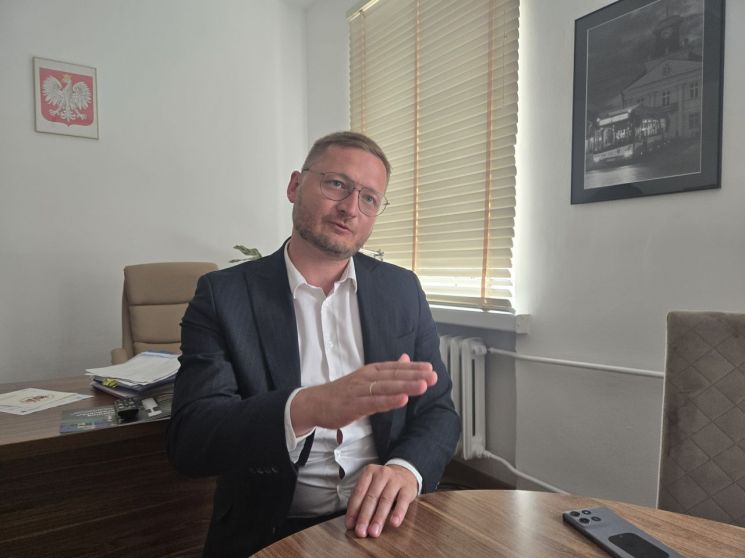 On the 24th of last month, Pawel Adamow, Deputy Mayor of Konin, Poland, is explaining the just transition of Konin city at the Konin City Hall. Photo by Joo Sangdon
As the reduction of the coal industry led to higher unemployment and economic difficulties in the region, Konin shifted its policy focus to a just transition. Barbara Masternak, Business Cooperation Manager of Konin City, explained, "Due to limited budgets, there were not enough government-level support programs for the closure of coal-fired power plants and mines. Therefore, we are providing job transition training, startup support, and investment attraction through the European Union's Just Transition Fund."
The main focus of Konin's just transition efforts is attracting investment. It is difficult to transfer former coal power plant workers to other coal plants in different regions or to repurpose them for LNG power plants, so the strategy is to attract new industries to the region and provide jobs for former coal industry workers. Konin's strengths include transportation and power transmission and distribution networks built for the coal industry. Barbara Masternak said, "Konin is geographically central in Poland, with major highways crossing both north-south and east-west. There are still 30,000 hectares of land available for investment, so there is plenty of space for new companies to build factories. We are leveraging these strengths to attract investment."
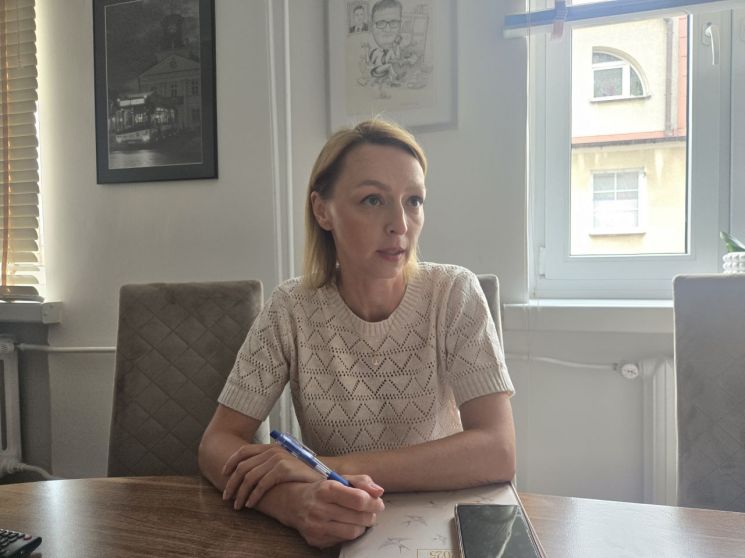 On the 24th of last month, Barbara Masternak, Business Cooperation Manager of Konin City, Poland, explained Konin City's investment attraction plans being promoted as part of a just transition at Konin City Hall. Photo by Joo Sangdon
To attract investment, Konin is creating industrial zones in units of 120 to 150 hectares. In fact, the city has succeeded in attracting both local companies, such as Poland's largest caviar processing plant, and foreign companies, including China's JS Energy. Last year alone, these efforts created more than 300 new jobs. Barbara Masternak emphasized, "We are currently negotiating concrete investment plans with several manufacturing companies, and relocations will soon be finalized. If such investment attraction continues, we will be able to fully restore the economy to the level of the coal power boom era."
Konin is also operating educational programs to ensure that attracting companies leads to increased local employment. The city is actively utilizing local universities. Barbara Masternak explained, "We are conducting cooperative vocational training with three universities in the city, including Poznan University of Technology. The city provides funding to universities to train talent needed by specific companies, allowing graduates to be hired directly by those companies. We also have laboratories for various types of vocational training."
Konin is also directly involved in building infrastructure such as housing to support investment attraction. Deputy Mayor Pawel Adamow emphasized, "The city is focusing on securing housing and forest space as a key initiative for attracting investment. To this end, the city is making direct investments and also pursuing housing projects through private developers."
Barbara Masternak also requested investment from Korean companies in Konin. She said, "Konin hopes to attract investment from Asian companies, including those from Korea, China, and Japan. We are currently exploring electric vehicle investments from Korean and Chinese companies, so we hope you will take an interest."
Warsaw's Coal Power Plant Transformed into Space for Leisure, Shopping, and Offices
The capital city of Warsaw has also succeeded in converting a thermal power plant into commercial facilities such as shopping and office spaces. The former Powisle thermal power plant, visited on the 25th of last month, was bustling on a weekday afternoon with visitors dining with children, having coffee with friends, shopping, and office workers at their desks. This site was home to a coal-fired power plant that supplied electricity to Warsaw residents from 1904 to 2001. An employee at a cafe in Powisle said, "Most people visiting here for the first time do not know that a coal-fired power plant once stood here. Today, it has been transformed into a modern cultural and commercial space. Only when they see the power plant information signs and the remaining chimney do they realize that it used to be a power plant."
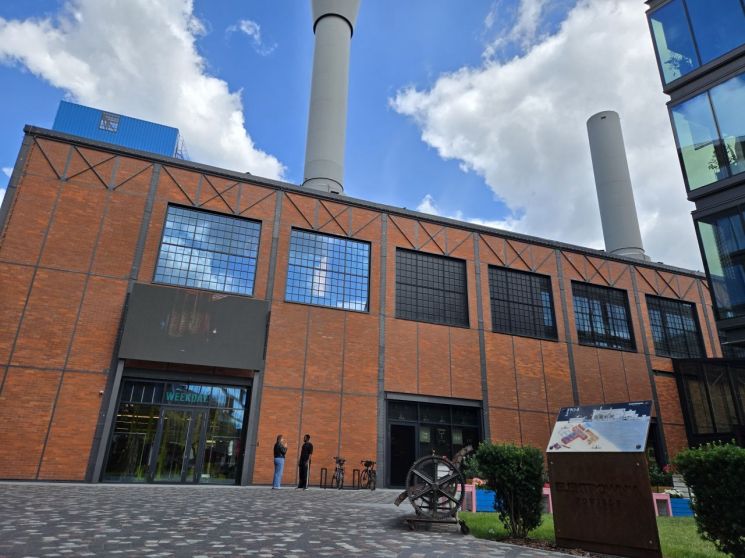 On the 25th of last month, I visited the Powisle commercial complex located in Warsaw, Poland. The chimney, which was once used in a coal power plant, is now used as a panoramic elevator. Photo by Joo Sangdon
Throughout Powisle, there are information boards displaying photographs of the former coal power plant and explanations of the electricity generation process. The chimney once used in the coal power plant has not been dismantled but is now used as a panoramic elevator. Cranes that transported coal and boilers used for coal power generation have also been preserved and incorporated into the remodeled building. Wojtek (60), who works as a security guard in Powisle, said, "I lived near the Powisle power plant when I was a child, and I never imagined it would be turned into a commercial space like this. Today, Powisle is a place of culture and relaxation for young people, and a place of memories for people of my generation."
This project was supported by the Press Promotion Fund, created from government advertising fees.

© The Asia Business Daily(www.asiae.co.kr). All rights reserved.
![Clutching a Stolen Dior Bag, Saying "I Hate Being Poor but Real"... The Grotesque Con of a "Human Knockoff" [Slate]](https://cwcontent.asiae.co.kr/asiaresize/183/2026021902243444107_1771435474.jpg)

















