A technology that enables the simple on-site detection of airborne antibiotic-resistant bacteria has been developed. This breakthrough is expected to lead to a paradigm shift in infectious disease response.
The Korea Research Institute of Bioscience and Biotechnology (KRIBB) announced on July 17 that the research team led by Dr. Eun Kyung Lim at the Bio-Nano Research Center, in collaboration with Professor Jeongho Hwang's team at Yonsei University, has developed a diagnostic technology called "CN-TAR (Cas9 Nickase-Triggered Amplification Reaction)" with this functionality.
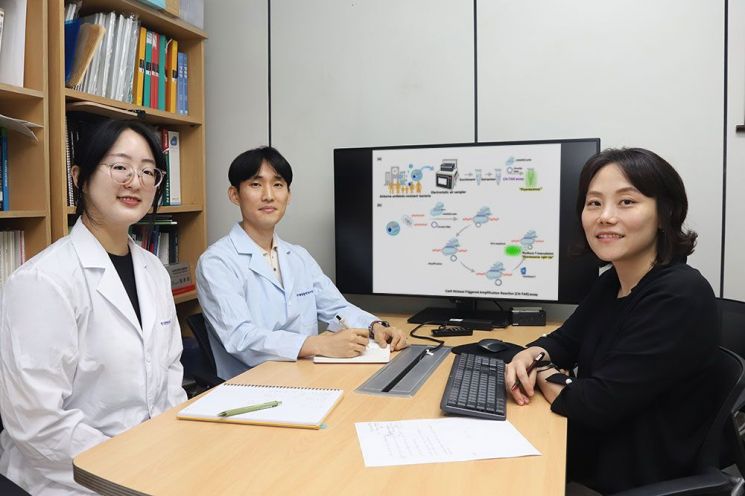 (From right) Research director Dr. Eun Kyung Lim, first author Dr. Seungbeom Seo, researcher Jina Lee. Provided by Korea Research Institute of Bioscience and Biotechnology
Recently, the spread of superbugs that can be transmitted through the air has become a serious concern. In particular, methicillin-resistant Staphylococcus aureus (MRSA) and vancomycin-resistant enterococci (VRE) can cause diseases such as pneumonia and sepsis, but are difficult to treat with conventional antibiotics.
Previously, it was believed that MRSA and similar bacteria could only infect through direct contact with patients. However, recent findings have revealed that they can also be transmitted through the air, making it difficult to rule out the risk of airborne infection. For this reason, there is a growing demand for "on-site diagnostic technologies" that can immediately detect bacteria capable of causing infections in hospitals and public places.
The technology developed by the joint research team, CN-TAR, is an "on-site platform technology" designed to meet this demand. It is expected to serve as a game changer in infection prevention and the establishment of public health safety networks.
This technology repurposes the CRISPR-Cas9 system, widely known as a gene-editing tool, for diagnostic purposes. It accurately identifies and cleaves specific bacterial genes, then amplifies the cleavage products in real time and visualizes the results with light. This is a one-stop smart diagnostic technology that captures and analyzes even trace amounts of bacterial genes floating in the air in real time, providing results through a light signal.
Performance verification showed that CN-TAR operated with extremely high sensitivity, accurately detecting bacteria even at the level of 1 to 2 gene copies (1.40 copies/μL, 1.13 copies/μL). According to the joint research team, it demonstrated performance comparable to or better than the widely used RT-PCR analysis method in hospitals.
Most notably, CN-TAR can be manufactured as a portable diagnostic device without the need for expensive equipment, allowing for real-time monitoring not only in hospitals, schools, nursing homes, food factories, and pharmaceutical plants, but also in factory wastewater and soil. This broad applicability is a significant advantage.
Dr. Eun Kyung Lim stated, "CN-TAR is a groundbreaking 'on-site diagnostic technology' that enables anyone to quickly and easily detect airborne bacteria anytime, anywhere, without expensive equipment. It is expected to make a direct contribution to protecting the lives and health of the public."
This research was supported by the Ministry of Environment's project for the development of management technologies for biological risk factors in indoor air, the Ministry of Science and ICT's basic research program for individuals, and major projects at KRIBB. The results were recently published online in the environmental journal 'J. Hazard. Mater.'
© The Asia Business Daily(www.asiae.co.kr). All rights reserved.
![Clutching a Stolen Dior Bag, Saying "I Hate Being Poor but Real"... The Grotesque Con of a "Human Knockoff" [Slate]](https://cwcontent.asiae.co.kr/asiaresize/183/2026021902243444107_1771435474.jpg)















