More Than 30 Supernumerary Teeth: A Rare Case Worldwide
Indiscriminate Extraction May Risk Jawbone Damage
An 11-year-old girl was found to have as many as 81 teeth in her mouth, shocking the academic community. On July 15, international media outlets including VN Express reported that an 11-year-old girl living in Brazil visited a hospital to have one upper baby tooth extracted. However, an X-ray examination revealed a total of 81 teeth in her mouth, consisting of 18 baby teeth, 32 permanent teeth, and 31 supernumerary teeth.
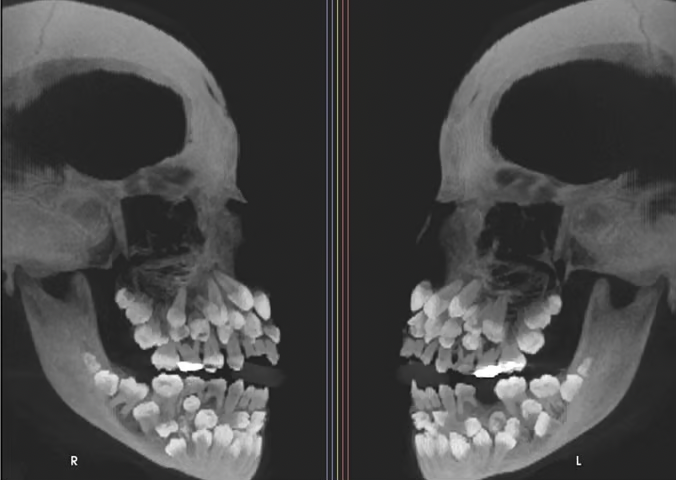 An 11-year-old girl was found to have as many as 81 teeth in her mouth, shocking the academic community. VN Express
The presence of extra teeth beyond the normal adult count of 32 is called "multiple hyperdontia." This condition can cause problems such as impaction of teeth within the gums, which interferes with the eruption of normal teeth (the process of teeth emerging above the gumline), or misalignment of the dental arch. Additionally, various issues can arise, such as cysts forming around the impacted supernumerary teeth. Multiple hyperdontia is a congenital condition, and it is not uncommon for only one or two supernumerary teeth to be found. Generally, extraction is recommended for supernumerary teeth that could cause complications, and especially in children, early extraction is advised to prevent interference with the eruption of permanent teeth. After extraction, orthodontic treatment may be necessary to align the teeth. However, cases like this one, where more than 30 supernumerary teeth are found, are extremely rare worldwide. This case was identified during treatment by a research team at the Dental Hospital of the Federal University of Juiz de Fora in Minas Gerais, Brazil, and was reported in the American Journal of Orthodontics and Dentofacial Orthopedics.
The research team conducted detailed imaging studies to determine the exact location of the teeth and also performed related genetic tests to check for any association with genetic disorders. Multiple hyperdontia is often accompanied by conditions such as cleidocranial dysplasia, Gardner syndrome, or cleft palate, but test results showed that the girl did not have any of these disorders.
Additional chromosomal analysis revealed a structural abnormality (chromosomal inversion) in a segment of chromosome 9. Although this is a rare genetic variation, the research team stated that it is unclear whether it is directly related to the occurrence of supernumerary teeth. Some supernumerary teeth are deeply embedded in the gums or resemble normal teeth in shape, making accurate identification difficult. Indiscriminate extraction could risk damage to the jawbone. Therefore, the research team has reportedly formed a multidisciplinary team?including specialists in orthodontics, oral and maxillofacial surgery, periodontics, and prosthodontics?to develop a long-term treatment plan.
© The Asia Business Daily(www.asiae.co.kr). All rights reserved.
![Clutching a Stolen Dior Bag, Saying "I Hate Being Poor but Real"... The Grotesque Con of a "Human Knockoff" [Slate]](https://cwcontent.asiae.co.kr/asiaresize/183/2026021902243444107_1771435474.jpg)















