Discharged Just Two Weeks After Second Kidney Transplant
"Another flower has bloomed in my life. I never thought I would be given a second chance, but I would like to express my gratitude to everyone who has gifted me with another precious and beautiful flower."
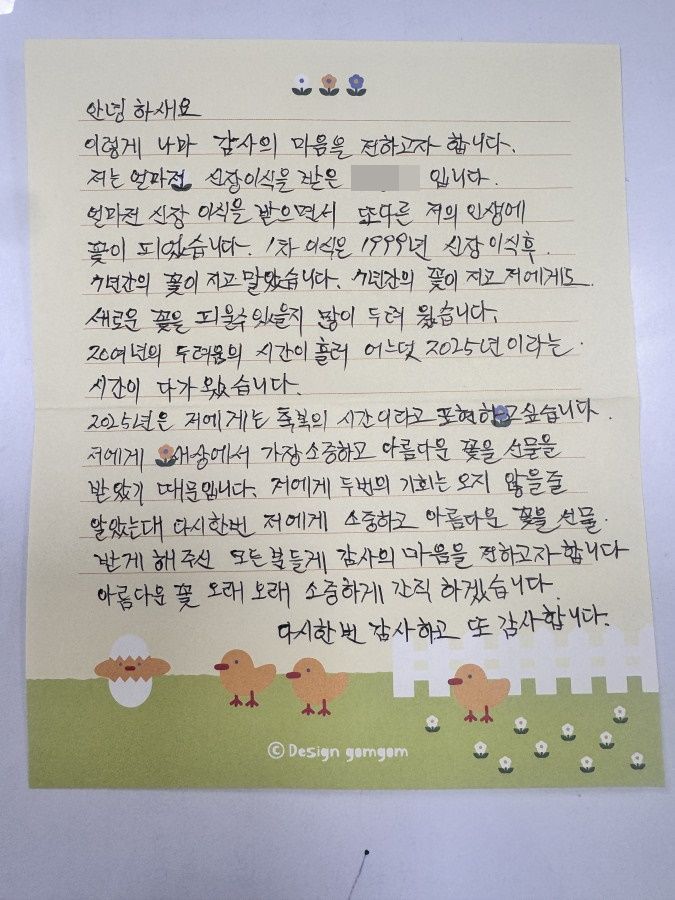
Seoul St. Mary's Hospital announced on the 17th that a woman in her 50s, Kyungmo, who began a new life after a second kidney transplant, had sent a thank you letter.
Ms. Kyungmo was diagnosed with end-stage renal failure in her early 20s and underwent hemodialysis for a long period of time. When she received her first kidney transplant in 1999, she hoped for a normal and healthy life, but after seven years, the transplanted kidney began to lose function due to rejection, and she had to resume dialysis treatment.
Once a patient receives a transplant, it is often difficult to undergo a second transplant due to antibody formation against the kidney, a condition known as "high sensitization." In Kyungmo's case, when the first transplanted kidney lost its function, antibodies developed as well. After a long wait, she was finally eligible for another transplant, but due to the risk of acute rejection caused by these antibodies, she had to postpone the surgery opportunity seven times.
Finally, this past April, she had the opportunity to receive a kidney from a brain-dead donor whose genotype was relatively compatible. Based on the results of a detailed antibody test, she received treatments such as antibody injections prior to the transplant to prevent rejection. Two weeks after the transplant, she was discharged in good health, and now, three months later, the transplanted kidney is functioning stably without rejection or complications.
Professor Jung Byungha of the Department of Nephrology, who had provided regular care for the patient over a long period, stated, "When dialysis is prolonged, various complications such as vascular calcification can occur, and even if a transplant opportunity arises, health issues often make transplantation difficult. I would like to once again express my deep gratitude to the brain-dead donor and their family for giving the gift of new life, and I hope this news brings hope to the many patients who are enduring difficult treatments and waiting for their turn for transplantation."
© The Asia Business Daily(www.asiae.co.kr). All rights reserved.
![Clutching a Stolen Dior Bag, Saying "I Hate Being Poor but Real"... The Grotesque Con of a "Human Knockoff" [Slate]](https://cwcontent.asiae.co.kr/asiaresize/183/2026021902243444107_1771435474.jpg)















