First Korea-Japan Semiconductor Materials Joint Venture... Completion Planned for 2027
Aiming to Produce '11 Nine' Ultra-High Purity Polysilicon
Combining Technological Expertise, Eco-Friendly Production, and Strategic Partnership
OCI Holdings and Japan's Tokuyama have joined forces to produce polysilicon, a key material for semiconductors. Their goal is to manufacture '11 Nine' (99.999999999%) ultra-high purity polysilicon for semiconductors, rather than the relatively lower-purity type used for solar power. This marks the first time that a Korean and Japanese company have established a joint venture in the semiconductor materials sector.
OCI Holdings announced on the 17th that it held a groundbreaking ceremony for the joint venture OTSM (OCI Tokuyama Semiconductor Materials) with Tokuyama on the morning of the 16th at the Samalaju Industrial Park in Sarawak, Malaysia. The joint venture will be owned equally by OCI Holdings' Malaysian subsidiary, OCI Terrasus, and Tokuyama, with each holding a 50% stake. The companies plan to invest a total of $435 million (approximately 600 billion won) to build a semiconductor-grade polysilicon production plant with an annual capacity of 8,000 tons.
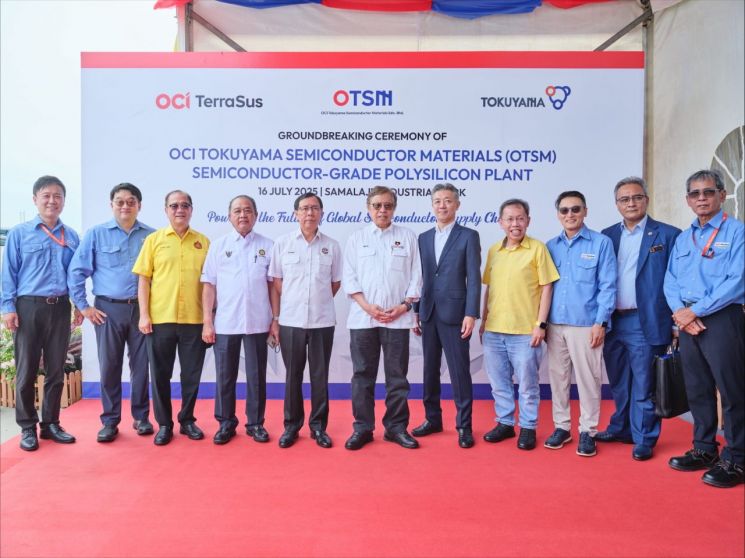 OCI Holdings announced on the 17th that it held a groundbreaking ceremony for the joint venture OTSM (OCI Tokuyama Semiconductor Materials) with Tokuyama on the morning of the 16th at the Samalaju Industrial Park in Sarawak, Malaysia. Lee Woohyun, Chairman of OCI Holdings (second from the left), Kim Taekjung, Vice Chairman (third from the right), and other attendees participated in the ceremony and took a commemorative photo. Photo by OCI Holdings
The plant is scheduled to be completed in the first half of 2027, after which it will undergo customer approval procedures (PCN) and begin full-scale mass production in 2029. The production will utilize approximately 132,000 square meters of existing land owned by OCI Terrasus. The products manufactured at the plant will be supplied to major semiconductor companies in Korea, Japan, and Taiwan.
The plant's electricity will be supplied via hydropower through a 10-year long-term power purchase agreement (PPA) with Malaysia's state-owned energy company, Sarawak Energy (SEB). This is advantageous for meeting international environmental, social, and governance (ESG) standards, as it minimizes carbon emissions in the energy-intensive process of semiconductor material production.
Currently, OCI Holdings produces about 4,700 tons of semiconductor-grade polysilicon annually at its Gunsan plant. With this new joint venture plant, production capacity will increase by nearly 1.7 times. The company aims to expand its global market share while creating synergies with Tokuyama's advanced purification technology.

This joint venture is particularly noteworthy as it represents the first semiconductor materials collaboration between Korea and Japan in celebration of the 60th anniversary of diplomatic relations. Until now, cooperation between the two countries has mainly focused on finished products and equipment, and this is the first strategic alliance in the core material field of polysilicon.
Lee Woohyun, Chairman of OCI Holdings, stated, "The semiconductor-grade polysilicon produced by OTSM will play an important role in the global semiconductor supply chain," and added, "Through cooperation with Tokuyama and Sarawak, we will proactively respond to rising semiconductor demand." Sarawak Governor Abang Johari emphasized, "We expect this strategic partnership to contribute to the local economy and job creation," and pledged full support from the Malaysian government.
Unlike general solar-grade polysilicon, semiconductor-grade polysilicon requires ultra-high purity technology, and only a few companies worldwide?such as Germany's Wacker, the United States' Hemlock, and Japan's Tokuyama?possess production capabilities. With this joint venture, OCI Holdings aims to achieve three goals: technological advancement, eco-friendly production, and expansion of an Asia-centered supply chain.
© The Asia Business Daily(www.asiae.co.kr). All rights reserved.


















