From 13 to 3 Artists Amid Concerns Over Becoming a Lodging Facility
74 Billion Won Invested, Yet Multi-Million Won Deficit
Local Roundtable on Space Utilization Planned for September
"Public Interest Project... Improvements Planned Starting This Year"
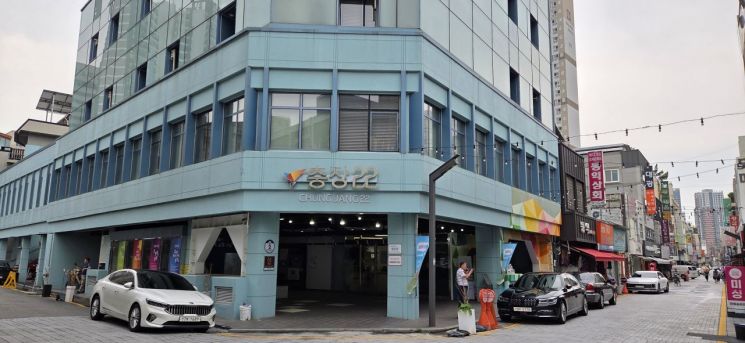
The local government is struggling with how to utilize the residency spaces at 'Chungjang 22', which was established as a shared workspace and residential facility to allow local artists to focus on their creative activities. Chungjang 22 was created to provide local artists with free or relatively affordable workspaces, but there is ongoing debate over appropriate usage periods due to concerns that long-term stays could turn the facility into a de facto lodging business.
In addition, although billions of won in subsidies are being invested, the facility continues to operate at a deficit each year without concrete performance evaluations, making innovation in its management an urgent issue.
According to Donggu, Gwangju on July 16, the district opened Chungjang 22 in 2020 with a budget of 7.4 billion won, in the Chungjang-ro 4·5-ga area. Chungjang 22 was established to develop business models linked to the local content of Chungjang-ro 4·5-ga and to operate cultural and artistic programs.
Chungjang 22 consists of two buildings: a newly constructed building from 2020 with one basement and two above-ground floors, and an expanded/remodeled building with one basement and four above-ground floors. The facilities include 22 independent residency studios for local artists, shared offices, a fitness center, a cafe, and more. The facility has been operated by a commissioned organization: SangSangO Co., Ltd. from June 2020 to May 2023, and since June 2023 by the Daedong Cultural Foundation.
The commissioned organization renews its contract every two years. It is known that SangSangO, which renewed its contract in 2022, gave up operation after only one year due to management difficulties.
At the time of its establishment, the residency spaces (shared work and residential areas) housed 13 artists working in fields such as cultural planning, tourism, storytelling, media art, industrial design, and festival planning. However, this year, only three residency artists remained. This decrease is attributed to the new commissioned operator reducing the length of stay for existing artists and requiring them to sign new contracts.
Donggu has set a policy in which the commissioned organization can use its discretion to allocate residency spaces to artists staying less than six months, but after six months, selection must be made through an open recruitment process.
As a result, from June 2023 through last year, most of the independent residency studios remained vacant. During this period, 269 people, including Chungjang Festival directors and staff, Miro Center, Gwangju Cultural Foundation, a Mongolian delegation, and the Bareun History Citizens' Coalition, stayed there temporarily.
Consequently, the use of the residency spaces has steadily declined compared to the initial period. Since June 2023, the Chungjang 22 Cultural Project Group has held 136 exhibitions and performances, but only 19 residency programs. Most of the exhibitions and performances were special exhibitions featuring foreign or well-known artists.
One artist who had stayed in the residency space said, "When the commissioned operator suddenly changed, my contract period ended. I was forced to leave without even being given time to secure another workspace. At the time, the artists were involved in activities related to local revitalization, such as Donggu's festivals and projects. I hope the space, which was created for local artists, will be properly utilized."
Furthermore, although billions of won in subsidies are injected into the operation of Chungjang 22 each year, it continues to run at a deficit. In 2020, the annual project cost was 90 million won, but after the change in the commissioned operator, 330 million won was spent from June 2023 to December of last year, more than doubling the subsidy.
Looking at the breakdown of the subsidies, about 184 million won (55%) was spent on personnel expenses, while only about 81 million won (22%) was used for cultural and artistic event programs. During this period, Chungjang 22 Cultural Project Group's total business income was only 219 million won, but expenditures, including subsidies, reached 554 million won, leading to criticism that it has become a tax drain.
Donggu Council member Lee Jiaeh pointed out at the Donggu Council's special session on July 11, "Of the 22 independent studios, only three are occupied by long-term resident artists, and the facility has effectively become a guesthouse. The commissioned operating expenses surged from 90 million won in 2022 to 260 million won last year, but there are hardly any tangible results." At that time, Councilor Lee proposed four key reforms: operating based on performance, normalizing the financial structure, attracting more young people, and introducing a performance evaluation system.
The district plans to hold a roundtable discussion in September to develop measures to ensure the residency spaces are used efficiently and do not become mere lodging facilities. The goal is to build consensus on the dual functions of shared workspace and residential space by discussing cases from other regions with local residents and experts.
A district official stated, "When we first contracted with the initial commissioned organization, the residency spaces were operated either free of charge or for rent, and we expected sufficient revenue if all rental spaces were fully utilized. However, now that the residency spaces are operated according to specific conditions, we have had no choice but to increase the subsidies. Because Chungjang 22 pursues public interest, it is structurally bound to run a deficit. We plan to hold a roundtable, referencing similar commercial districts and other residency space cases, and improve operations starting this year."
© The Asia Business Daily(www.asiae.co.kr). All rights reserved.

















