Targeting the Local Market Ahead of the 60 Trillion Won Submarine Project
Hanwha Ocean is establishing a branch office in Canada. This move is seen as a strategic step to gain an advantage in the Canadian Patrol Submarine Project (CPSP), which is estimated to be worth up to 60 trillion won. Canada plans to introduce up to 12 submarines with a displacement of 3,000 tons, and the total project size, including maintenance, repair, and operations (MRO), amounts to 60 trillion won.
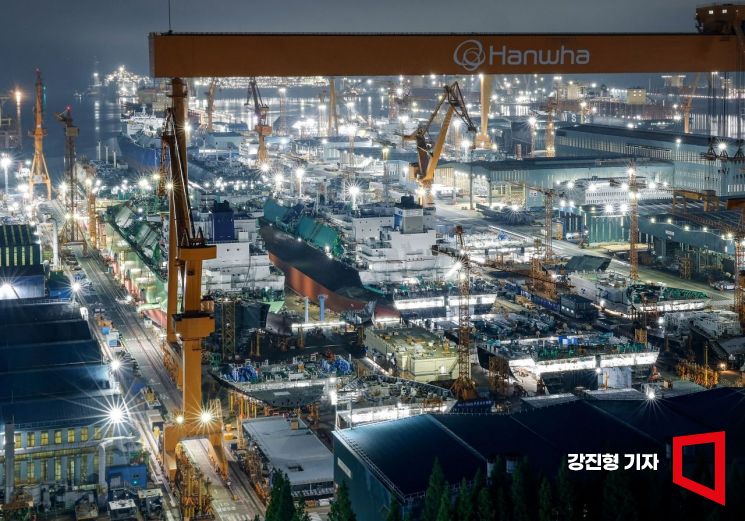 A liquefied natural gas (LNG) carrier ship filling the yard dock at Hanwha Ocean Okpo Shipyard in Geoje, Gyeongnam, is illuminated as construction work continues. Recently, the United States has been focusing on South Korea as a strategic partner to rebuild its outdated domestic shipbuilding industry. According to the shipbuilding industry reconstruction policy strongly promoted by the Trump administration, it is expected that the United States will order up to 448 vessels, including merchant ships, liquefied natural gas (LNG) carriers, and naval warships, by 2037. Photo by Kang Jinhyung
According to the Financial Supervisory Service’s electronic disclosure system on July 16, Hanwha Ocean held a board meeting on June 23 and unanimously approved the establishment of a Canadian branch office. Once established, this will be Hanwha Ocean’s seventh overseas branch and its second in North America. Currently, Hanwha Ocean has branch offices in six countries: the United States, Japan, Singapore, Norway, Greece, and Angola.
The Royal Canadian Navy is proceeding with the CPSP, a project to acquire 12 submarines with a displacement of 3,000 tons. The project budget alone is estimated at 60 trillion won, and the contractor is expected to be selected as early as 2026. HD Hyundai Heavy Industries and Hanwha Ocean have submitted a joint bid as a unified team. Canada has the longest coastline in the world, making naval power essential. Canada is pursuing a new submarine procurement project to replace its four 2,400-ton Victoria-class submarines, which were acquired from the British Royal Navy in 1998. The Korean shipbuilding industry has proposed the construction of the Dosan Ahn Changho-class submarine (KSS-III). The KSS-III class submarine has a displacement of 3,400 tons and is equipped with lithium-ion batteries and an air-independent propulsion (AIP) system. It can operate in the Arctic Ocean for up to three weeks.
Hanwha Ocean has recently been intensifying its efforts to enter the Canadian market. In May, together with its parent company Hanwha Aerospace, it was the only Korean company to participate in 'CANSEC 2025,' Canada’s largest defense industry exhibition. At CANSEC, Hanwha Ocean signed memorandums of understanding (MOUs) with Canadian security and maritime defense firms BlackBerry and L3Harris MAPS, pledging cooperation in the submarine sector.
The Korean government is also preparing special measures in response to the scale of Canada’s naval procurement. While special envoys are being considered for 14 countries, including the United States, Japan, and China, the dispatch of a special envoy to Canada is also under review. It is considered unusual for a presidential envoy to be sent to Canada, with candidates reportedly including lawmakers who are former military generals. Lim Woongsun, the second deputy director of the National Security Office, who oversees foreign policy at the presidential office and is a former ambassador to Canada, is expected to play a control tower role.
German shipbuilder ThyssenKrupp Marine Systems (TKMS) has also entered the competition for the Canadian submarine project. Germany is already building two naval vessels for Canada. Hanwha Ocean plans to strengthen its competitiveness for the Canadian submarine contract by signing cooperation agreements with local companies.
Previously, a Hanwha Ocean official stated, "We have optimized our proposal for the Royal Canadian Navy, which requires operations over vast areas," adding, "We can minimize the gap in Canada’s submarine capabilities through rapid delivery and reduce maintenance costs for the aging Victoria-class submarines."
© The Asia Business Daily(www.asiae.co.kr). All rights reserved.

















