CPI Growth Rate Rises from 2.4% in May to 2.7% in June
Core CPI Up 2.9%, Falls Short of Forecasts
Nvidia Surges on Resumption of H20 AI Chip Exports to China
The three major indices on the New York Stock Exchange showed mixed movements in early trading on July 15 (local time). Despite a rebound in the Consumer Price Index (CPI) for June, the core inflation rate came in below expectations, leading to gains in the S&P 500 and Nasdaq indices. Nvidia surged more than 4% following news that the U.S. government had approved the export of its H20 artificial intelligence (AI) chip to China.
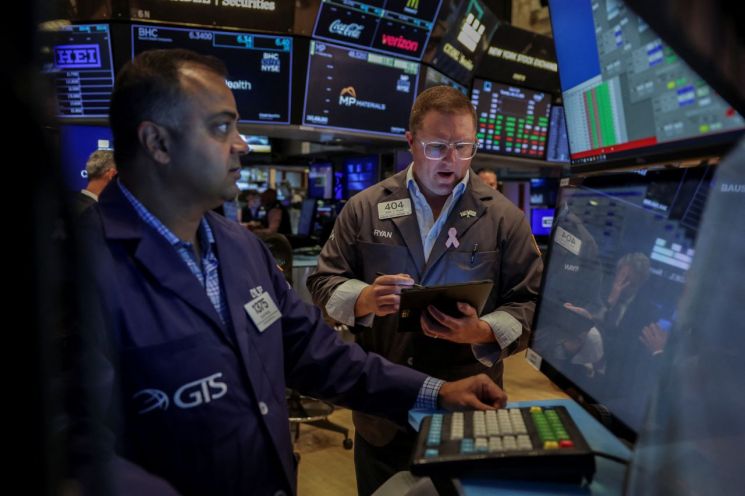
As of 10:19 a.m. on the same day on the New York Stock Exchange, the Dow Jones Industrial Average, which focuses on blue-chip stocks, was down 149.3 points (0.34%) from the previous trading day, standing at 44,310.35. The S&P 500, which tracks large-cap stocks, rose 11.37 points (0.18%) to 6,279.93, while the tech-heavy Nasdaq climbed 149.61 points (0.73%) to 20,789.94.
By stock, Nvidia soared 4.22%. Buying interest intensified after the Donald Trump administration allowed the resumption of sales of Nvidia's H20 AI chip to China. Jensen Huang, CEO of Nvidia, said in an interview with China Central Television (CCTV) on the same day, "The U.S. government has approved exports, so we can now ship. We will now sell the H20 in the Chinese market." Citigroup, which reported second-quarter results that exceeded Wall Street expectations, rose 1.44%, while JPMorgan fell 0.31%. Wells Fargo, despite reporting earnings above market expectations, plunged 4.78% after lowering its net interest income outlook.
Investors focused on inflation data released before the market opened. According to the U.S. Department of Labor, the CPI for June 2025 rose 2.7% year-on-year. This exceeded the market consensus of 2.6% and marked a wider increase compared to May's 2.4%. Analysts noted that the effects of tariffs began to gradually reflect in prices as summer set in. By category, housing and energy prices showed notable increases. Housing costs rose 0.2% from the previous month. Energy prices climbed 0.9%, with gasoline prices jumping 1%. Food prices increased by 0.3%. In contrast, prices for new cars and used cars and trucks fell by 0.3% and 0.7%, respectively.
However, the core CPI, which excludes volatile food and energy prices, rose 2.9% year-on-year. Although this was a slight increase from May's 2.8%, it was below the expert forecast of 3.0%. The core CPI is a key indicator of underlying inflation trends that the Federal Reserve closely monitors. While tariff-driven inflation has become more visible, investors were relieved that the figure came in below market expectations.
David Russell, Global Market Strategist at TradeStation, commented on the CPI report, saying, "The report eased fears of a worst-case scenario of a tariff-induced inflation surge, but the core CPI still remains well above the target of 2%. Overall, it's good news, but not definitive. Tariffs could still be imposed, and a wait-and-see attitude continues to prevail."
With the start of earnings season this week, the market is watching to see whether upcoming corporate earnings reports will provide momentum to overcome President Trump's tariff risks. According to market research firm FactSet, second-quarter net profits for S&P 500 companies are expected to increase by 4.3% year-on-year. However, this would be the lowest level since the fourth quarter of 2023.
U.S. Treasury yields are on the rise. The yield on the 10-year U.S. Treasury, the global benchmark for bond yields, rose 3 basis points from the previous day to 4.46%. The yield on the 2-year Treasury, which is sensitive to monetary policy, increased by 4 basis points to 3.94%.
© The Asia Business Daily(www.asiae.co.kr). All rights reserved.
![Clutching a Stolen Dior Bag, Saying "I Hate Being Poor but Real"... The Grotesque Con of a "Human Knockoff" [Slate]](https://cwcontent.asiae.co.kr/asiaresize/183/2026021902243444107_1771435474.jpg)















