"Tax Incentives Needed to Encourage Companies to Increase Dividends"
"Taxing Capital Gains on Virtual Assets Is Desirable"
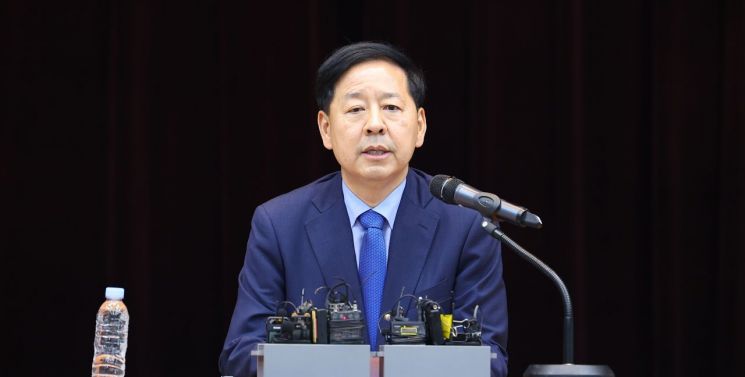 Koo Yoonchul, candidate for Deputy Prime Minister for Economic Affairs and Minister of Economy and Finance. Photo by Yonhap News
Koo Yoonchul, candidate for Deputy Prime Minister for Economic Affairs and Minister of Economy and Finance, stated, "I agree that appropriate taxation of residential rental income is necessary to ensure tax equity."
On July 15, in a written response to a confirmation hearing questionnaire submitted to the National Assembly, Koo gave this answer regarding the strengthening of taxation on residential rental income.
He added, "However, whether to further strengthen taxation should take into account the potential increase in housing rental prices that could result from higher tax burdens on small-scale landlords, such as retirees, or the transfer of tax burdens to tenants."
Regarding the push for separate taxation of dividend income, Koo responded, "Tax incentives that can encourage companies to increase dividends are necessary to advance the capital market and support asset formation for the public." Addressing concerns that this could be a "tax cut for the wealthy" benefiting high-income earners or major shareholders, he explained, "I will look into whether there are measures that can address these issues while still contributing to the revitalization of the capital market."
He also expressed his intention to tax reduced dividends, which are currently not subject to taxation. Reduced dividends refer to dividends paid after converting capital reserves into retained earnings.
He stated, "Since there is no substantial economic difference from ordinary dividends and there have been concerns about their misuse for tax avoidance, I will prepare improvement measures considering tax equity and enforceability."
Regarding the introduction of income and transaction taxes on virtual assets, he said, "Given the principle of 'tax where there is income,' it is desirable to tax capital gains as reflected in the Income Tax Act," and added, "With the taxation of virtual assets postponed for two years to 2027, I will actively participate in related discussions in the National Assembly if they arise."
On the corporate tax rate, he said, "Compared to countries with similar economic scale among OECD members, our overall tax rate, including local taxes, is somewhat low," and added, "There has been a weakening of the tax base due to economic slowdown and corporate tax rate cuts under the previous administration." He did not mention any specific possibility of adjusting the tax rate.
In addition, he expressed a cautious stance on changing the unit of income taxation from individuals to consumption units such as couples or families, citing the need for national consensus.
Regarding the argument for a dual policy of differentiating corporate and income tax rates between the Seoul metropolitan area and non-metropolitan regions, he viewed it negatively, stating, "In principle, national taxes are imposed uniformly across the country, so differentiating tax rates by region could cause regional conflict and undermine tax equity among workers and corporations."
On the reform of the comprehensive real estate holding tax, he explained in principle, "It is necessary to take a comprehensive approach, considering the impact on the market and the principle of ability-to-pay taxation (the principle that taxes should be levied according to the taxpayer's ability to pay)."
He also said that reforming the inheritance tax "should be decided after comprehensively reviewing fiscal conditions and the range of beneficiaries during the National Assembly's discussions."
© The Asia Business Daily(www.asiae.co.kr). All rights reserved.

















