"Don't look at me, don't look at me..."
Argentine influencer's video of humanoid robot hotel in Japan goes viral
Henna Hotel, the world's first robot hotel,
features robots handling check-in and room service
Despite automation, service quality and customer satisfaction remain challenges
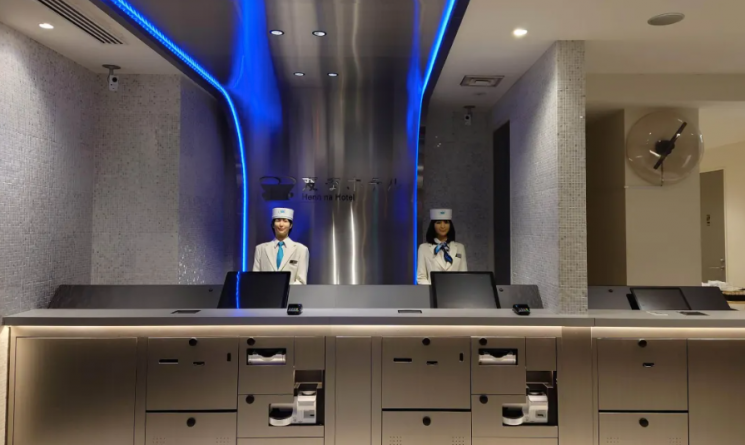
"Don't look at me, don't look at me, it's too scary..."
A video of an influencer from Argentina visiting an unmanned hotel in Tokyo, Japan, where humanoid robots greet guests, has gone viral.
According to the South China Morning Post (SCMP) on July 14 (local time), an Argentine influencer shared the robot-operated check-in process at Tokyo's Henna Hotel on social media on June 25. The video shows a humanoid robot in uniform scanning a passport, confirming the guest's stay schedule, and automatically issuing a room key, with the entire process carried out by the robot.
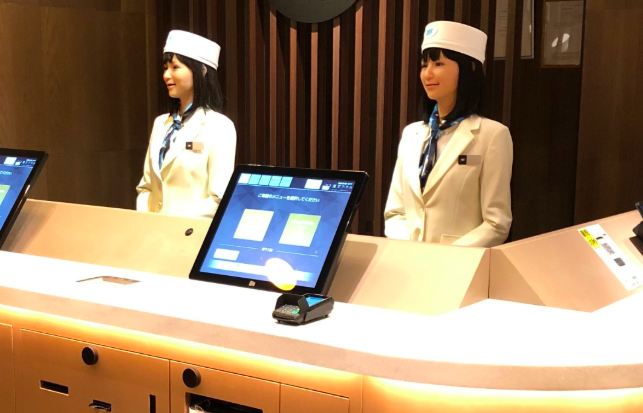
In the video, the influencer appears nervous in front of the reception desk lined with robots, repeatedly saying, "Don't look at me, don't look at me," and even tells the check-in robot, "You are too scary."
The video has been viewed more than 88,000 times, attracting significant attention. Viewers left a variety of comments, such as "It's like a horror movie," "It's kind of creepy," "At least robots can't be rude like people," and "In fact, being guided by robots might be more accurate and convenient."
Henna Hotel, which opened its first location in Nagasaki in 2015, is the world's first robot hotel and now operates more than 20 locations across Japan, including Tokyo, Osaka, and Kyoto. There is also a branch in Myeong-dong, South Korea. At some locations, dinosaur-shaped robots handle check-in, and AI voice assistants are installed in guest rooms. The hotel has been listed in the Guinness Book of World Records as the hotel with the most robots working.
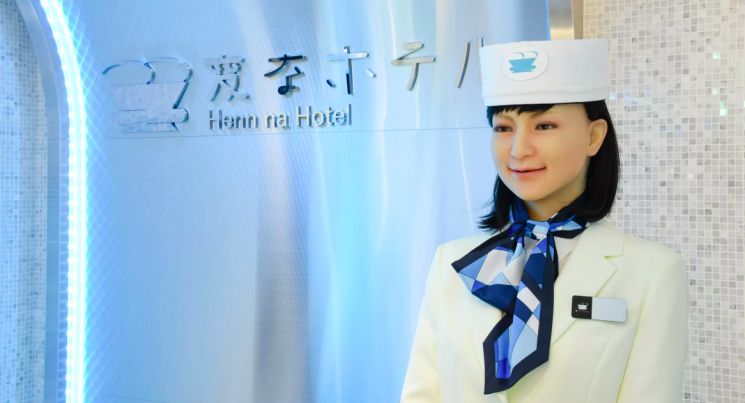
However, the technological completeness of the system still faces limitations. Henna Hotel once operated about 240 robots but has since reduced the number to less than half and rehired human staff at some locations. This change was due to recurring operational issues, including voice recognition errors, inadequate responses to customer requests, and mechanical failures. Industry experts have analyzed that while robots offer advantages in terms of labor cost reduction and operational efficiency, maintaining customer satisfaction and service quality remains a challenge.
Japan is rapidly introducing unmanned systems in various sectors, such as hotels, food service, and logistics, in response to an aging population and labor shortages. The hotel industry in Japan is also accelerating the trend toward automation. Robots are being deployed for repetitive and non-face-to-face tasks such as cleaning, luggage handling, and room service, and some hotels now operate fully automated systems for the entire process from check-in to check-out.
© The Asia Business Daily(www.asiae.co.kr). All rights reserved.
![Clutching a Stolen Dior Bag, Saying "I Hate Being Poor but Real"... The Grotesque Con of a "Human Knockoff" [Slate]](https://cwcontent.asiae.co.kr/asiaresize/183/2026021902243444107_1771435474.jpg)

















