Agricultural and Seafood Prices Surge Across the Board Due to Heatwave
Watermelon Followed by Mackerel Prices Jump Over 30%
Heatwave Expected to Further Drive Up Prices in the Second Half of the Year
Prices of summer fruits and vegetables popular during the season, such as watermelon and young radish, are rising rapidly. Due to the heatwave, agricultural yields have declined and supply has decreased, leading to a sharp increase in prices. As consumers search for relatively cheaper fruits and vegetables, the upward trend in prices is spreading to alternative products as well. With the burden of rising prices on consumers intensifying, the government is also responding by implementing key supply measures for agricultural and livestock products and launching discount events.
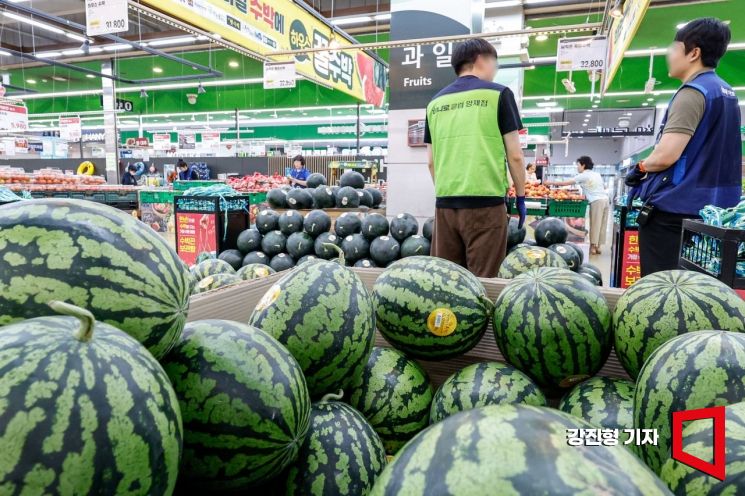 Since early this month, an early heatwave has caused a 'heatflation' phenomenon where agricultural product prices are rising. In the past week, the price of a whole watermelon has exceeded 30,000 won, and especially the prices of heat-sensitive vegetables like cabbage and spinach have increased. On July 14, watermelons were displayed at Hanaro Mart Yangjae Branch in Seocho-gu, Seoul. 2025.7.14. Photo by Kang Jinhyung
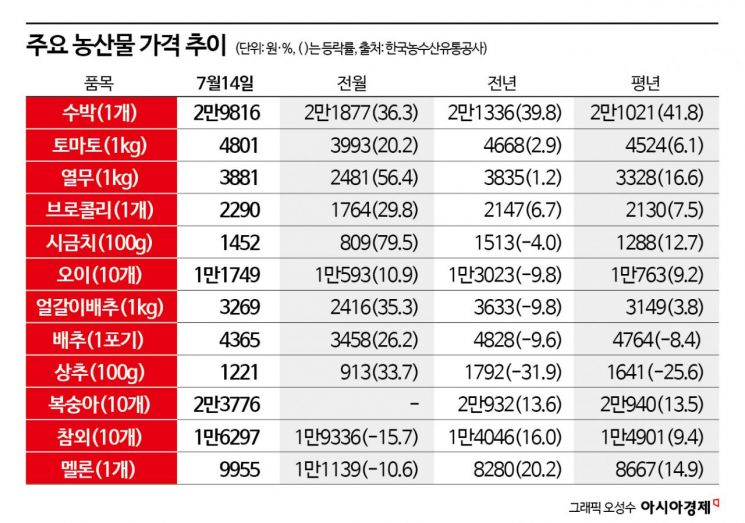
According to the Korea Agro-Fisheries & Food Trade Corporation (aT)'s Korea Agricultural Marketing Information Service (KAMIS) on July 15, the retail price of a whole watermelon as of July 14 was 29,816 won, up 36.3% from a month ago (21,877 won). This means the price increased by about 8,000 won in just one month. Compared to the same period last year (21,336 won), the price is up 39.8%, and compared to the average year (21,021 won), it is up 41.8%. In the distribution industry, there are already many places selling watermelons for over 30,000 won.
In addition to watermelon, prices of vegetables in high demand during summer are rising across the board. Young radish, which is popular for making young radish kimchi in summer, is priced at 3,881 won per kilogram, up 56.4% from a month ago (2,481 won). Although the increase compared to last year (3,835 won) is relatively small at 1.2%, the price is 16.6% higher than the average year (3,328 won). Besides young radish, the price of early cabbage (1kg) rose 35.3% from a month ago (2,416 won), and the price of cabbage increased by 26.2%. Additionally, the price of spinach soared by 79.5% in one month to 1,452 won per 100g, and broccoli rose by 29.8% to 2,290 won per head compared to the previous month (1,764 won).
Fruit prices are no exception. The price of one melon is 9,955 won, up 20.2% from the same period last year (8,280 won) and 14.9% higher than the average year (8,667 won). The prices of chamoe and white peach (per 10 pieces) are 16,297 won and 23,776 won, respectively, up 16.0% and 13.6% from the same period last year. Compared to the average year, these prices are more than 10% higher.
Seafood prices are also rising. The average price of domestic salted mackerel is 6,437 won per pair, which is 37.7% higher than the same period last year (4,674 won) and a staggering 62.7% higher than the average year (3,967 won). Spanish mackerel has exceeded 10,000 won per fish, reaching 11,646 won, which is 39.2% higher than a month ago (8,368 won). Additionally, prices of mussels (up 18.1%) and abalone (up 7.0%) are also rising rapidly.
The main reason for the sharp rise in vegetable and fruit prices is deteriorating crop growth due to high temperatures. For example, in the case of watermelon, the heatwave has reduced the sugar content, resulting in fewer shipments that meet quality standards. Similarly, the rise in seafood prices is attributed to a 1 to 2 degree increase in sea surface temperatures, which has led to a decrease in fish catches.
Increased demand is also contributing to higher prices. As summer heat arrives earlier and becomes more severe each year, more consumers are seeking cool fruits like watermelon and melon, or making young radish and cucumber kimchi.
Among livestock products, chicken prices have seen a slight upward trend. According to the Korea Institute for Animal Products Quality Evaluation, as of July 14, the retail price of broilers was 6,138 won per kilogram, up 4.3% from the same period last year (5,886 won) and 7.6% higher than the average year (5,703 won). Egg prices show a similar trend. The retail price for 10 extra-large eggs was 3,750 won, up 12.5% from the same period last year (3,334 won) and 6.5% higher than the average year (3,520 won).
The rise in chicken prices is due to increased poultry deaths caused by the heatwave, as well as higher demand for samgyetang during the summer. However, since prices have already risen significantly and supply is expected to remain relatively stable in the future, further price increases are likely to be limited. The Korea Rural Economic Institute stated, "Strict management is needed to prepare for heatwaves and heavy rains during the summer," but also predicted, "The number of chickens slaughtered for samgyetang during the peak summer season in July and August is expected to reach between 44.45 million and 45.34 million, an increase of about 0.8% compared to the same period last year."
The main reason for the sharp rise in vegetable and fruit prices is deteriorating crop growth due to high temperatures. For example, in the case of watermelon, the heatwave has reduced the sugar content, resulting in fewer shipments that meet quality standards. Similarly, the rise in seafood prices is attributed to a 1 to 2 degree increase in sea surface temperatures, which has led to a decrease in fish catches.
Increased demand is also contributing to higher prices. As summer heat arrives earlier and becomes more severe each year, more consumers are seeking cool fruits like watermelon and melon, or making young radish and cucumber kimchi.
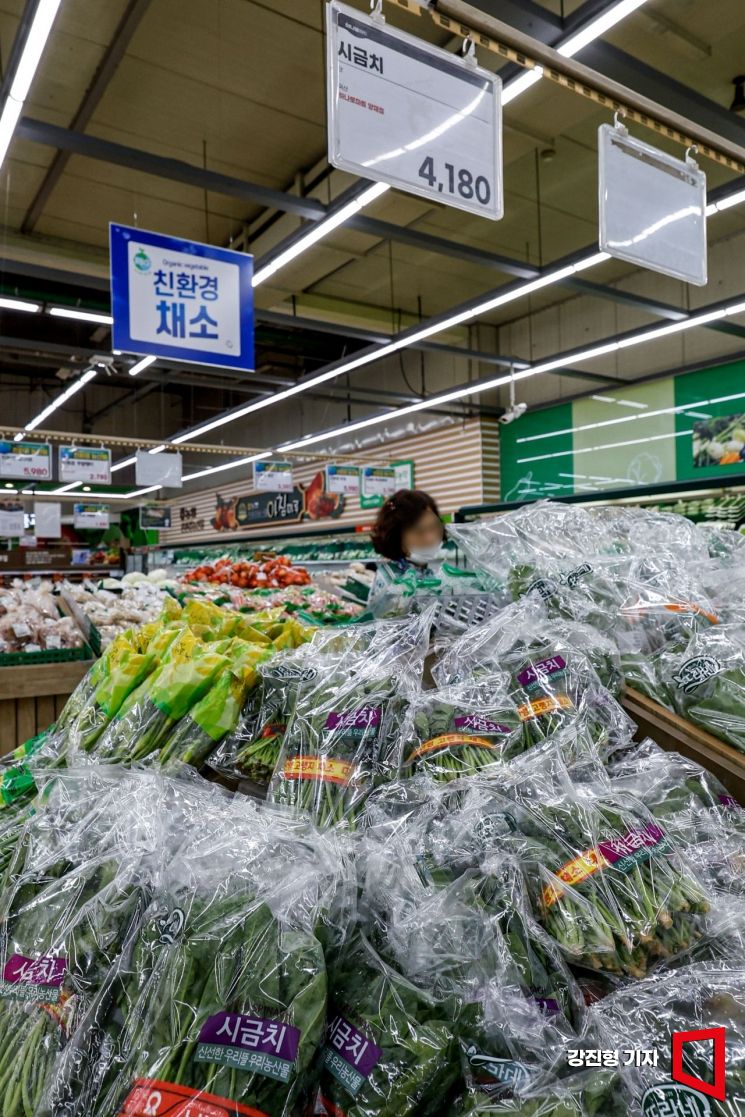 Since early this month, an early heatwave has caused a 'heatflation' phenomenon, leading to rising agricultural product prices. In the past week, the price of a whole watermelon has exceeded 30,000 won, and prices of heat-sensitive vegetables such as cabbage and spinach have increased. On July 14, spinach was displayed at Hanaro Mart Yangjae Branch in Seocho-gu, Seoul. 2025.7.14. Photo by Kang Jinhyung
Looking ahead, while there may be some differences by item, the upward trend in vegetable and fruit prices is unlikely to subside easily. For watermelon, shipments are expected to be similar to last year, but overall prices are likely to remain high due to rising temperatures and the resulting increase in prices of alternative items like chamoe. The Korea Rural Economic Institute analyzed, "For chamoe, higher temperatures have increased pests and diseases, reducing yields and leading to a roughly 5% decrease in shipments. For tomatoes, increased heat damage during the summer and additional virus damage in areas like Jangsu, Jeonbuk, have reduced shipments, so prices are expected to rise compared to last year."
As the burden of agricultural product prices on consumers grows, the government is taking preemptive measures by expanding reserves of major agricultural, livestock, and fisheries products and supporting various discount events. The Ministry of Economy and Finance held a price-related vice-ministerial meeting the previous day to discuss supply stabilization measures for key items such as potatoes, cabbage, and Korean beef. For cabbage, the government has secured more than double the available volume, increasing from 17,000 tons last year to 35,500 tons this year. For Korean beef, supply will be increased by 1.3 times compared to normal levels to meet summer demand.
The Ministry of Agriculture, Food and Rural Affairs is supporting discount events at over 12,000 on- and offline retailers selling domestic agricultural and livestock products. From July 17 to August 6, the government will provide up to a 40% discount on major agricultural and livestock products such as fruits and chicken. The individual discount limit will be raised from 10,000 won per week to 20,000 won. In 130 traditional markets nationwide, an on-site rebate event worth 10 billion won will be held from August 4 to 9.
Meanwhile, the price increases caused by this heatwave are expected to continue for some time and are likely to affect prices during Chuseok as well. According to a study by Hyundai Research Institute analyzing summer temperatures and price trends over 31 years from 1991 to 2021, in the 16 years with prolonged heatwaves, the average inflation rate in the second half of the year was 0.2 percentage points higher than in the first half during those periods.
© The Asia Business Daily(www.asiae.co.kr). All rights reserved.



















