Polarization of Foot Traffic on Major Streets Intensifies
Digital Transformation, Not Economic Downturn, Is the Main Cause
Decline in Offline Demand Is a Global Trend
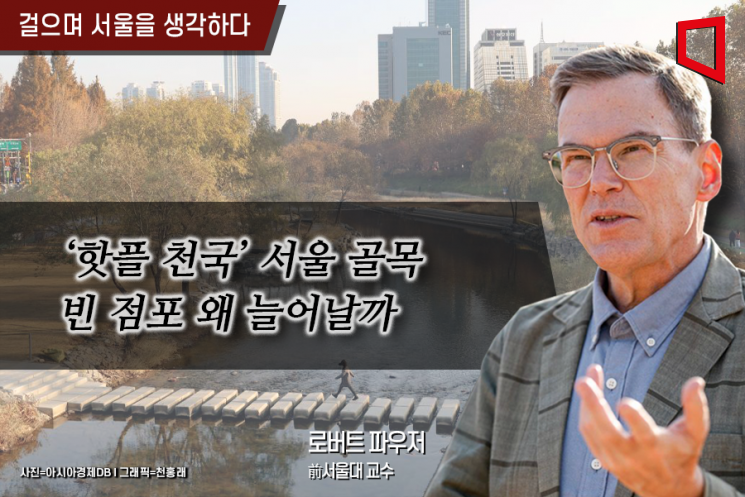
In June, I had the opportunity to greet a Korean professor who has lived in the United States for over 40 years at an event. He remarked, "The situation is very bad. Small business owners are collapsing, and I am worried about the Korean economy."
Except for the COVID-19 period, I have visited Korea once or twice every year. Last spring, I stayed in Korea for quite a long time. Areas popular among young people and tourists, such as Hongdae, Seongsu, and Myeong-dong, were bustling everywhere. There were noticeably more cafes and restaurants, and many shops were selling cosmetics, luxury goods, or products targeting tourists. Experience-based stores, such as selfie photo studios and Hanbok rental shops, were also gaining popularity. The focus seemed to be less on purchasing goods and more on a variety of experiences, including eating and drinking.
The commercial map of Seoul is much broader than just the hotspots favored by young people and tourists. The Gangnam commercial district is especially extensive, and there are also long-established commercial hubs like Yeouido, Sinchon, and Yeongdeungpo. In recent years, new commercial areas have emerged in former industrial zones, such as Gasan Digital Complex and G-Valley. In addition, there are countless neighborhood commercial areas and shopping centers within apartment complexes.
A closer look at each area reveals that the professor's point is valid. There are many closed shops and places with "For Rent" signs. However, is it accurate to diagnose this phenomenon solely as a result of poor economic conditions? Could it not be a natural flow resulting from changing times?
According to common sense, when the economy is bad, stores close down. A large number of vacant shops in a particular area indicates that the local commercial district is struggling. The same applies to office spaces. Traditionally, Seoul's commercial districts have not had many vacancies. This has led to an expectation that businesses will always be maintained at a certain level. In other words, commercial areas are supposed to be streets filled with buildings and bustling with foot traffic. But is this conventional wisdom still valid in the 21st century?
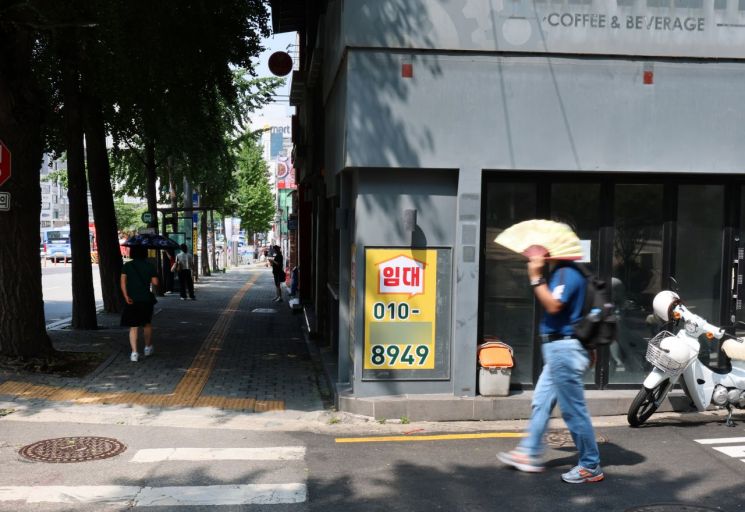 An For Rent sign is posted on the first-floor commercial space in the iconic shopping district of Sinchon. Photo by Yoon Dongju
The case of New York is worth considering. In Manhattan's commercial districts, there used to be few vacant shops or offices. Around the mid-2010s, however, even Fifth Avenue saw an increase in empty stores due to the so-called "retail apocalypse" in the United States. At that time, though, New York's economy was recovering from the 2008 crisis and was generally on an upward trend. However, as the online shopping market grew, lifestyles changed, and physical stores on the street became less essential. The COVID-19 pandemic further entrenched the online shopping culture, and with the rapid rise of remote work and food delivery, it became possible for businesses to operate without necessarily maintaining physical stores or offices. Although New York has recovered from the pandemic, the recent widespread adoption of AI has led to a decline in demand for office space, and such spaces are gradually being converted into residential use. As of 2025, everyday life has become even more digitalized, and the demand for physical spaces like stores and offices continues to decrease. As a result, since it is not feasible to leave these now-obsolete urban spaces empty, the pace of conversion to residential and other uses is accelerating.
It is difficult to simply conclude that the increase in vacant shops on Seoul's streets is solely due to a worsening economy. Like New York, much of daily life in Seoul has become digitalized, and online shopping and food delivery have become widespread. Physical stores and offices are no longer as essential as they once were. Although Seoul has fewer remote workers than New York, the rapid adoption of AI is likely to accelerate this trend. Therefore, the growing number of vacant shops on Seoul's streets can be seen as a result of structural changes in the economy.
Another notable characteristic of Seoul is its rapidly aging population. Compared to New York, the pace of demographic aging is much faster. As the population ages, the number of people living on pensions increases, and consumption patterns naturally become more frugal. This inevitably affects commercial districts. As overall consumption declines, the need for stores diminishes, which in turn leads to an increase in vacant shops. In central Tokyo's commercial districts, the situation still appears positive due to the large floating population, including tourists, but as one moves toward residential areas, aging is accelerating rapidly, and as a result, traditional commercial sectors are being hit hard.
In conclusion, Seoul's commercial districts are currently facing difficulties due to two major changes: economic structural shifts and demographic changes. While some commercial areas are emerging as hotspots thanks to the consumption preferences of the younger generation and a boom in foreign tourism, this trend is limited in scale. Not all commercial districts can become hotspots. Therefore, it is important to find urban regeneration solutions that fit the current reality. Where can such solutions be found?
There are two main directions to consider. One is to reduce the scope of commercial districts in line with economic structural changes while expanding residential functions. By reducing the area of commercial zones, commercial activity can be concentrated within a smaller range. For example, in Bomun-dong, Seongbuk-gu, Seoul, if the main commercial areas are centered around the main road near Bomun Station and commercial activity is restricted within residential neighborhoods, the number of vacant shops can be reduced and the residential environment can be improved.
Another approach is to convert commercial buildings into residential use. For example, even in traditional commercial districts such as Sinchon or Yeongdeungpo, the commercial area can be limited, and existing commercial facilities can be converted for residential purposes. In addition, compared to other major cities worldwide, the old city center within the Four Great Gates of Seoul has a relatively small resident population. Increasing the resident population by converting commercial and office buildings into housing in this area could be a viable idea. Increasing the resident population is a very important factor in urban regeneration.
The other direction is to develop commercial districts that cater to the tastes of adults and retirees. In many major cities around the world, such as Ginza in Tokyo or Kensington in London, there are commercial districts specifically favored by adult customers. While some areas of Yeouido and Gangnam may appear similar, their main consumer base is primarily business professionals. Although it is not easy to create new commercial districts tailored to new customer segments in line with economic and demographic changes, if we shift our focus in this direction, it could greatly help maintain Seoul's vibrancy while adapting to current circumstances.
Robert Fouser, former professor at Seoul National University
© The Asia Business Daily(www.asiae.co.kr). All rights reserved.
![Clutching a Stolen Dior Bag, Saying "I Hate Being Poor but Real"... The Grotesque Con of a "Human Knockoff" [Slate]](https://cwcontent.asiae.co.kr/asiaresize/183/2026021902243444107_1771435474.jpg)
















