The Gyeonggi-do Economic Science Promotion Agency is strengthening its cooperation with agricultural technology centers in four cities and counties in northern Gyeonggi to industrialize bio-based materials derived from agricultural by-products.
On July 15, the agency announced that it had signed a business agreement with the agricultural technology centers of Goyang, Yeoncheon, Paju, and Pocheon at the Gwanggyo Bio Center to foster the "Upcycled Bio-material Industry in Northern Gyeonggi."
This agreement aims to convert local agricultural by-products into high-value-added bio-materials, link them to the beauty and healthcare industries, and establish a circular economy ecosystem based on eco-friendly principles. Another key objective is to build an industrial foundation that contributes to achieving carbon neutrality and spreading ESG values.
Northern Gyeonggi is known as a major producer of high-quality agricultural products such as Job's tears, jujube, apples, blueberries, and Schisandra. However, most by-products generated after harvest, such as branches, peels, and leaves, have been classified as industrial waste.
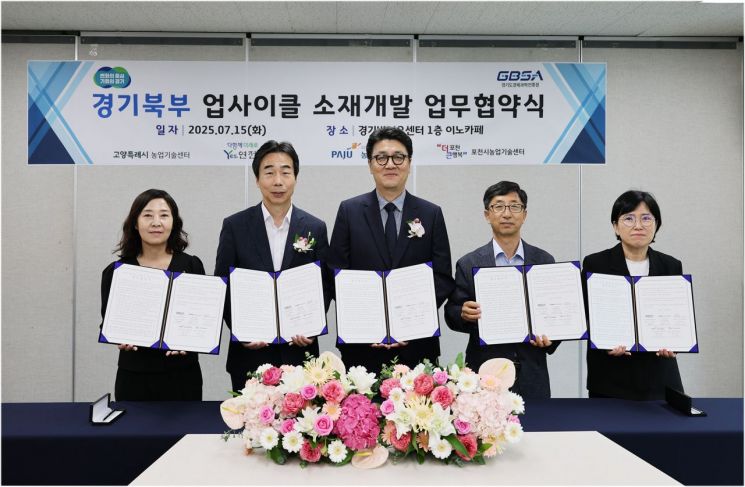 Gyeonggi-do Economic Science Promotion Agency signed a business agreement on upcycled material development in northern Gyeonggi with agricultural technology centers from four cities and counties, including Goyang, Yeoncheon, and Pocheon, on the 15th. Provided by Gyeonggi-do Economic Science Promotion Agency
Focusing on these resources, the agency is launching an "upcycling project" in collaboration with city and county agricultural technology centers to convert them into high-performance bio-materials.
Goyang is beginning to develop functional materials using rose branches, perilla stalks, and soybean stems; Yeoncheon is focusing on Job's tears bran, jujube, grape branches, and red ginseng residue; and Pocheon is working on functional material development using apples, Schisandra, and blueberries.
These raw materials show strong potential for advancement into functional cosmetics and health supplements, and the efforts are also being linked to technology transfer and patent applications. In the mid to long term, they are expected to become a central pillar of a resource-circulating bio-industry.
Hyun Changha, Director of Future Growth at the agency, stated, "This agreement will serve as a turning point in establishing an eco-friendly industrial ecosystem in northern Gyeonggi without resource waste," adding, "We will actively support the northern region so that it can emerge as a hub for sustainable beauty and healthcare industries."
© The Asia Business Daily(www.asiae.co.kr). All rights reserved.
![Clutching a Stolen Dior Bag, Saying "I Hate Being Poor but Real"... The Grotesque Con of a "Human Knockoff" [Slate]](https://cwcontent.asiae.co.kr/asiaresize/183/2026021902243444107_1771435474.jpg)















