Centering on Blue Valley National Industrial Complex... Laying the Foundation for the Next 100 Years of Industry
Designation as a Secondary Battery Opportunity Development Zone Supports R&D and Workforce Training
Despite the global economic downturn and contraction of its core industries, Pohang City is accelerating efforts to attract advanced strategic industries centered around the Blue Valley National Industrial Complex to ensure the city's sustainable growth.
As part of its mid- to long-term strategy looking ahead to the next 100 years, the city aims to proactively establish a foundation for next-generation industries such as secondary batteries, hydrogen, bio, and AI data centers.
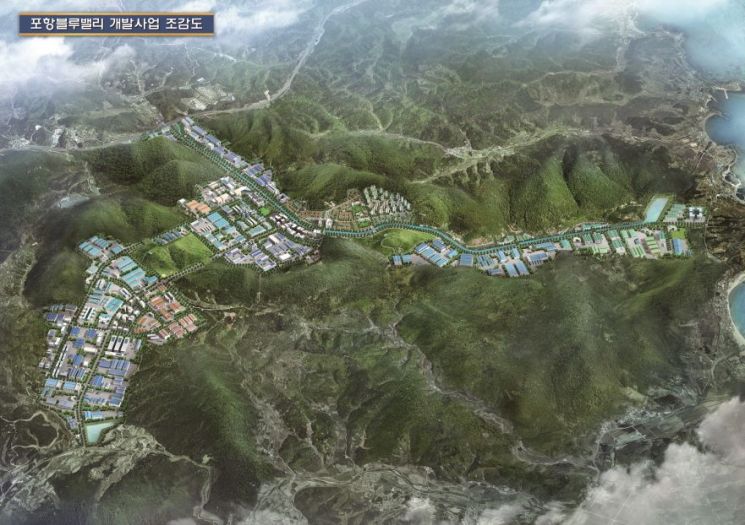
The Blue Valley National Industrial Complex was established in 2009 with the goal of fostering parts and materials industries for automobiles, ships, and machinery. However, in response to rapidly changing industrial conditions, Pohang City has continued to revise the industrial complex plan and expand infrastructure to attract advanced industries such as secondary batteries and data centers.
As a result, key companies in the secondary battery sector, including POSCO Future M and EcoPro, have successively moved in, and the complex has achieved designations as a secondary battery specialized complex and an Opportunity Development Zone.
In particular, in July 2023, EcoPro announced plans to invest KRW 2 trillion over five years to establish a cathode material value chain hub on a 210,000-pyeong site within the Pohang Blue Valley National Industrial Complex by 2028, with an expected job creation effect of over 1,100 positions.
Currently, the Blue Valley National Industrial Complex has a sales rate of about 60%. Although some large-scale investments have been withdrawn due to the 'secondary battery chasm,' Pohang City has attracted around 40 companies, including POSCO Future M and EcoPro. Once the total investment of KRW 2.4 trillion is completed, approximately 2,600 jobs are expected to be created.
If companies that have signed MOUs also move in, the total investment is expected to reach KRW 5.1 trillion, with employment rising to 3,300 people.
Graphene Square, which is scheduled for completion in October this year with an investment of KRW 46 billion in the Blue Valley Industrial Complex, is expected to become a pillar of Pohang's future growth industries by commercializing the nation's first large-scale graphene synthesis technology through the production of graphene film and modules and establishing a 'Graphene Valley.'
In addition, by 2028, the city plans to invest a total of KRW 19.18 billion in an area of about 280,000 square meters to create the nation's largest 'hydrogen fuel cell cluster,' which will include a corporate concentration zone, parts and materials performance evaluation, and a fuel cell demonstration core. This is expected to attract over 30 hydrogen companies, create more than 10,000 jobs, and generate over KRW 800 billion in production inducement effects.
Notably, the Blue Valley National Industrial Complex offers a variety of policy support benefits, including R&D and workforce development support, as well as corporate and income tax reductions of 100% for five years and 50% for the following two years.
Pohang City plans to actively leverage these institutional strengths and location infrastructure to provide tailored administrative support and incentives for new growth industries such as AI, batteries, and hydrogen, ensuring these efforts lead to tangible investment outcomes.
Mayor Lee Kangdeok stated, "We will develop the Blue Valley National Industrial Complex into a hub for national advanced strategic industries and create a competitive specialized industrial complex," adding, "We will do our utmost to attract large-scale investments in advanced strategic industries and strengthen the competitiveness of local industries."
© The Asia Business Daily(www.asiae.co.kr). All rights reserved.
![Clutching a Stolen Dior Bag, Saying "I Hate Being Poor but Real"... The Grotesque Con of a "Human Knockoff" [Slate]](https://cwcontent.asiae.co.kr/asiaresize/183/2026021902243444107_1771435474.jpg)















