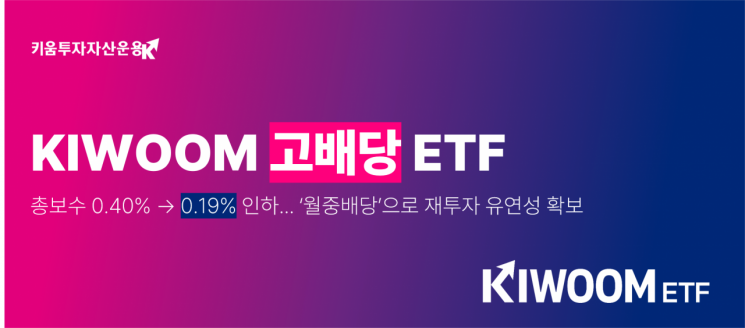
The reduction in the total expense ratio and the switch to mid-month dividends are measures aimed at enhancing investors' actual returns and providing greater flexibility for reinvestment strategies. The annual expense ratio of 0.19% is relatively low among high-dividend ETFs listed in Korea, establishing a fee structure that minimizes the burden on investors. The mid-month dividend structure is expected to have a positive effect for both long-term investors and those managing pension accounts, as it allows for more flexible timing of reinvestment of distributions.
The KIWOOM High Dividend ETF tracks the "MKF Wealth High Dividend 20 Index," selecting companies that have posted net profits for the past four consecutive years, have a dividend payout ratio below 90%, and have actually paid cash dividends. This high-conviction ETF focuses exclusively on the 20 stocks with the highest dividend yields.
Approximately 60% of all holdings are financial stocks in high-dividend sectors such as banking, insurance, and securities. This composition naturally aligns with the current trend in the market, where high-dividend, financial-sector-focused ETFs are leading the way, driven by government policies such as the introduction of separate taxation on dividend income, amendments to the Commercial Act, and strengthened shareholder return initiatives. These policy trends are expected to further benefit such ETFs in the future.
It is also noteworthy that, due to its strict selection criteria, the ETF has not experienced a reduction in dividends per share over the past three years. Over the past year, the ETF has delivered a dividend yield of approximately 4.99%, providing stable cash flow, and has demonstrated outstanding competitiveness in terms of performance.
According to financial information provider FnGuide, as of July 14, the KIWOOM High Dividend ETF has posted returns of 18.78% over one month, 53.35% over six months, and 53.98% year-to-date. It has maintained strong performance across major return intervals among domestic equity high-dividend ETFs. The product is emerging as a practical alternative for investors seeking both dividend income and market returns.
A representative from Kiwoom Asset Management stated, "The domestic dividend investment environment is gradually improving in line with the government's capital market policies, including amendments to the Commercial Act, the introduction of separate taxation on dividend income, and incentives to increase dividends."
The representative added, "With the revision of the foreign tax credit system and the push for legislation related to Section 899 of the U.S. tax code, psychological barriers to investing in U.S. ETFs are rising. As a result, demand for domestic equity ETFs, including domestic high-dividend ETFs, is expected to increase further."
© The Asia Business Daily(www.asiae.co.kr). All rights reserved.
![Clutching a Stolen Dior Bag, Saying "I Hate Being Poor but Real"... The Grotesque Con of a "Human Knockoff" [Slate]](https://cwcontent.asiae.co.kr/asiaresize/183/2026021902243444107_1771435474.jpg)















