Gyeonggi Province has uncovered 20 businesses that violated the Livestock Products Sanitary Control Act, including storing frozen products under refrigeration or at room temperature, or failing to conduct in-house quality inspections.
The Gyeonggi-do Special Judicial Police Unit announced on the 15th that, from June 16 to 27, it conducted an intensive investigation targeting livestock product processing companies and meat packaging and processing companies within the province. As a result, the unit identified 362 livestock product processing companies suspected of illegal activities and detected 22 violations at 20 of these companies.
This investigation was carried out as a preemptive inspection of companies manufacturing ground meat products such as sausages and hamburger patties, which are popular with children and have a high risk of causing "hamburger disease" infections, in order to prevent such incidents in advance ahead of the summer season.
"Hamburger disease" is the name given after dozens of children were infected in a group outbreak after eating hamburgers containing contaminated ground beef at fast food restaurants.
Enterohemorrhagic Escherichia coli, commonly known as "hamburger disease," can be eliminated by proper heating, making it crucial to ensure thorough cooking. Symptoms caused by enterohemorrhagic Escherichia coli, which mainly occur in the summer, include diarrhea, severe cramping abdominal pain, bloody stools, vomiting, and mild fever.
Among the main cases detected, Company A, a livestock product company, was found to have failed to conduct mandatory monthly in-house quality inspections on its products.
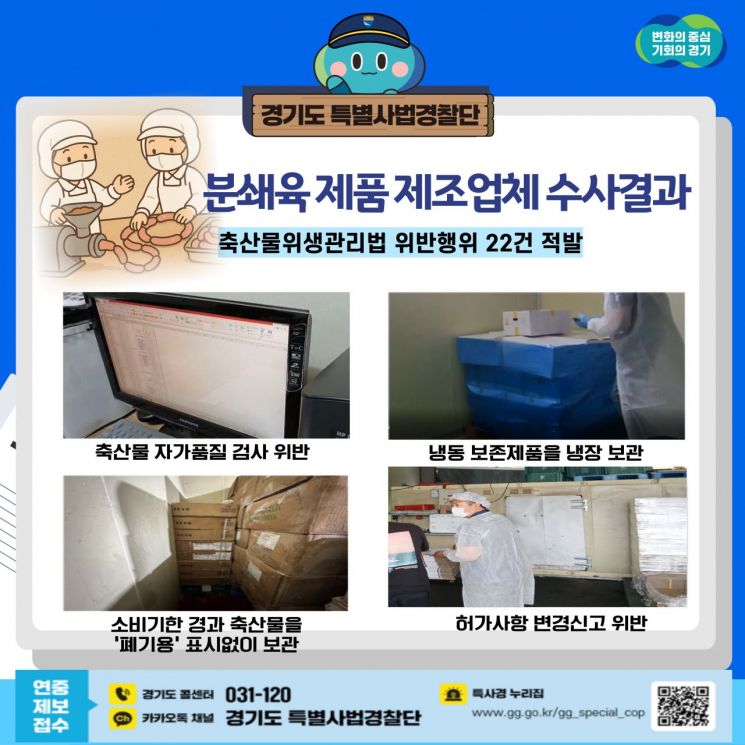 Case of Crackdown on Illegal Activities by Ground Meat Product Manufacturers by Gyeonggi-do Special Judicial Police Unit
Company B, a livestock product company, was caught storing 500 kg of frozen beef omasum, which is supposed to be kept in a freezer, in a refrigerator instead.
Company C, a livestock product company, was found storing 200 kg of frozen beef intestines past their expiration date without labeling them as "for disposal." Livestock products past their expiration date must be labeled as "for disposal" and stored accordingly.
Company D, a livestock product company, was found to have used an additional finished product freezer of approximately 29 cubic meters without reporting the change to the relevant authorities. After obtaining a license for livestock product processing from the relevant authorities, any changes must be reported before business operations continue.
Ki Ido, head of the Gyeonggi-do Special Judicial Police Unit, stated, "Through crackdowns and awareness campaigns targeting livestock product processing companies and meat packaging and processing companies, we will do our utmost to raise awareness of legal compliance and heighten vigilance, thereby preventing food poisoning incidents caused by improper management and creating a safe food environment for residents."
© The Asia Business Daily(www.asiae.co.kr). All rights reserved.
![Clutching a Stolen Dior Bag, Saying "I Hate Being Poor but Real"... The Grotesque Con of a "Human Knockoff" [Slate]](https://cwcontent.asiae.co.kr/asiaresize/183/2026021902243444107_1771435474.jpg)















