Environment Minister nominee Kim Sung-hwan stated on the 15th, "We will focus on fostering decarbonization industries such as electric vehicles, heat pumps, and renewable energy to create jobs and strengthen export competitiveness."
In his opening remarks at the confirmation hearing held by the National Assembly's Environment and Labor Committee that day, Kim said, "The climate crisis is threatening the survival of humanity, and the international economic order is rapidly being reorganized around carbon neutrality at this critical juncture."
He explained, "Last year, the carbon dioxide concentration in Anmyeondo reached a record high of 430 ppm, and it is now increasing by about 3 ppm each year. Experts warn that if the carbon dioxide concentration exceeds 450 ppm, the Earth's temperature could rise by more than 2 degrees Celsius, potentially leading to a collapse of the global economy. Arithmetically, this could happen in 6 to 7 years."
He continued, "To respond to the climate crisis, it is urgent to minimize the use of fossil fuels and to achieve an energy transition by meeting essential energy needs with renewable energy. If I am given the opportunity to serve as Environment Minister, I will lay the foundation for a decarbonized green civilization by enhancing sustainability across society and the economy."
Kim emphasized, "First, we are obligated to reduce greenhouse gas emissions by 40% compared to 2018 levels by 2030," adding, "To ensure the seamless achievement of the national reduction target, we will make every effort to reduce carbon emissions in all sectors, including power generation, industry, transportation, and buildings."
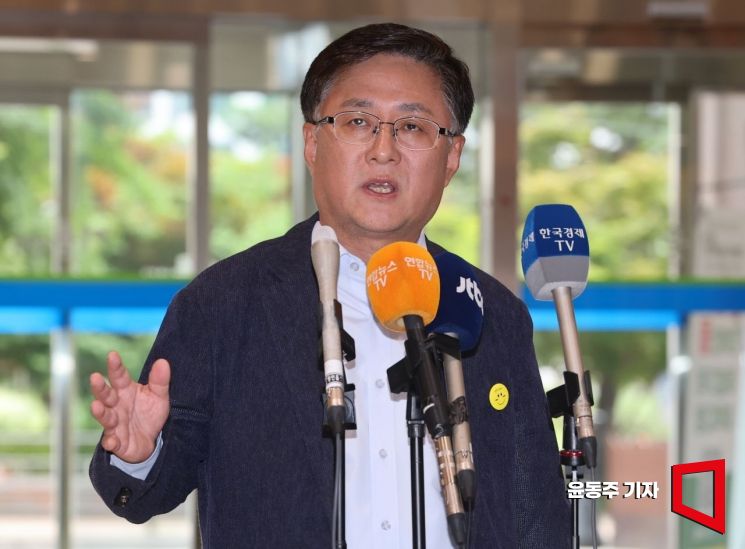 Environment Minister nominee Sung-Hwan Kim is arriving at the confirmation hearing preparation office set up at the Irum Center in Yeouido, Yeongdeungpo-gu, Seoul on the 24th, expressing his thoughts. 2025.06.24 Photo by Dongju Yoon
He also said, "We will focus on fostering decarbonization industries such as electric vehicles, heat pumps, and renewable energy to create jobs and strengthen export competitiveness. We will develop renewable energy transition models tailored to regional characteristics, such as solar power, wind power, and biogas, and revitalize regions facing population decline by sharing benefits with local residents."
Additionally, he stated, "We will increase the proportion of paid allocation of emission permits to strengthen the carbon reduction function of the emission trading market, and create a virtuous cycle by using the increased revenue from emission permits to expand support for decarbonization in high-emission industries."
He also suggested establishing a flood response system to cope with recurring heavy rainfall every year. Kim said, "We will advance flood forecasting using artificial intelligence (AI) and steadily expand flood defense facilities, such as deep underground rainwater tunnels, to prevent urban flooding. We will also strengthen water resource infrastructure to ensure a continuous water supply for people's livelihoods and industry, even in the event of extreme droughts." He emphasized timely support for water supply facilities for high-tech industries such as semiconductors and secondary batteries.
Kim stated, "To realize a sustainable circular economy, this year we will establish a 'de-plastic' roadmap and strive for the health and safety of the public as well as a sustainable future." To this end, he explained, "We will expand the obligation to use recycled materials and strengthen the recycling responsibilities of manufacturers and importers of plastics and electrical and electronic products, thereby establishing a system for resource circulation."
He said, "We will gradually strengthen the total air pollutant load management system to reduce air pollutants from industrial sites, and also promote air quality improvement projects that the public can feel, supporting environmental improvements at emission sites near residential areas." He added, "To restore the natural state of the four major rivers, we will ensure the continuity of water flow from the source to the estuary and dramatically improve water quality and aquatic ecosystems through thorough management of pollution sources."
Kim stated, "We will fundamentally resolve the issue of victims of humidifier disinfectants and establish a comprehensive environmental welfare system so that vulnerable groups, including low-income households, children, and the elderly, are not left behind and can have their basic environmental rights guaranteed."
© The Asia Business Daily(www.asiae.co.kr). All rights reserved.
![Clutching a Stolen Dior Bag, Saying "I Hate Being Poor but Real"... The Grotesque Con of a "Human Knockoff" [Slate]](https://cwcontent.asiae.co.kr/asiaresize/183/2026021902243444107_1771435474.jpg)















