Brazil Forms Task Force: "If 50% Is Imposed, We Will Also Impose 50%"
Mexico: "We Expect Results by August 1"
The two major Latin American economies, Brazil and Mexico, have taken divergent approaches in response to U.S. President Donald Trump's "tariff bomb." While Brazil is considering retaliatory tariffs and responding head-on, Mexico is seeking a solution through negotiation. Each country is pursuing what it considers the optimal strategy based on its own circumstances.
According to Reuters and other sources on July 14 (local time), Brazilian Vice President Geraldo Alckmin announced that President Luiz Inacio Lula da Silva would form a tariff response task force (TF) with business leaders affected by the tariffs.
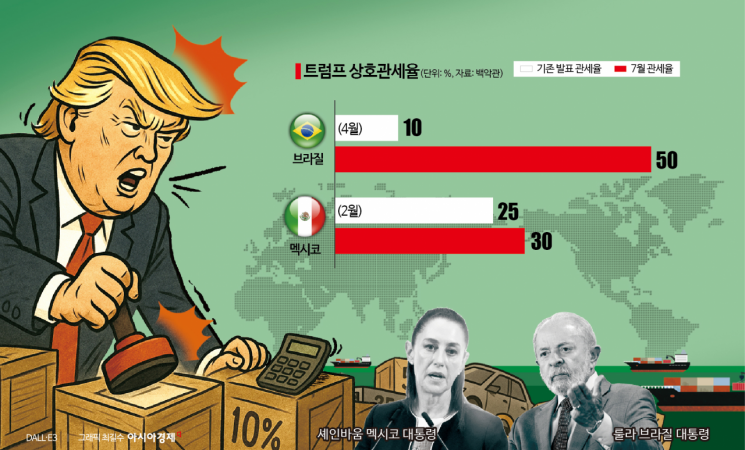
On July 9, President Trump announced in a tariff letter that, starting August 1, a 50% tariff would be imposed on Brazil. Initially, when reciprocal tariffs were announced in April, the rate was set at 10%, but it has now increased by 40 percentage points. As the justification for the tariff hike, Trump cited unfair trade practices and described the trial of former President Jair Bolsonaro, who has been indicted for plotting a coup, as a "witch hunt." Bolsonaro, often called the "Trump of the Tropics," is President Lula's main political rival. Upon the release of the letter, the Brazilian government immediately responded, stating, "We will not tolerate interference or protection from anyone."
Vice President Alckmin stated that, following President Trump's tariff announcement, the Brazilian government did not request a delay or reduction in tariffs, but has been communicating with industries heavily affected by the tariffs and is making efforts to overturn the measures. He also noted that U.S. companies operating in Brazil would be impacted by the tariffs, and that since May, Brazil has sent proposals to the U.S. for tariff discussions but has not received a response.
The Brazilian government plans to discuss tariffs with business leaders and seek their understanding regarding the potential impact if negotiations stall and steep tariffs are imposed.
Brazil is also laying the groundwork for retaliatory tariffs. On this day, President Lula is signing a presidential decree that sets government response standards for cases where foreign measures damage the Brazilian economy. The decree will take effect immediately upon its publication in the official gazette on July 15.
Previously, on July 13, President Lula held a cabinet meeting and instructed ministers to maintain "firmness and composure" during tariff discussions with the United States. In a recent interview with local media outlet Record TV, he stated, "If there is no negotiation, the principle of reciprocity will apply. If he (President Trump) imposes a 50% tariff on us, we will impose a 50% tariff on them." According to local media G1, Lula also instructed that, regarding negotiation topics such as the independence of the judiciary and issues related to Brazilian sovereignty, "no ground should be conceded" to the United States.
Mexico, which is facing a planned 30% tariff, maintains that it will stand up to U.S. infringement of its sovereignty, but is seeking a negotiated settlement rather than a retaliatory approach like Brazil's.
Mexican President Claudia Sheinbaum stated at a regular press conference that "Mexico has done its part in the war against fentanyl, and the United States must also fulfill its responsibilities." She added, "Given the significant progress on security issues with the United States, we expect to achieve results by August 1."
In February, President Trump imposed a 25% tariff on Mexico, citing illegal immigration and fentanyl inflows as problems. He recently announced a plan to increase the tariff to 30%.
The divergent responses of Brazil and Mexico are rooted in their economic structures. According to the Brazilian government, Brazil's cumulative trade deficit with the United States from 2009 through June of this year amounts to $90.2 billion. As a result, even if tariff negotiations with the U.S. break down, the impact is not expected to be catastrophic. In contrast, Mexico, which is tied to the United States through the United States-Mexico-Canada Agreement (USMCA), is highly dependent on U.S. trade. Eighty percent of Mexico's exports are destined for the United States.
Meanwhile, separately from these issues, the Trump administration has decided to impose a 17.09% tariff on fresh tomatoes from Mexico starting today. According to the Florida Tomato Exchange, Mexican tomatoes currently account for about 70% of the U.S. market.
© The Asia Business Daily(www.asiae.co.kr). All rights reserved.
![Clutching a Stolen Dior Bag, Saying "I Hate Being Poor but Real"... The Grotesque Con of a "Human Knockoff" [Slate]](https://cwcontent.asiae.co.kr/asiaresize/183/2026021902243444107_1771435474.jpg)















