PCP Standard Survey Reveals
Seoul University Students Dissatisfied
with Costly Rented Rooms
It was found that university students in Seoul are generally dissatisfied with their rented rooms, despite paying high monthly rents. More than half of the respondents said they would not recommend their current living space to others.
On July 15, PCP Standard, which operates the campus community house 'Loof', announced the results of its '2025 University Student Living Situation Survey', conducted with 600 university students in Seoul.
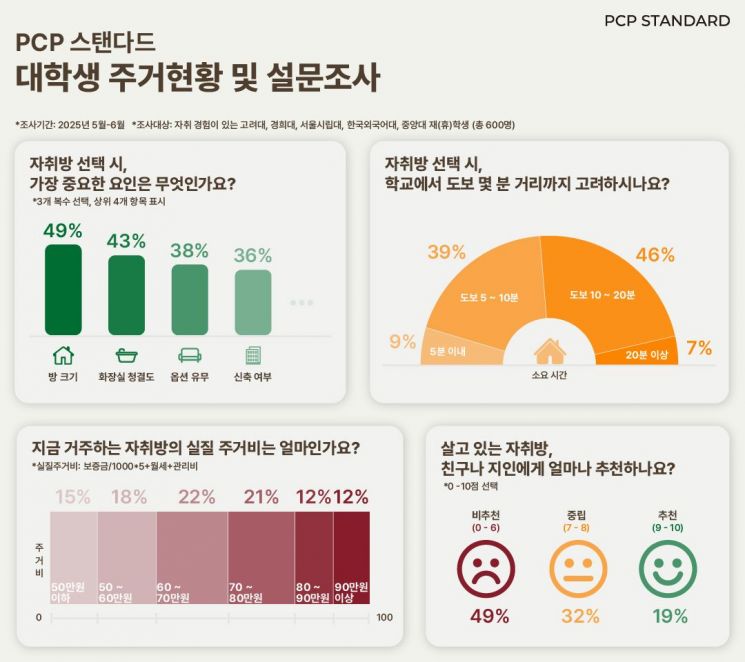
The main reason for starting to live independently was 'to reduce commuting time' (55.5%), followed by 'to secure privacy' (24.8%). Notably, a significant number of respondents chose to live on their own even though they already resided in Seoul or the greater metropolitan area. In addition, 40% of respondents preferred a rented room within walking distance, with no intention of using public transportation. This trend is interpreted as being due to the absolute shortage of dormitory supply and the system that excludes those living nearby from dormitory priority. The burden of waiting for dormitory lotteries, fatigue from communal living, and the demand for independent spaces all contributed to this result.
Furthermore, 56.6% of respondents were living in rented rooms with monthly rents of 500,000 won or more, 32.3% paid 600,000 won or more, and 9.1% paid 700,000 won or more. The main reasons for discomfort in these rooms were basic living environment issues such as mold, poor soundproofing, and lack of sunlight. In reality, the survey revealed that higher housing costs do not necessarily guarantee a comfortable environment. When asked about their criteria for choosing a rented room, students cited 'age or newness of the building' (42.8%), 'room layout' (31.0%), and 'availability of amenities' (22.7%) as important factors. This shows that 'new construction' and 'convenience facilities' are key considerations.
A representative from PCP Standard explained, "The existing university one-room neighborhoods are aging, and considering students' financial situations, the cost is relatively high, yet these rooms fail to provide a comfortable environment. As a result, students are expressing increased demand for better facilities and living conditions."
© The Asia Business Daily(www.asiae.co.kr). All rights reserved.
![Clutching a Stolen Dior Bag, Saying "I Hate Being Poor but Real"... The Grotesque Con of a "Human Knockoff" [Slate]](https://cwcontent.asiae.co.kr/asiaresize/183/2026021902243444107_1771435474.jpg)
















