Resident Doctors' Group Holds Closed-Door Meeting with National Assembly Health Committee on July 14
Extraordinary General Assembly Scheduled for July 19 to Finalize Demands to the Government
Expected to Request Measures Such as Postponement of Military Enlistment and Additional Specialist Exams
Resident doctors who had left hospitals due to the conflict between the medical community and the government have begun earnest discussions to return to their training sites. As they make contact with political circles and explore the possibility of returning in September, they are building justification for their return by emphasizing preconditions such as improvements in training environments and mitigation of legal risks.
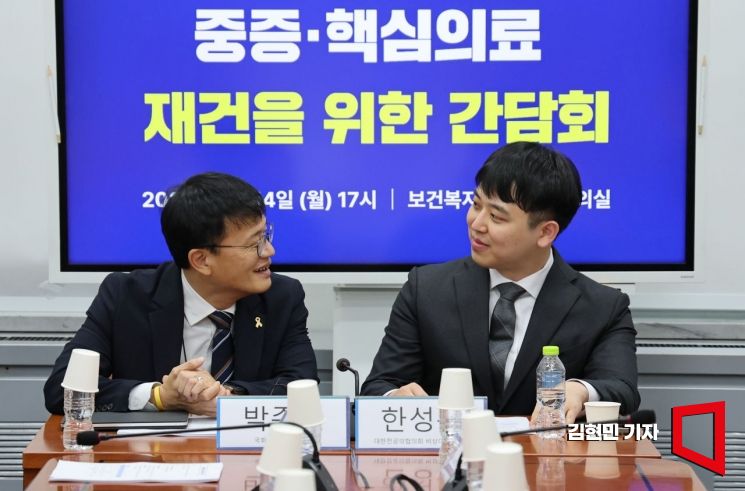 Park Jumin, chairman of the National Assembly Health and Welfare Committee and a member of the Democratic Party of Korea (left), is talking with Han Sungjon, emergency committee chairman of the Korean Intern Resident Association, at a meeting held at the National Assembly on the 14th. Photo by Kim Hyunmin
According to the medical community on July 15, Park Jumin, chairman of the National Assembly Health and Welfare Committee, ruling party lawmakers, Han Sungjon, emergency committee chairman of the Korean Intern Resident Association (KIRA), and other resident doctors who had resigned, sat down together at the 'Meeting for the Restoration of Critical and Essential Medical Care' held in a subcommittee room of the Health and Welfare Committee at the National Assembly the previous day.
At the meeting, both sides reportedly reached a consensus to work together to resolve not only the immediate challenges facing critical and essential medical care, related systems, and the training environment for residents, but also mid- to long-term issues.
On this day, KIRA also released the results of a survey conducted among residents in critical and essential medical fields. According to the survey, 88% of residents who stated they would quit their training midway belonged to critical and essential medical departments, and among those planning to change specialties, 94.1% were also from these departments. The association stressed that the most urgent issue to be resolved is the situation in which residents are refusing to return due to poor working conditions.
Kim Jaeyeon, an emergency committee member of KIRA, explained, "In critical and essential medical fields, the number of patients assigned to each resident is excessively high," adding, "There is a significant gap between the training we expected and the reality, leading many to lose interest and drop out midway." Park Kyungsoo, another emergency committee member, identified the alleviation of legal burdens related to unintended medical accidents as a core issue, stating, "If legal risks are reduced, doctors will be able to treat patients with greater responsibility, and patients will receive better care."
However, specific conditions for residents' return, such as military service exemptions or additional specialist exams, which were initially expected to be discussed at the meeting, were not addressed. This is interpreted as a move conscious of public opinion, which could turn negative due to controversy over preferential treatment.
Based on the results of discussions with the National Assembly, KIRA plans to hold an extraordinary general assembly of resident representatives from training hospitals nationwide on July 19 to gather further opinions and formulate demands to present to the government. Residents are reportedly hoping for measures such as postponement of enlistment for those who have not yet completed military service, guarantees for residents to return to training hospitals after discharge, and shortening of the training period.
If the internal conditions for return are finalized, it appears that full-scale negotiations with the government, including the Ministry of Health and Welfare, will begin. One emergency committee member said, "We feel heavy-hearted for the anxiety patients and their families must have experienced during this situation," adding, "We will continue our efforts and deliberations toward the shared goal of better medical care for both patients and the medical community."
© The Asia Business Daily(www.asiae.co.kr). All rights reserved.
![Clutching a Stolen Dior Bag, Saying "I Hate Being Poor but Real"... The Grotesque Con of a "Human Knockoff" [Slate]](https://cwcontent.asiae.co.kr/asiaresize/183/2026021902243444107_1771435474.jpg)















