Combining AI Reconstruction Algorithm with Ultra-Compact Thin-Film Filter
Potential Applications in Mobile Medical Diagnostics and Food Safety Inspection
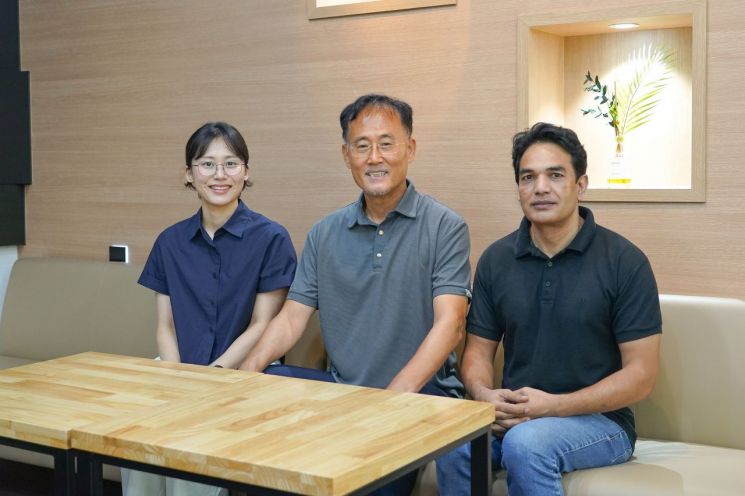 (From left) Youngin Choi, student of Electrical, Electronics and Computer Engineering, Professor Heungno Lee, and Researcher David Samuel Bhatti. Provided by GIST
On July 15, the Gwangju Institute of Science and Technology (GIST) announced that the research team led by Professor Heungno Lee from the Department of Electrical, Electronics and Computer Engineering has developed a new concept computational spectrometer technology. This technology combines an artificial intelligence (AI) reconstruction algorithm with an ultra-compact sensor based on a multilayer thin-film filter, which was first introduced in 2022. As a result, it can reconstruct precise spectral information from a single image capture.
The research team previously demonstrated, through a study published in Scientific Reports, the feasibility of implementing single-shot computational spectrometer hardware by integrating a multilayer thin-film filter structure?fabricated with semiconductor-level precision?with a CMOS sensor*. This device was able to precisely reconstruct the 500?850 nm spectrum from a single image capture.
In this latest study, the team advanced their work by precisely designing the AI reconstruction algorithm and optimizing the entire system, significantly improving both measurement accuracy and processing speed. Notably, by compressively measuring optical signals at the filter level and then reconstructing the full spectrum using AI, they achieved a hardware-software integrated structure. This enables high-precision wavelength analysis without mechanical scanning, thereby completing a hyperspectral fusion technology.
With this, the team has simultaneously achieved high precision, low power consumption, and miniaturization that surpass the limitations of conventional spectrometers, and has specifically demonstrated the potential for application as a next-generation optical sensor platform for mobile devices and field diagnostic sensors.
A spectrometer is a core analytical instrument that non-invasively identifies the composition, structure, and state of materials by analyzing the unique wavelength characteristics exhibited when matter interacts with light. It is an essential tool for accurate and rapid analysis in various fields, including medical diagnostics, food quality inspection, environmental pollution monitoring, and art authentication.
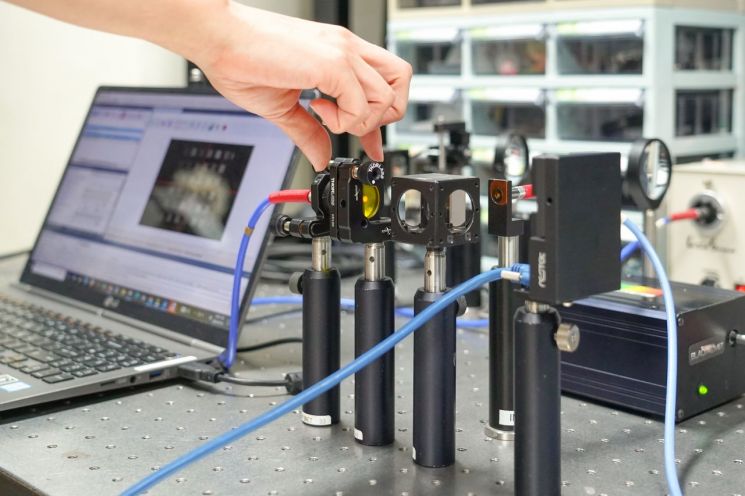 Proposed spectrometer experimental setup and sensor prototype (measurement environment with precisely aligned light source, filter array, and detector array).
However, conventional high-resolution spectrometers require large and heavy mechanical components for precise wavelength analysis, and their complex structures and lengthy measurement times have posed significant challenges for real-time, on-site applications. To be suitable for portable or mobile sensors, it is necessary to achieve miniaturization, real-time operation, and low cost simultaneously. To date, computational spectrometers under development have faced commercialization challenges due to limitations in reconstruction accuracy and filter resolution.
To address this, the research team proposed a new computational spectrometer architecture that combines an ultra-compact filter sensor based on multilayer thin-film filters with a U-Net-based AI reconstruction algorithm, and demonstrated its performance experimentally. The team designed 36 different filters by combining titanium dioxide and silicon dioxide thin films with different refractive indices, arranged them in a 6×6 array, and mounted them on a commercial CMOS image sensor.
The resulting sensor can disperse and measure wavelength information in the 500?850 nm range by filter unit from a single image capture. U-Net is an AI deep learning model architecture specialized for image segmentation, which restores input images to high-resolution outputs through its U-shaped encoder-decoder structure. It is widely used in medical image analysis and optical signal reconstruction.
The measured image signals are reconstructed into the full spectrum using a deep learning model that applies residual connections to the U-Net architecture. This model, trained on 3,223 real spectral data samples, enables faster and more precise reconstruction than conventional optimization-based methods and achieved a high accuracy with a root mean square error (RMSE) of 0.0288 in the 500?850 nm wavelength range.
Furthermore, by implementing a non-scanning structure that measures the full spectrum with a single shot, the team increased measurement speed. The high compatibility with CMOS sensors also secures the potential for miniaturization, mass production, and low-power operation, making commercialization feasible.
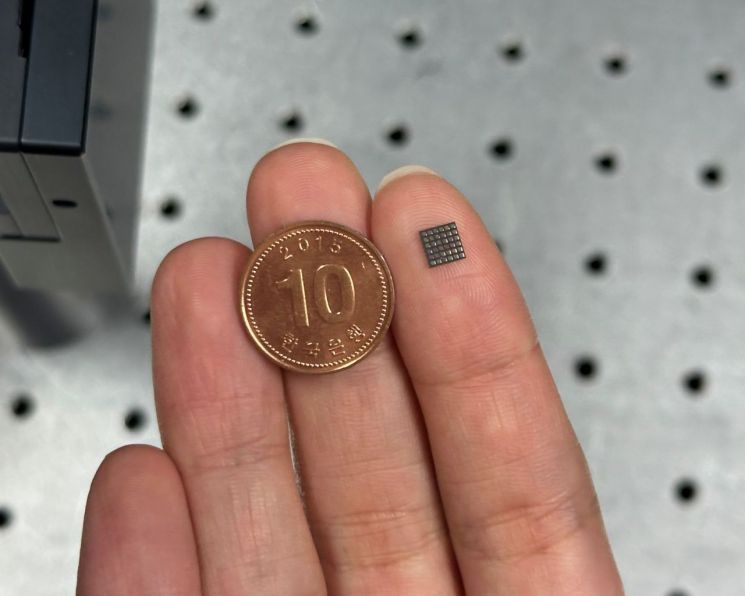
The research team also confirmed the structural uniformity and high manufacturing yield of the multilayer thin-film filters using a scanning electron microscope. The overall sensor size was reduced to 4.5×4.5 mm², achieving a level of miniaturization that allows direct integration into mobile devices, wearable devices, and field diagnostic platforms.
This technology is attracting attention as a next-generation precision optical sensor platform that can be applied in various fields such as mobile medical diagnostics, food safety inspection, counterfeit document detection, and real-time environmental monitoring. At the same time, as an AI-based optical technology, it is expected to become a key foundational technology that drives a paradigm shift in the optical industry.
Professor Heungno Lee stated, "This research is a case where we have simultaneously enhanced the precision and efficiency of computational spectrometers by integrating ultra-compact hardware with AI algorithms. In the future, if combined with large language models (LLMs), users could scan their health status or food quality with a hyperspectral camera embedded in a smartphone and receive real-time guidance in natural language, enabling a new user experience."
© The Asia Business Daily(www.asiae.co.kr). All rights reserved.
![Clutching a Stolen Dior Bag, Saying "I Hate Being Poor but Real"... The Grotesque Con of a "Human Knockoff" [Slate]](https://cwcontent.asiae.co.kr/asiaresize/183/2026021902243444107_1771435474.jpg)

















