President Lee Presides Over Cabinet Meeting on July 15
On Medical Students' Full Return: "A Fortunate Development... I Hope They Deeply Consider Their Social Responsibility"
Partial Amendment to the Commercial Act to Strengthen Minority Shareholder Rights Passed... "3% Rule" to Take Effect in One Year
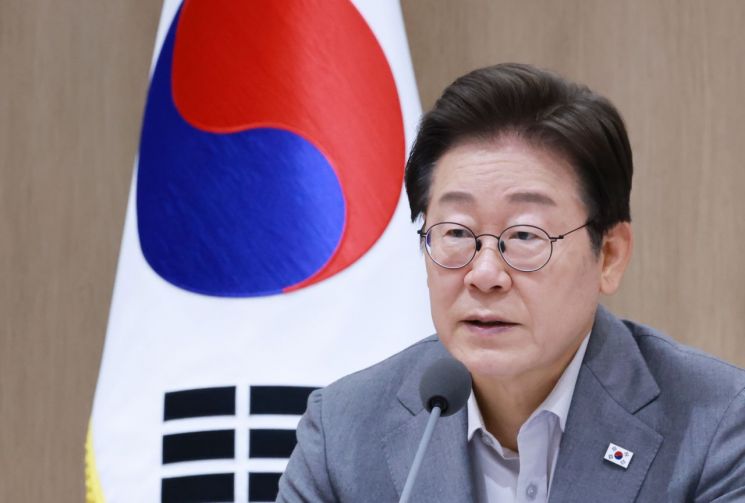
On July 15, President Lee Jaemyung indicated during a Cabinet meeting that the government would continue to play an active fiscal role next year. To this end, he instructed each ministry to boldly adjust wasteful expenditures. Regarding the full return of medical students, he said it was "a fortunate development," but also urged them to "think deeply about what social responsibility means." Following President Lee's remarks, the Cabinet passed a partial amendment to the Commercial Act aimed at strengthening the rights of minority shareholders.
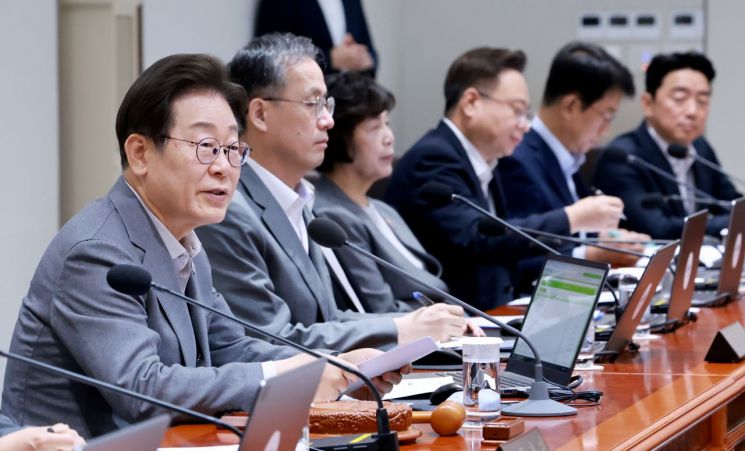
In his opening remarks at the Cabinet meeting held at the presidential office in Yongsan, President Lee stated, "The circumstances surrounding our economy are not easy, and the private sector's fundamentals have been significantly depleted, so I believe the government's active fiscal role will remain very important next year." However, he also analyzed, "There is not much fiscal leeway in the national budget." He added, "I ask each ministry to boldly adjust budgets that are habitual, inefficient, or wasteful, and to broadly reflect public opinion in the budget formulation process to ensure efficient budget planning."
President Lee welcomed the recent announcement by medical students to return to their studies. He said, "It is fortunate that medical students have decided to return to their studies. Although it is late, it is truly a welcome development, and I ask the education authorities to swiftly implement the necessary follow-up measures."
President Lee continued, "I urge medical students, as future healthcare professionals responsible for the health and lives of our people, to think more deeply about what social responsibility means." He also explained, "Relevant departments should quickly and thoroughly devise measures to address gaps in regional healthcare, essential medical services, and emergency medical care, which are public goods." He further added, "Although no one can be blamed, I hope that from now on, dialogue can proceed smoothly in all areas, and I ask the authorities to maintain close communication with medical professionals."
Medical students had launched a collective leave of absence in February last year after the government announced a plan to increase the medical school quota by 2,000. The government subsequently proposed measures such as exemption from academic probation, additional national exams, and a fundamental review of the medical school quota, but the students did not return. However, on July 12, the Korean Medical Student Association (KMSA), a group representing medical students, issued a statement declaring their return after one year and five months.
On this day, the Cabinet also approved a partial amendment to the Commercial Act. The amendment includes: ▲ codifying directors' duty of loyalty to both the company and shareholders ▲ changing the title of outside directors in listed companies to independent directors and expanding the mandatory appointment ratio ▲ limiting the voting rights of major shareholders and related parties to 3% when electing audit committee members (the "3% rule") ▲ requiring listed companies above a certain size to hold electronic general meetings of shareholders.
The provision expanding directors' duty of loyalty from the company alone to "the company and shareholders" will take effect immediately upon promulgation by the government. From that point, directors of corporations must protect the interests of all shareholders and treat them fairly when performing their duties. Previously, decisions favoring minority major shareholders during physical division or mergers could be made without legal consequences, but going forward, such actions may constitute criminal breach of trust under the Criminal Act.
The so-called 3% rule will take effect one year after promulgation. The provision limiting the voting rights of major shareholders and their related parties to 3% when electing outside directors to the audit committee was the main point of contention between the ruling and opposition parties. The opposition party, the People Power Party, initially opposed it, citing difficulties for businesses, but agreed after announcing a "forward-looking review" on June 30. However, the introduction of cumulative voting and separate election of audit committee members will be discussed at a later date.
The provision changing the title of outside directors in listed companies to independent directors and expanding the mandatory appointment ratio from one-fourth to one-third will take effect one year after promulgation. Companies must meet these requirements within one year of the effective date. As of this day, listed companies must comply with the new independent director ratio within two years. The provision introducing electronic general meetings of shareholders is scheduled to take effect on January 1, 2027.
This amendment to the Commercial Act is also the first bipartisan legislative achievement of the Lee Jaemyung administration. The amendment had passed the National Assembly in March, led by the Democratic Party, but was scrapped at the Cabinet meeting due to the exercise of the right to request reconsideration (veto) by former Acting President and Prime Minister Han Ducksoo. However, after President Lee's inauguration, the Democratic Party prioritized re-legislation, and the bill passed the National Assembly plenary session again on July 3.
On this day, the Cabinet also reviewed 14 presidential decrees and 16 bills for promulgation. The amendments to presidential decrees included provisions requiring registration with the Financial Services Commission for those wishing to engage in loan brokerage using a loan brokerage system, and strengthening capital requirements for loan businesses, as stipulated in the "Partial Amendment to the Enforcement Decree of the Act on Registration of Loan Businesses and Protection of Financial Users." Among the amendments, the Ministry of National Defense's organizational restructuring proposal was put on hold.
In addition, the Cabinet passed a partial amendment to the Martial Law Act, which includes: ▲ removing residence and movement restrictions from the list of special measures that the martial law commander can impose in emergency martial law areas ▲ prohibiting any acts that obstruct National Assembly members and staff from entering the National Assembly after martial law is declared, with violations punishable by imprisonment or detention for up to five years. The amendment to the Martial Law Act will take effect immediately upon promulgation.
Meanwhile, the National Fire Agency, Korea Meteorological Administration, and Korea Forest Service, which were not among the ministries attending the Cabinet meeting, gave work reports. President Lee plans to summon the heads of affiliated agencies for work reports as needed.
© The Asia Business Daily(www.asiae.co.kr). All rights reserved.
![Clutching a Stolen Dior Bag, Saying "I Hate Being Poor but Real"... The Grotesque Con of a "Human Knockoff" [Slate]](https://cwcontent.asiae.co.kr/asiaresize/183/2026021902243444107_1771435474.jpg)
















