Trump Says He Is "Disappointed in Putin"... Shifts Position
New Sanctions Against Russia Amid Stalled Peace Talks
Plans to Provide Ukraine with Patriot Missiles and Other Weapons
U.S. President Donald Trump has pledged large-scale military aid to Ukraine and warned that he will impose additional sanctions, including a "secondary tariff" of up to 100%, if Russia does not agree to a ceasefire within 50 days. President Trump, who had declared during his presidential campaign that he would "end the war within 24 hours of taking office," has introduced a new set of sanctions against Russia after nearly six months of stalled peace negotiations regarding the war in Ukraine.
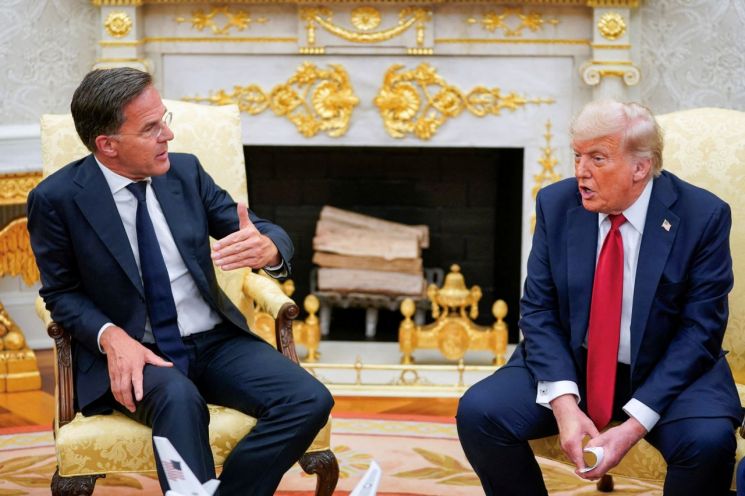
On July 14 (local time), President Trump told reporters at the White House during a meeting with Mark Rutte, Secretary General of the North Atlantic Treaty Organization (NATO), "I am disappointed in President (Vladimir) Putin of Russia," adding, "Even just two months ago, I thought we could reach an agreement, but that did not happen."
He stated, "If an agreement is not reached within 50 days, we will impose very harsh tariffs," and explained that countries trading with Russia would face tariffs of "about 100%, which is called a secondary tariff."
This means that if Russia does not agree to a ceasefire, countries or companies trading with Russia will be subject to secondary tariffs of up to 100%, effectively isolating Russia from global trade. Countries importing Russian energy, such as crude oil, are expected to be subject to these secondary tariffs. However, President Trump did not specify the details of the secondary tariffs.
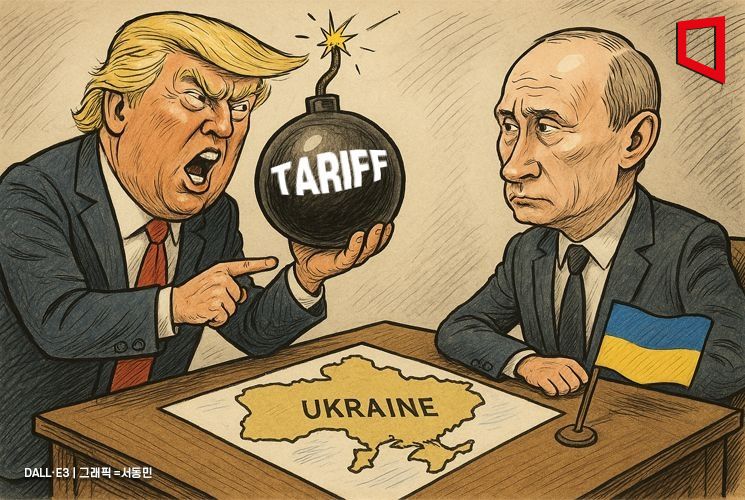
President Trump also made it clear that he intends to provide Ukraine with advanced weaponry, including the Patriot air defense system.
He said, "We will not purchase (the weapons), but we will manufacture them," adding, "State-of-the-art equipment, including the Patriot missile system, will arrive within a few days." He also stated that the cost of supplying these weapons would be borne by NATO member countries, not the United States. President Trump emphasized, "We signed an agreement with NATO today," and "Under the agreement signed today, NATO will cover the costs."
This approach, in which NATO member countries in Europe?who feel threatened by Russia's invasion of Ukraine?purchase and supply the weapons, rather than the United States directly bearing the costs, is consistent with President Trump's previous position. At the recent NATO summit, President Trump secured a pledge from member states to increase their annual defense spending from 2% to up to 5% of their gross domestic product (GDP), and this measure is in line with that commitment.
This marks a significant shift from the previous policy, which had been passive regarding military aid to Ukraine. President Trump had long claimed, based on his personal rapport with President Putin, that he could end the war within 24 hours of taking office. After his inauguration, he did not hesitate to defend Russia, the aggressor, while criticizing Ukraine, the victim. However, as peace negotiations failed to bear fruit due to President Putin's uncooperative stance, President Trump appears to have changed his position.
At a White House faith office luncheon held later that afternoon, President Trump reiterated his frustration with President Putin, saying, "There were several times when I thought the negotiations were settled. Even when I went home, I told the First Lady, 'I had a great conversation with Putin, and it's over now,' but she would say, 'Wow, that's strange. I just heard Russia bombed a (hospital) nurse...'"
The New York Times (NYT) commented, "President Trump has now acknowledged that it is difficult to end the war in Ukraine," and noted, "After years of making favorable assessments of Russia's leader, he abruptly changed his stance as his frustration grew over the lack of progress toward a ceasefire."
© The Asia Business Daily(www.asiae.co.kr). All rights reserved.
![Clutching a Stolen Dior Bag, Saying "I Hate Being Poor but Real"... The Grotesque Con of a "Human Knockoff" [Slate]](https://cwcontent.asiae.co.kr/asiaresize/183/2026021902243444107_1771435474.jpg)
















