Democratic Party Environment and Labor Committee Meets with Six Major Economic Organizations
Ruling Party: "Business Community Fails to Propose Solutions"
Likely to Pass During July Extraordinary Session of the National Assembly
The Democratic Party of Korea on July 14 hinted at the possibility of passing the amendment to Articles 2 and 3 of the Trade Union Act (commonly known as the Yellow Envelope Act) during the July extraordinary session of the National Assembly, despite requests from the business community to slow down the process, stating, "There is not much time left."
Kim Jooyoung, a Democratic Party lawmaker and ruling party secretary of the National Assembly's Environment and Labor Committee, met with reporters after the "Democratic Party Environment and Labor Committee-Economic Six Organizations (Korea Employers Federation, Korea Chamber of Commerce and Industry, Federation of Korean Industries, Korea International Trade Association, Korea Federation of SMEs, Korea Federation of Middle Market Enterprises) Labor Policy Meeting" held at the Korea Employers Federation building in Mapo-gu, Seoul, that afternoon. He said, "It is difficult to specify the exact timing for handling the Yellow Envelope Act, but within the Democratic Party, the debate over this bill has already been largely settled."
The Yellow Envelope Act seeks to limit excessive damage claims against striking workers and expands the definition of "employer" to grant indirect employment (platform and subcontracted) workers the right to negotiate directly with the principal employer. It also includes provisions to broaden the scope of labor disputes to ensure the protection of legitimate industrial actions.
According to Kim, the business community expressed significant concerns about the ambiguity of the "employer" definition during the meeting, but failed to present any concrete alternatives. He stated, "The business community raised many concerns about the concept of 'employer,' but even among themselves, they admitted there were few viable solutions. They have not yet found an answer."
When asked whether additional meetings would be held to further reflect the business community's position, Kim replied, "Unless there is some progress, there may not be further meetings, since even the business organizations have not found an answer regarding the definition of 'employer'." This suggests that revisions to the Yellow Envelope Act's provisions will be difficult until an acceptable solution is proposed.
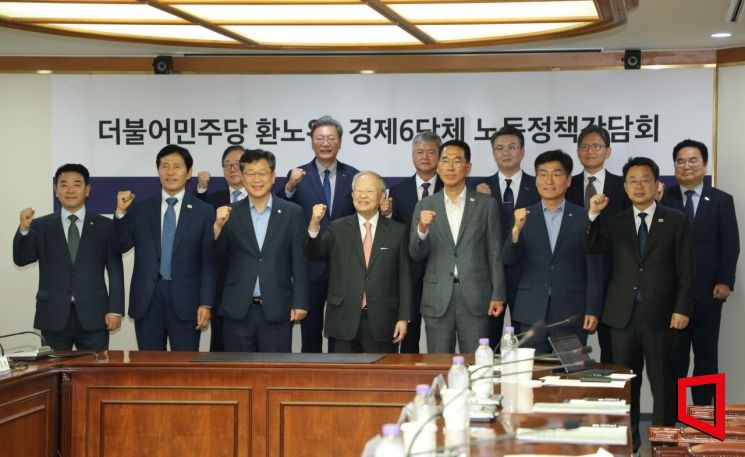
Previously, Ahn Ho-young, the Democratic Party lawmaker and chairperson of the Environment and Labor Committee, stated in his opening remarks, "It is the responsibility of the committee to come up with reasonable and swift alternatives that can be accepted by the business community, labor, and the public alike," adding, "Through continued communication and consultation, we will work to expand social consensus and create mutually beneficial solutions."
However, the business community maintains its opposition, arguing that the Yellow Envelope Act could cause confusion at industrial sites. Sohn Kyungshik, chairman of the Korea Employers Federation, previously expressed concern in his opening remarks, saying, "Even if hundreds of subcontractor unions demand negotiations, the principal employer cannot respond to each case individually, which would plunge industrial sites into a state of extreme confusion."
He also appealed, "The amendment stipulates that liability for damages will be determined based on the degree of involvement, such as the reason for fault and contribution of each participant in the illegal act. However, in reality, when a strike occurs, unions may occupy workplaces, wear masks, or cover CCTV cameras to commit illegal acts, making it difficult for employers to prove the individual illegal acts of union members."
He particularly emphasized, "The amendment to the Trade Union Act is not simply a matter of revising a law, but a significant change that could bring enormous disruption to our labor-management relations." He urged that, rather than rushing to implement the Yellow Envelope Act, the process should be slowed down to allow for social dialogue and to ensure that all agreements between labor and management are reflected.
© The Asia Business Daily(www.asiae.co.kr). All rights reserved.
![Clutching a Stolen Dior Bag, Saying "I Hate Being Poor but Real"... The Grotesque Con of a "Human Knockoff" [Slate]](https://cwcontent.asiae.co.kr/asiaresize/183/2026021902243444107_1771435474.jpg)















