A Large Number of Chonnam National University and Chosun University Medical Students Subject to Repeating a Year
Supplementary Classes Planned; Concerns Over Internal Conflict With Existing Students
"Academic Flexibility Under Consideration According to Ministry of Education Guidelines"
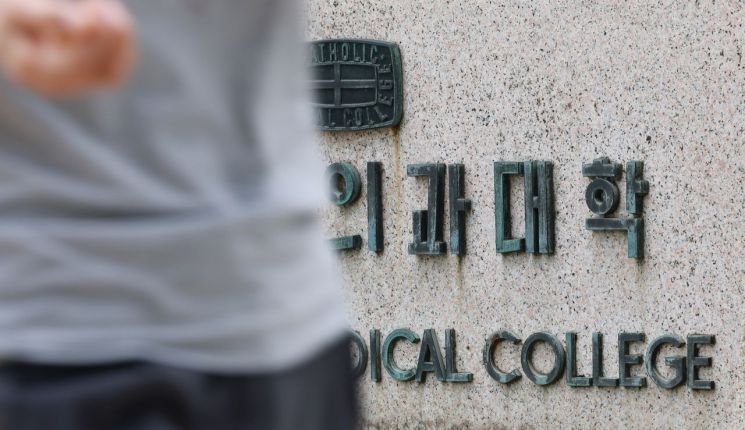 Medical students who had been away from school for nearly a year and a half suddenly declared their return, and on the 13th at a medical school in Seoul. Photo by Yonhap News
Medical students who left school in February last year in protest against the government's policy to increase medical school admissions have declared their full return after 17 months, raising expectations that the long-standing conflict between doctors and the government may finally come to an end.
However, in order to allow students who are subject to repeating a year after missing classes during the first semester to return to school, measures such as academic flexibility are necessary. Additionally, concerns are being raised about fairness compared to students who have already returned.
According to local universities on July 14, Chonnam National University Medical School classified about 330 pre-medical students (89%) and 183 medical students (51%) out of a total of 737 enrolled students as subject to repeating a year. At Chosun University Medical School, 223 out of 878 enrolled students are on a leave of absence. However, a significant number of enrolled students have also been classified as subject to repeating a year due to insufficient attendance days.
For third- and fourth-year students, whose curriculum is mainly focused on clinical practice, they are required to complete 52 weeks of practical training. If they do not attend at least twice a week, they are subject to repeating a year. For other grades, if students do not attend more than a quarter of the total class days, they receive an F grade and may be required to repeat the year.
Chonnam National University and Chosun University medical schools have decided, according to their academic regulations, to determine academic actions such as repeating a year or expulsion for students who did not attend classes at the end of the academic year.
Previously, on July 12, the Korean Medical Students Association (KMSA) held a joint press conference at the Korean Medical Association building in Yongsan-gu, Seoul, together with the National Assembly's Health and Welfare Committee, the Education Committee, and the Korean Medical Association. They stated, "We will trust the National Assembly and the government and do our best to ensure that all students return to school and that the medical education and healthcare system are normalized." They also called for "comprehensive measures to be prepared so that medical students can return to education through the normalization of the academic calendar."
Medical schools are expressing difficulties in response to the students' sudden declaration of return. Ultimately, for medical students to return and keep up with classes, they will need to return from the second semester, but will have to delay graduation or make up for missed classes during vacations to catch up with the required number of class days.
Since the academic calendar for medical schools is fundamentally based on a one-year system, it is structurally difficult for students who lack the required number of class days in the first semester to immediately return and participate in classes from the second semester.
Therefore, universities need to urgently organize supplementary classes to help students make up for what they missed. This could start during the upcoming summer vacation, or students could take the second semester classes together with those who have already returned and make up for missed courses during subsequent vacations. Some universities have expressed their intention to expand class capacity to accommodate returning students, but in reality, there are limits to hiring more faculty or securing more classrooms.
In addition, as the return of medical students becomes full-scale, there are concerns about internal conflicts with some students who had already returned and continued their studies. If returning students are given various privileges, these conflicts could intensify. There is also the issue of fairness, with criticism that preferential measures may be taken only for returning medical students within the university.
The Ministry of Education has not yet officially announced whether academic flexibility or special measures will be applied to returning medical students. Each university plans to prepare response measures for medical schools nationwide according to the Ministry's guidelines.
An official from a local medical school said, "It is still difficult to say anything specific regarding the return of medical students," and added, "We need to wait for the Ministry of Education's decision on the timing of return and academic flexibility."
© The Asia Business Daily(www.asiae.co.kr). All rights reserved.

















