Korea Christian Federation Holds 140th Anniversary Symposium
Over 150 Attendees Including Church Leaders and Various Figures
"Early Missions Contributed to Modernization through Education and Medicine"
"Public Roles Fulfilled in Welfare, Democratization, and Missions"
Participants in the "140th Anniversary Symposium of Korean Christianity," hosted by the Korea Christian Federation, organized by the 140th Anniversary Commemoration Committee of Korean Christianity, and sponsored by the Ministry of Culture, Sports and Tourism, shared these impressions. The event was held on the 20th floor Press Club of the Korea Press Center at 10 a.m. on the 14th, attended by over 150 people, including Korean church leaders, theology university professors, and various figures.
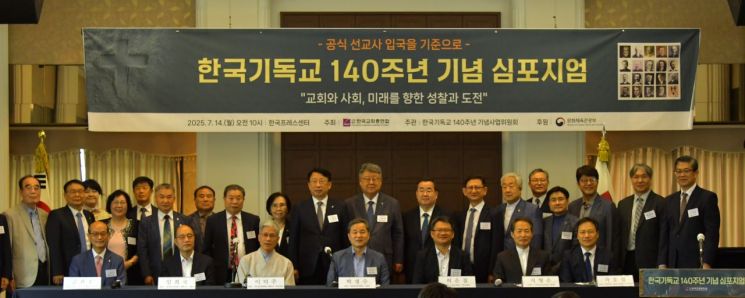 On the 14th at 10 a.m., the "140th Anniversary Symposium of Korean Christianity" was held on the 20th floor Press Club of the Korea Press Center, attended by over 150 people including Korean church leaders, theology university professors, and various figures. Korea Christian Federation
This year marks the 140th anniversary since April 5, 1885, when Horace G. Underwood, a missionary from the American Northern Presbyterian Church, and Henry G. Appenzeller, a missionary from the Northern Methodist Episcopal Church, officially entered Joseon to spread the gospel. This symposium is part of the "140th Anniversary of Korean Christianity" commemorative project that began in March. In March and May, tours of modern Christian cultural heritage sites were held; on April 20, the Easter KBS documentary "Miracle, Toward People" was produced and aired; and on April 23, the original cantata "Chronicles of Light" was performed.
At the opening ceremony of the first part of the symposium, Kim Younggeol, co-representative president, delivered congratulatory remarks, stating, "The light of the gospel, which began with the official entry of missionaries 140 years ago, established the values of freedom and democracy by eliminating discrimination and promoting love and equality according to God's order of creation. This became the foundation for the restoration of national sovereignty and the founding of the free Republic of Korea. I hope that the Korean church will once again embrace the legacy of faith through the gospel and vigorously move toward the future."
The symposium was moderated by Park Kyungsoo, professor at Presbyterian University and Theological Seminary. In the first presentation, Lee Deokjoo, emeritus professor at Methodist Theological University, explained the theological and historical basis of the 140th anniversary of Korean Christianity, stating, "After King Gojong granted permission for missionary work for medical and educational purposes on July 2, 1884, Korean Christian missions began with the arrival of Methodist missionary Appenzeller and Northern Presbyterian missionary Underwood on Easter, April 5, 1885."
In the second presentation, Lim Heeguk, emeritus professor at Presbyterian University and Theological Seminary, summarized, "The 140 years of Korean Christianity have been a history of public theology and social responsibility." He emphasized that, "Early missions contributed to the modernization of this land through education and medicine, took a leading role in the March 1st Movement and the establishment of the Provisional Government, and the Presbyterian Church constitution contains the principles of a democratic republic and representative democracy, which became the foundation for the development of democracy in Korean society."
In the third presentation, Kim Panho, president of Youngsan Theological Institute, stated, "For 140 years since the arrival of Appenzeller and Underwood, Korean Christianity has grown while fulfilling public roles in various fields such as education, medicine, social welfare, democratization, and missions." He further evaluated that, "Especially, the revival and Pentecostal movement in the mid-20th century, charismatic leadership, expanded lay participation, and the shift from 'receiving' to 'sending' missions established the church as an influential presence in both the nation and the world."
During the discussion, Professor Heo Euncheol, in response to Professor Lee Deokjoo's presentation, raised questions about whether the concept of nationhood can remain a core category in church history interpretation even in a post-national era, and why the historical evaluation that Christianity contributed to Korea's modernization is not widely shared in today's society. Professor Kwak Hocheol, commenting on Professor Kim Panho's presentation, questioned whether, in the digital age, the church should move away from a senior-centered hierarchical leadership and instead adopt a generationally integrated leadership that expands youth-led project management and youth participation in order to effectively connect with the next generation.
The Korea Christian Federation plans to compile the manuscripts and proposals presented at the symposium and provide them to member denominations and churches nationwide by the end of July.
Participants pledged to commemorate the 140th anniversary of Korean Christianity by striving to recover the essence and mission of the gospel and to become a Korean church that shines as the light of the world.
© The Asia Business Daily(www.asiae.co.kr). All rights reserved.
![Clutching a Stolen Dior Bag, Saying "I Hate Being Poor but Real"... The Grotesque Con of a "Human Knockoff" [Slate]](https://cwcontent.asiae.co.kr/asiaresize/183/2026021902243444107_1771435474.jpg)















