Trade Surplus Rises on Strong First-Half Exports
FT: "Companies Rushed Exports During Tariff Grace Period"
Speculation Grows That Trump May Escalate Trade Negotiations
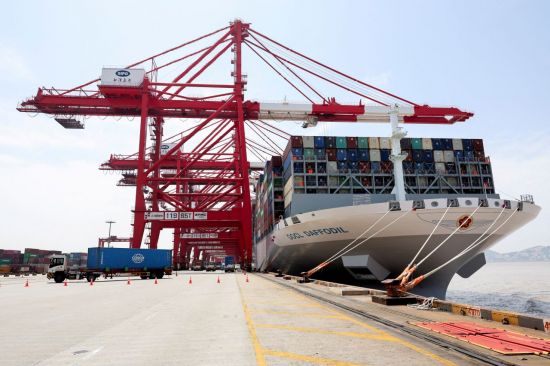 On the 17th of last month (local time), a container export ship was docked at a port near Shanghai, China. Photo by Reuters Yonhap News
China recorded a 5.8% year-on-year increase in exports in June, resulting in the largest trade surplus ever for the first half of the year. While the Chinese government assessed that China's trade made "progress" despite external pressure, some analysts pointed out that Chinese companies rushed exports during the tariff grace period granted by U.S. President Donald Trump.
According to Bloomberg and the UK’s Financial Times (FT) on July 14, China’s export value in June reached $325 billion (approximately 449 trillion won), up 5.8% from the same period last year. The export growth rate exceeded the forecasts of both Bloomberg and Reuters experts, and also surpassed the previous month’s (May) growth rate of 4.8%. During the same period, import growth was limited to 1.1%.
For the first half of the year (January to June), cumulative exports totaled $1.81 trillion, marking the largest amount in the past decade since 2015. Accordingly, the trade surplus for the same period also reached a record high of $586 billion, according to Bloomberg.
Wang Lingjun, Deputy Director General of China’s General Administration of Customs, stated at a press conference that “China’s trade made progress in the first half of the year despite pressure,” adding, “However, we must also recognize that unilateralism and protectionism are spreading worldwide, and that the external environment is becoming more complex, severe, and uncertain.”
Exports to the United States continued to decline, but some of the losses were offset by increased exports to ASEAN (Association of Southeast Asian Nations) countries. In fact, exports to the U.S. in June fell by 16.1%, while exports to the ten ASEAN countries increased by 17% compared to the previous year. FT analyzed that this was the result of Chinese companies shipping goods in advance before the final agreement deadline in August.
FT added that this strong trade performance in the first half of the year could prompt the U.S. administration under Donald Trump to further increase pressure on China and Southeast Asian countries known as so-called "origin-washing" countries.
Previously, President Trump made it clear that tariffs would take effect starting August 1. A 50% tariff is planned for copper imports, and additional item-specific tariffs may be introduced. During trade negotiations, the U.S. has also proposed regulations on transshipped products passing through third countries. For example, under the trade agreement with Vietnam, a 20% tariff was imposed on Vietnamese imports, while transshipped goods were subject to double that rate at 40%.
Meanwhile, China’s second-quarter gross domestic product (GDP) announcement is also scheduled for this week. According to a Reuters expert survey, GDP is expected to have increased by 5.1% compared to the same period last year.
© The Asia Business Daily(www.asiae.co.kr). All rights reserved.
![Clutching a Stolen Dior Bag, Saying "I Hate Being Poor but Real"... The Grotesque Con of a "Human Knockoff" [Slate]](https://cwcontent.asiae.co.kr/asiaresize/183/2026021902243444107_1771435474.jpg)















