KITA Releases Report on "Export Competitiveness of the Data Center Industry"
Global Data Center Investment Growth Rate Surges
Korea Needs to Target Niche Markets
Urgent Need for Pan-Government Support, Including Designation as a Strategic Industry
As the commercialization of generative artificial intelligence (AI) technology accelerates, global demand for data centers is surging. In this context, some experts argue that data centers based on a high-efficiency, eco-friendly, and self-sustaining ecosystem should be fostered as a strategic export industry.
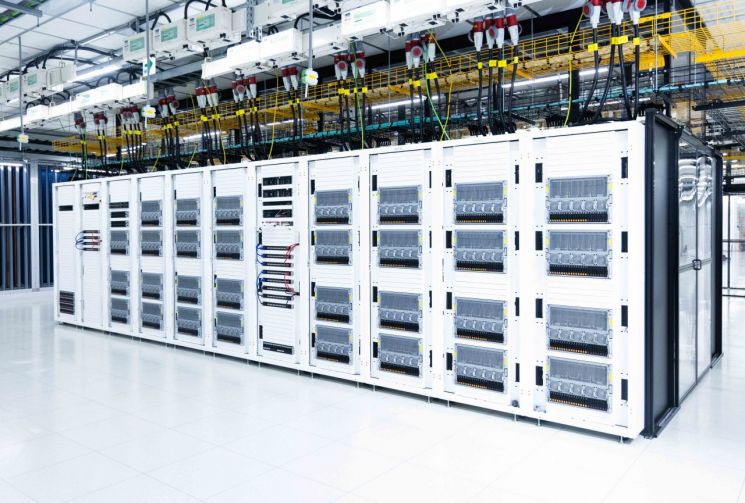
On July 14, the Korea International Trade Association's Institute for International Trade and Commerce published a report titled "Measures to Strengthen Export Competitiveness and Implications for the Data Center Industry Triggered by AI," making this argument.
According to the report, from 2003 to 2021, major global companies' investments in data centers increased at an average annual rate of 21.1%. After generative AI became a major topic in 2022, the average annual growth rate soared to 169.4%. The global data center market is also projected to grow from $372.8 billion in 2023 to $624.1 billion in 2029, a 67.4% increase.
Recognizing this trend, major countries are actively implementing policies to foster their data center industries. The United States has designated data centers as national security facilities and is promoting policies to introduce next-generation energy sources such as small modular reactors (SMRs) to ensure stable power supply. In Japan, the Ministry of Economy, Trade and Industry operates a fast-track system that integrates and coordinates data center location, power supply, and technology demonstration. Vietnam and China are also actively attracting data centers by easing regulations, such as allowing 100% foreign ownership of businesses.
In contrast, according to the OCI database, South Korea ranks 22nd in the world in terms of the number of data centers, 29th in data center investment over the past five years ($400 million), and 10th in attracting domestic investment ($8.5 billion).
The report also identified several weaknesses in South Korea's data center industry: the concentration of data centers in the Seoul metropolitan area is increasing the burden on the power grid; energy efficiency and the use of domestically produced equipment are low; and support for data centers in terms of tax incentives and site selection is insufficient. To overcome these limitations, the report suggested that a strategic approach focusing on the strengths of Korean companies?AI semiconductors, power infrastructure, and cooling systems?is needed.
It also emphasized that eco-friendly hyperscale (ultra-large) data centers for high-power computing, as well as edge (small-scale) data centers based on low-power AI chip neural processing units (NPUs), which are a core technology of domestic startups, are promising niche markets to target.
In addition, the report recommended shifting from hardware infrastructure exports to an integrated service export structure that encompasses design, operation, and maintenance. Other proposals included designating data centers as a "digital export strategic industry and infrastructure," establishing a pan-government control tower, designating national strategic technology commercialization facilities and raising tax credit rates, building export-oriented standard models, and creating eco-friendly clusters outside the Seoul metropolitan area.
Jinsil Moo, Senior Research Fellow at the Korea International Trade Association, stated, "Data centers are a high value-added industry that can drive the export of the entire ecosystem, including cloud and AI services, integrated infrastructure for design, construction, and operation, and related components such as semiconductors, cooling equipment, and power devices." He emphasized, "We must recognize data centers as strategic security assets and work to secure export competitiveness."
© The Asia Business Daily(www.asiae.co.kr). All rights reserved.
![Clutching a Stolen Dior Bag, Saying "I Hate Being Poor but Real"... The Grotesque Con of a "Human Knockoff" [Slate]](https://cwcontent.asiae.co.kr/asiaresize/183/2026021902243444107_1771435474.jpg)















