Kim Yoonduk, Nominee for Minister of Land, Infrastructure and Transport, Served on the 19th and 21st National Assembly Land Committees
Established Legal Basis for Metropolitan Transportation Support Beyond Special and Metropolitan Cities
Kim Yoonduk, a Democratic Party lawmaker nominated as the first Minister of Land, Infrastructure and Transport in the Lee Jaemyung administration, previously served as a member of the National Assembly's Land, Infrastructure and Transport Committee during the latter half of the 19th National Assembly and the first half of the 21st National Assembly. During his tenure, he introduced several bills aimed at regional development. As the new administration emphasizes 'balanced national development' as a core function of the Ministry of Land, Infrastructure and Transport, there is growing interest in whether Kim, as a close aide to the President and a senior ruling party lawmaker, will provide strong momentum for these initiatives.
According to the National Assembly's bill information system on July 14, Kim has sponsored a bill to amend the Special Act on the Management of Metropolitan Transportation in Large Cities during this session. Previously, the installation of roads, railways, transfer facilities, and Bus Rapid Transit (BRT) systems was only possible in metropolitan cities, special cities, or adjacent areas. The key point of Kim's bill is to allow such installations in regions with demand, even if they do not have a metropolitan city.
Jeonju in North Jeolla Province, Kim's constituency, is a prime example. He also expanded the scope of metropolitan transportation facilities to include provincial capitals with populations of over 500,000. Kim's amendment was incorporated into the committee substitute, passed the final vote, and was promulgated in April. The law is set to take effect in October this year.
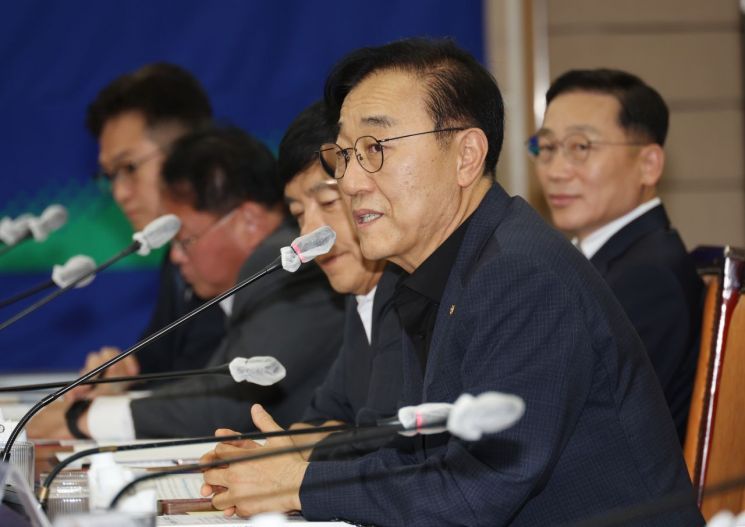 Democratic Party lawmaker Kim Yoonduk (Jeonjugap), nominated as the Minister of Land, Infrastructure and Transport, is speaking at the "Jeonbuk National Assembly Members, Province, and City/County Budget Policy Council" held at Jeonbuk Provincial Office on the 11th. Photo by Yonhap News
The concept of 'Smart Green Industrial Complexes,' which combine advanced technology and eco-friendly elements with existing industrial complexes, is also based on an amendment proposed by Kim during the 21st National Assembly. In 2020, he introduced an amendment to the Act on Industrial Complexes and Development to support the Saemangeum project as it completed its first phase. The following year, Kim proposed a bill to establish a national museum as a way to promote Saemangeum domestically and internationally, thus providing a legal basis for a project that had been underway since 2016. He also passed a bill to clarify the legal basis for the establishment of Korea Land and Geospatial Informatix Corporation, a public corporation headquartered in his district, which had previously been operated under the Framework Act on Spatial Information.
Although not all of his proposals were enacted, Kim also sponsored a bill to amend the Development Gains Recapture Act to introduce a procedure for verifying the appropriateness of fees in development projects, which was ultimately discarded. He also proposed an amendment to the Apartment Housing Management Act to mandate external audits for apartment complexes with fewer than 300 households. In addition, he introduced amendments aimed at reducing inconveniences for people with hearing impairments when using public transportation and at providing housing support for children under 18. These legislative efforts reflect his focus on expanding the government's public role in the land and transportation sectors.
Within political circles, there is considerable interest in how Kim, if appointed as minister, will address the many pressing issues as a 'powerful' lawmaker. During the Democratic Party's primary for the 20th presidential election, Kim was the only lawmaker from North Jeolla Province to support Lee Jaemyung, making him one of the President's closest confidants. Having held key positions within both the party and government, Kim is now expected to play a central role in policy implementation following this cabinet reshuffle. Both inside and outside the government, Kim's appointment is seen as a strategic move to achieve both 'organizational stability' and 'field leadership' within the Ministry of Land, Infrastructure and Transport. He will need to work closely with Lee Sangkyung, the newly appointed First Vice Minister and a former professor, and Kang Heeup, the new Second Vice Minister appointed the previous day, who is a career official from within the ministry.
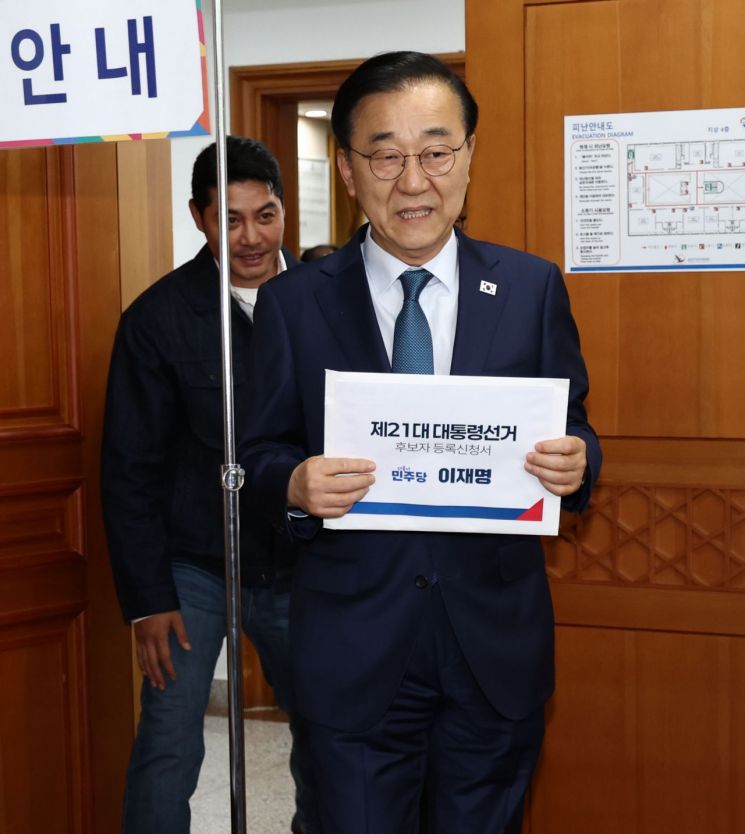 On May 10, Kim Yoonduk, Secretary General of the Democratic Party of Korea, entered the Gwacheon Central Election Commission in Gyeonggi Province to register Lee Jae-myung, then presidential candidate, for the 21st presidential election. Photo by Yonhap News
The land and transportation sector is closely tied to the daily lives of citizens, and there are many urgent issues that need to be addressed. In particular, stabilizing the real estate market is an immediate priority. Amid rising housing prices and the impact of lending regulations (DSR Phase 3 and the June 27 measures), instability persists in the rental market and in the polarization between the capital region and other areas. Given Kim's positive stance on protecting real demand and expanding rental housing during his time as vice chair of the Democratic Party's Housing Welfare Special Committee, it is expected that the Lee Jaemyung administration will strengthen its 'real demand-oriented supply policy.' On July 12, the day after his nomination, Kim stated, "As the housing market in Seoul and some other areas is overheating, I will do my utmost to quickly supply quality housing in preferred locations and ensure stable market management."
In the area of balanced development, Kim is expected to develop detailed policies in line with the 'Five Regions, Three Special Zones' strategy emphasized by President Lee and the National Policy Planning Committee. While he has previously focused on constituency-specific issues, there are now high expectations for nationwide development policies that take into account the unique characteristics of each region. Kim emphasized, "I will actively pursue policies to achieve balanced national development and bridge mobility gaps so that everyone can enjoy a basic quality of life, anytime and anywhere," and added, "To revive the challenging economy, I will work to expand growth engines through advanced industrial complexes and future mobility."
Meanwhile, in March, Kim reported that his spouse owns a 130-square-meter apartment in his constituency. The reported value was 400 million won, while the market price was approximately 462 million won.
© The Asia Business Daily(www.asiae.co.kr). All rights reserved.
![Clutching a Stolen Dior Bag, Saying "I Hate Being Poor but Real"... The Grotesque Con of a "Human Knockoff" [Slate]](https://cwcontent.asiae.co.kr/asiaresize/183/2026021902243444107_1771435474.jpg)

















