Chairperson Lee Hanju Mentions Consideration of Elevating Ministry of Science and ICT to Deputy Prime Minister Level
President Lee Jaemyung's Top Pledge: 100 Trillion Won Investment in AI and More
If Baek Kyunghoon Is Confirmed, Likely to Serve as Deputy Prime Minister
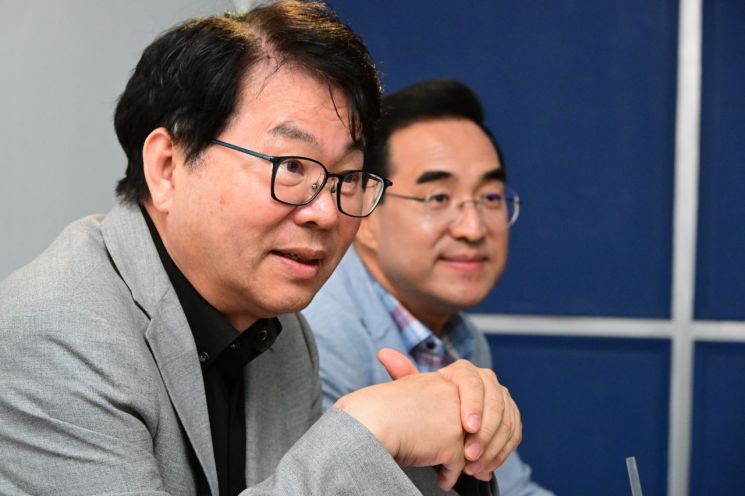
The National Policy Planning Committee is considering a plan to elevate the heads of certain ministries, including the Ministry of Science and ICT, to the position of Deputy Prime Minister. Previously, both inside and outside political circles, there had been discussions about reinstating the position of Deputy Prime Minister for Science and Technology. In this context, Lee Hanju, Chairperson of the National Policy Planning Committee, directly mentioned the reorganization plan involving Deputy Prime Minister positions, confirming that related discussions are underway.
At a press briefing on the 13th, Chairperson Lee stated, regarding the expansion of Deputy Prime Minister positions including the possible creation of a Deputy Prime Minister for Science and Technology, "There have been discussions about reorganizing the Deputy Prime Minister system." President Lee Jaemyung's first major pledge is to invest 100 trillion won in artificial intelligence (AI) and to establish an "AI highway" by building AI data centers, with the goal of making Korea one of the top three AI powers. To support this policy, the committee is discussing reorganizing the Ministry of Science and ICT into a Deputy Prime Minister-level institution. Park Honggeun, head of the planning subcommittee of the National Policy Planning Committee and a member of the Democratic Party, who also attended the briefing, added, "We are reviewing whether the Deputy Prime Minister system is necessary, and if it is established, we are also considering how to make government operations more efficient." The National Policy Planning Committee plans to finalize and announce its reorganization plan within this month.
The introduction of a Deputy Prime Minister for Science and Technology was a campaign pledge made by both ruling and opposition parties during the presidential election. In the Democratic Party, Choi Minhee, Chairperson of the National Assembly's Science, ICT, Broadcasting and Communications Committee, led the proposal of related legislation. Kim Moonsu, the People Power Party's presidential candidate, also promised to introduce a Deputy Prime Minister for Science and Technology. Lee Junseok, the Reform Party's presidential candidate, also stated he would merge the Ministry of Science and ICT with the Ministry of Education and increase the number of Deputy Prime Ministers from two to three.
If Baek Kyunghoon, a former head of the LG AI Research Institute and the nominee for Minister of Science and ICT, is appointed as minister, it is expected that he will concurrently serve as Deputy Prime Minister if the system is reinstated. According to the current Government Organization Act, the Deputy Prime Minister must also serve as a minister. Article 19 stipulates that "the Deputy Prime Ministers shall concurrently serve as the Minister of Economy and Finance and the Minister of Education," respectively. During the Roh Moo-hyun administration, the Deputy Prime Minister for Science and Technology also held the position concurrently as a minister.
From July 2004 to February 2008, Oh Myung and Kim Woosik served as Deputy Prime Ministers for Science and Technology. At that time, the Deputy Prime Minister had authority over the allocation and coordination of the national research and development (R&D) budget, as well as overall science and technology policy. During this period, R&D investment increased rapidly. The government's R&D budget was 6.5154 trillion won in 2003, but rose to 10.8 trillion won in 2008, increasing by more than 10% annually on average. Currently, the National Policy Planning Committee is also pursuing a plan to allocate more than 5% of the government budget to R&D.
Jung Yoon, President of Cheongwoon University, who served as Vice Minister of Science and Technology during the Roh Moo-hyun administration and worked alongside Deputy Prime Minister Kim Woosik, said in an interview with Asia Economy, "In the past, the Deputy Prime Minister for Science and Technology played a strong coordinating role, working across different ministries." He added, "It has been 17 years since the Deputy Prime Minister for Science and Technology system was abolished, but in today's more complex global environment and the era of AI, a strong control tower that can facilitate inter-ministerial cooperation is needed now more than ever."
© The Asia Business Daily(www.asiae.co.kr). All rights reserved.

















