Uncertainty Remains Over Specifying USFK Troop Levels
U.S. Congress Removes Funding Prohibition Clause Since Fiscal Year 2022
As the Donald Trump administration is reportedly reviewing adjustments to the size and role of U.S. Forces Korea (USFK), changes have been made to the provisions regarding USFK in the U.S. Congress’s annual defense budget and policy bill.
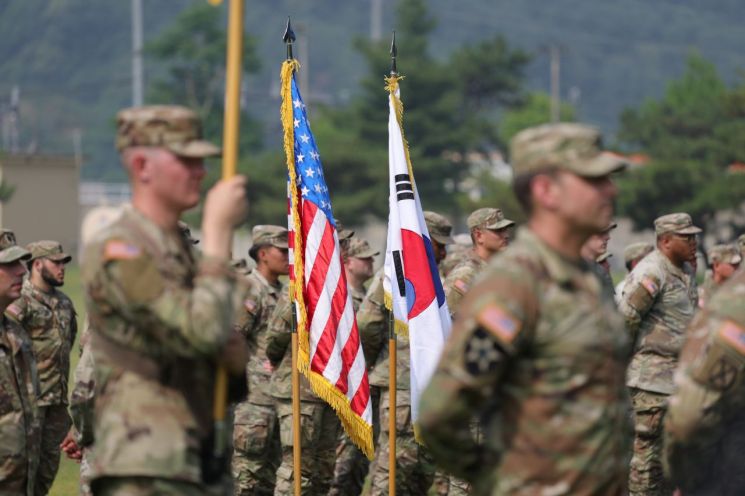
According to the U.S. Senate Armed Services Committee on the 13th (local time), the summary of the National Defense Authorization Act (NDAA) for fiscal year 2026 states that “no reduction of the U.S. military posture on the Korean Peninsula or transfer of wartime operational control to the Combined Forces Command shall be permitted unless the Secretary of Defense certifies to Congress that such actions are in the national interest.” It also instructs the Chairman of the Joint Chiefs of Staff, the Commander of the Indo-Pacific Command, and the Commander of USFK to conduct independent assessments of the risks associated with reducing USFK or transferring operational control. The bill passed the Senate Armed Services Committee on July 9 with 26 votes in favor and 1 against.
The NDAA is an annual bill that authorizes the U.S. Department of Defense’s budget and policies. It must pass both the Senate and the House of Representatives before a unified version is finalized. While the full text of the bill has not yet been released, the provisions regarding USFK described in the summary differ from those in the NDAA enacted under the previous Biden administration.
The NDAA for fiscal year 2025, which passed Congress in December, explicitly stated that it is the sense of Congress that the Secretary of Defense should continue efforts to strengthen U.S. security alliances and partnerships in the Indo-Pacific region. These efforts include “maintaining the current level of approximately 28,500 U.S. troops stationed in Korea, enhancing mutual defense cooperation, and reaffirming the commitment to provide extended deterrence using the full range of U.S. defense capabilities,” as part of strengthening the alliance with Korea. While it did not explicitly prohibit reductions in USFK, it specified the current level of 28,500 troops, emphasizing bipartisan congressional support for the presence of USFK.
It remains to be seen whether the final version of the current bill will specify the size of USFK, but the provisions in this bill are similar to those in the NDAA during the first Trump administration, when concerns about USFK reductions were high. During fiscal years 2019 to 2021, under the first Trump administration, Congress specified the size of USFK and also prohibited the use of NDAA funds for reducing USFK.
At that time, a proviso allowed for reductions only if the Secretary of Defense certified to Congress that such reductions were in the U.S. national interest, would not significantly undermine the security of U.S. alliances in the region, and had been appropriately coordinated with Korea and Japan. However, it was the prohibition on the use of funds?not the Secretary of Defense’s certification?that effectively prevented President Trump from reducing USFK. Therefore, some observers point out that if USFK reductions are permitted solely based on the Secretary of Defense’s certification, without practical control measures such as a funding prohibition, Congress could actually be opening the door to USFK reductions.
The funding prohibition was removed from the NDAA after President Trump failed to win re-election and the Biden administration, which prioritizes alliances and cooperation, took office, eliminating concerns about USFK reductions. Since fiscal year 2022, Congress has deleted the provision prohibiting the use of NDAA funds for USFK reductions and has instead expressed support for the presence of USFK by specifying the current troop level in the NDAA.
© The Asia Business Daily(www.asiae.co.kr). All rights reserved.
![Clutching a Stolen Dior Bag, Saying "I Hate Being Poor but Real"... The Grotesque Con of a "Human Knockoff" [Slate]](https://cwcontent.asiae.co.kr/asiaresize/183/2026021902243444107_1771435474.jpg)















