Only Experts and Lawmakers Recommended by Parties Attended
No One Represented the Voice of the Business Community
"Business Leaders Nominated as Ministers, but...
Criticism Mounts That They Will Follow the Government and Ruling Party Line"
With a series of business leaders being nominated as ministerial candidates, the business community, which had anticipated a smooth partnership with the new administration, is now expressing disappointment at the ruling party's approach to amending the Commercial Act.
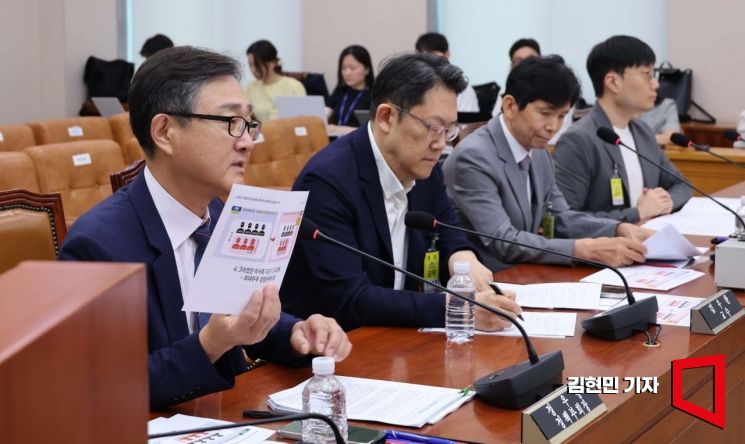 On the 11th, at the Public Hearing for the Additional Amendment of the Commercial Act held by the Subcommittee 1 of the Legislation and Judiciary Committee of the National Assembly, Woo Yong Jung, Vice President of Policy at the Korea Listed Companies Association, is testifying. From the left: Woo Yong Jung, Vice President of Policy at the Korea Listed Companies Association; Woo Chan Kim, Professor at Korea University; Joon Sun Choi, Emeritus Professor at Sungkyunkwan University School of Law; Tae Jun Yoon, Director of the Shareholder Action Platform ACT. July 11, 2025 Photo by Hyunmin Kim
According to the business community on July 14, criticism has emerged regarding the procedural legitimacy of the public hearing on the Commercial Act amendment bill, which was held by the Legislation and Judiciary Committee of the National Assembly on July 11.
This public hearing was organized to gather opinions from various sectors on the mandatory cumulative voting system and the expansion of separate election of audit committee members, which are to be added to the Commercial Act amendment bill that passed the plenary session on July 3. The business community has consistently opposed these provisions, arguing that they could hinder companies' management activities. Nevertheless, the Legislation and Judiciary Committee did not invite any representatives from the business community or anyone who could adequately voice their perspective. Only experts recommended by both the ruling and opposition parties and committee members attended. It has also been reported that some parts of the hearing were held behind closed doors.
There is an interpretation that the National Assembly did not invite business representatives to the hearing because it believed that their participation would only result in a repetition of existing arguments. Some have responded cynically to the very composition of the hearing, which proceeded without input from the business sector. One official from the business community remarked, "Given the way the Commercial Act is being amended, it seems unlikely that ministers with business backgrounds will be able to play an active role," adding, "They too will probably follow the stance of the government and the ruling party."
The six major economic organizations visited the National Assembly on June 30 to hold a meeting with the Democratic Party and convey their opinions on the Commercial Act amendment bill. At this meeting, the vice presidents of the six organizations expressed concerns about shareholder intervention in management, the possibility of mass lawsuits, and the potential contraction of investment and new businesses. In response, the Democratic Party decided to hold a public hearing on issues such as the cumulative voting system after discussions between the ruling and opposition parties. Economic organizations, aiming to more thoroughly highlight the problems of the amendment and present diverse opinions at the hearing, reportedly reviewed the bill again in detail immediately after it passed on July 3.
Although experts recommended by both the ruling and opposition parties attended the hearing, there was no meaningful progress, and only differences of opinion were reaffirmed. Woo Yong Jung, Vice President of Policy at the Korea Listed Companies Association, who attended as a witness on behalf of the People Power Party, pointed out, "If the current Commercial Act amendment passes, the expansion of the separate election of audit committee members could result in the appointment of audit committee members supported by foreign speculative capital," and warned, "The entry of outside personnel could lead to the leakage of our companies' core national technology information, causing us to lose global competitiveness." Kim Woo Chan, Professor at Korea University Business School, who attended as a witness for the Democratic Party, stated, "The business community opposes the amendment, citing reasons such as loss of control, management intervention, potential unconstitutionality, deviation from global standards, reverse discrimination, and leakage of confidential information." He added, "If control is transferred through the cumulative voting system and the separate election of audit committee members, it means there are significant problems with the company's major shareholders or management, and in such cases, the transfer of control is actually desirable."
© The Asia Business Daily(www.asiae.co.kr). All rights reserved.
![Clutching a Stolen Dior Bag, Saying "I Hate Being Poor but Real"... The Grotesque Con of a "Human Knockoff" [Slate]](https://cwcontent.asiae.co.kr/asiaresize/183/2026021902243444107_1771435474.jpg)















