Bank of Korea Submits Proposal to National Policy Planning Committee on Reforming Financial Stability Policy Framework
Need for Policy Tools Beyond Interest Rates to Address Financial Instability
Calls for Governance Structure to Enforce Macroprudential Policy Without Political Influence
Emphasizes Necessity of Independent Inspection Authority Over Non-Bank Financial Institutions
The Bank of Korea has conveyed to the National Policy Planning Committee its view that it needs macroprudential policy tools and the authority to independently inspect financial institutions, including non-bank entities. Analysts interpret this as the Bank of Korea raising its voice in line with the new administration’s overhaul of the financial supervisory system, after having previously pointed out issues with macroprudential policies that run counter to monetary policy and the increasing difficulty of managing financial stability due to the growing share of non-bank institutions.
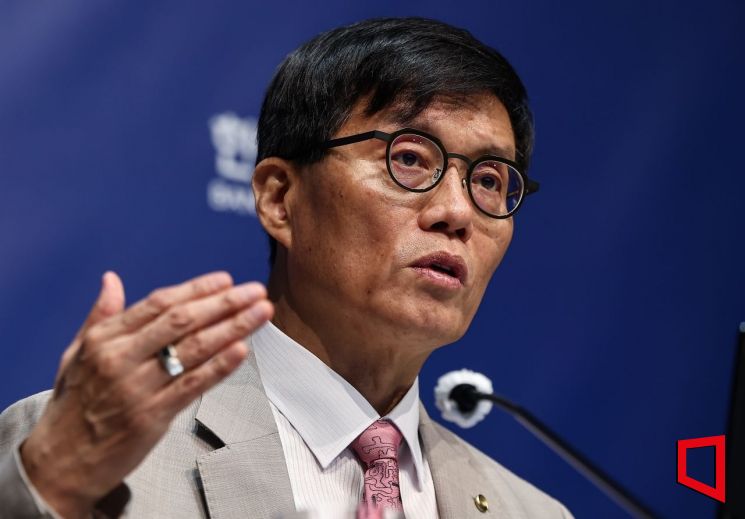 Lee Changyong, Governor of the Bank of Korea, is answering reporters' questions at a press conference on the monetary policy committee's interest rate decision held at the Bank of Korea in Jung-gu, Seoul on the 10th. Photo by Joint Press Corps
According to the Bank of Korea and political sources on July 14, the Bank of Korea recently submitted a proposal to the National Policy Planning Committee to reform the financial stability policy framework in a way that strengthens the Bank’s role in financial stability. The Bank of Korea emphasized to the committee that, "Although we are tasked with both price stability and financial stability, we do not have policy tools other than interest rates to proactively respond to financial instability," and stressed the need for related authority.
In terms of macroprudential management, it is reported that the Bank of Korea’s proposal includes the view that it should take the lead in deciding key ratios and requirements currently under the authority of the Financial Services Commission, such as the Debt Service Ratio (DSR), Loan-to-Value Ratio (LTV), Countercyclical Capital Buffer (CCyB), and Liquidity Coverage Ratio (LCR).
The Bank of Korea stressed that macroprudential policy should not be used as a tool for economic stimulus under political influence. The Bank’s position is that it should also take the lead in macroprudential policy in order to assess financial and economic conditions neutrally and to optimize liquidity management. In relation to this, Governor Lee Changyong stated at a press conference following the monetary policy meeting on the 10th, "The fact that household debt has not decreased even once in over 20 years, and the emergence of real estate project financing (PF) issues, are because macroprudential policy has not been implemented forcefully in practice."
He emphasized, "The Ministry of Economy and Finance, the Financial Services Commission, the Financial Supervisory Service, and the Bank of Korea should be able to discuss macroprudential policy, and especially, a governance structure should be created in which the Bank of Korea can raise its voice and implement policy forcefully without political influence." In this context, the Bank of Korea is said to have proposed to the committee that the Governor of the Bank of Korea should chair the financial stability council that decides macroprudential policy.
The Bank of Korea has also stated the need for the authority to independently inspect financial institutions, including non-bank entities. Currently, the Bank of Korea only has the authority to request joint inspections with the Financial Supervisory Service when necessary. Governor Lee has also emphasized, "The authority for joint inspections or investigations of non-bank financial institutions should be expanded," adding, "This is not about expanding authority, but about serving the national economy."
As the basis for these arguments, the Bank of Korea highlighted that major central banks around the world directly establish and implement macroprudential policy, hold microprudential supervisory authority, or play a central role in financial stability councils.
Meanwhile, the Bank of Korea suggested that if the financial supervisory decision-making body currently overseen by the Financial Services Commission is newly constituted, the Deputy Governor of the Bank of Korea should be included as an ex officio member, and a financial expert recommended by the Governor should be added as a standing member, in order to establish a structure that allows for policy coordination between the Bank of Korea and the supervisory body.
© The Asia Business Daily(www.asiae.co.kr). All rights reserved.
![Clutching a Stolen Dior Bag, Saying "I Hate Being Poor but Real"... The Grotesque Con of a "Human Knockoff" [Slate]](https://cwcontent.asiae.co.kr/asiaresize/183/2026021902243444107_1771435474.jpg)















