Recorded as Korea's Seventeenth World Heritage Site
"Masterpiece Creatively Depicting a Rare Theme"
Recommendations Include Reporting Progress on Sihyeon Dam Construction
The "Petroglyphs along the Bangucheon Stream," which reflect the lives of prehistoric people, have been inscribed on the UNESCO World Heritage List.

On July 12 (local time), the UNESCO World Heritage Committee, at its 47th session held in Paris, France, inscribed the Petroglyphs along the Bangucheon Stream on the World Heritage List. The official registered English name is "Petroglyphs along the Bangucheon Stream."
The World Heritage designation refers to heritage recognized as having Outstanding Universal Value (OUV) that must be protected for all humanity, in accordance with the World Heritage Convention of 1972. World Heritage sites are classified as cultural heritage, natural heritage, or mixed heritage that possesses both characteristics. With this decision, South Korea now has fifteen cultural heritage sites and two natural heritage sites.
The petroglyphs along the Bangucheon Stream, which include the National Treasures "Bangudae Petroglyphs in Daegok-ri, Ulju" and "Cheonjeon-ri Inscriptions and Petroglyphs in Ulju," are regarded as the essence of prehistoric culture on the Korean Peninsula. It is believed that a variety of images were engraved over a long period of time. Petroglyphs refer to images carved or painted on rock surfaces or cave walls.
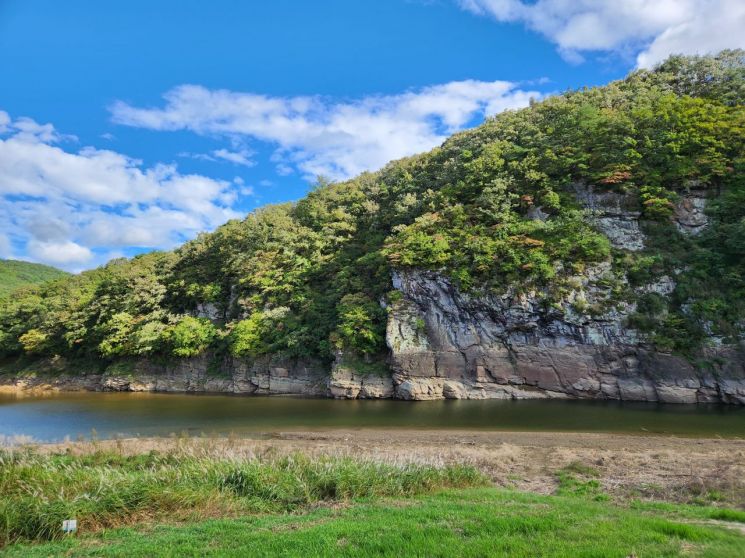
The Bangudae Petroglyphs in Daegok-ri, Ulju, discovered in 1971, are commonly referred to as the "Bangudae Petroglyphs." They are located on the cliffs of the Bangucheon Stream, a tributary of the upper Taehwa River. On a rock surface approximately 4.5 meters high and 8 meters wide, images of marine animals, terrestrial animals, and hunting scenes are densely engraved. According to a drawing catalog published by the Bangucheon Petroglyphs World Heritage Promotion Team of Ulsan Metropolitan City, which analyzed 3D scan drawings and measured data, a total of 312 images have been identified.
These petroglyphs are also well known for containing the oldest depictions of whale hunting. Images of harpooned whales, whales giving birth or accompanied by calves, and other scenes have drawn attention from the global academic community.
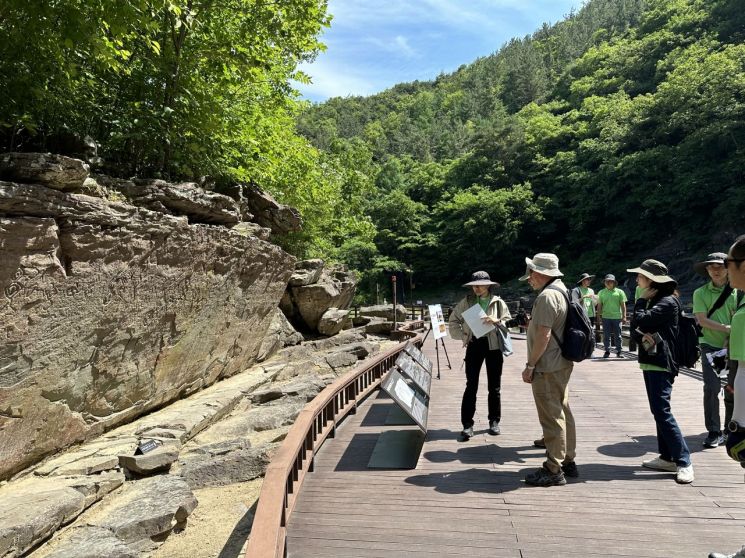
The World Heritage Committee stated, "The realistic images, based on outstanding powers of observation, are rendered in unique compositions," and added, "They demonstrate the artistic sensibilities of the people who lived on the Korean Peninsula." In particular, regarding the whale hunting scenes, the committee described them as "masterpieces that creatively depict the rare theme of various whales and the main stages of whaling," and explained that they serve as "unique evidence proving the tradition of petroglyphs that continued for about 6,000 years since prehistoric times, and as a concentrated representation of the cultural development of people living in the coastal regions of the Korean Peninsula."
The Cheonjeon-ri Inscriptions and Petroglyphs are located about 2 kilometers from the Bangudae Petroglyphs in Daegok-ri. Their existence became known in 1970, one year before the discovery of the Bangudae Petroglyphs. On a rock surface approximately 2.7 meters high and 9.8 meters wide, more than 620 figures, inscriptions, and drawings are engraved. Some of the inscriptions are believed to have been left during the reign of King Beopheung of Silla, making them an important resource for studying Silla society around the 6th century.

Along with the inscription decision, the World Heritage Committee made four recommendations: reporting on the progress of the Sihyeon Dam construction; ensuring the effective operation of the Bangucheon World Petroglyphs Center; formalizing a management system involving local communities and residents; and reporting all major development plans that could affect the OUV.
The National Heritage Administration pledged, "While faithfully preserving the World Heritage value of the Petroglyphs along the Bangucheon Stream, we will continue our policy efforts through active administration and close cooperation with local governments and residents."
© The Asia Business Daily(www.asiae.co.kr). All rights reserved.
![Clutching a Stolen Dior Bag, Saying "I Hate Being Poor but Real"... The Grotesque Con of a "Human Knockoff" [Slate]](https://cwcontent.asiae.co.kr/asiaresize/183/2026021902243444107_1771435474.jpg)

















