IBK Economic Research Institute Forecasts by Industrial Bank of Korea
Volatility in Manufacturing Rises, Service Sector Remains Stagnant
Tariffs Heighten Downward Pressure on the Economy
Industries Highly Dependent on the U.S. Unavoidably Impacted
"Growth in SME Lending Slows Due to Increased Credit Risk"
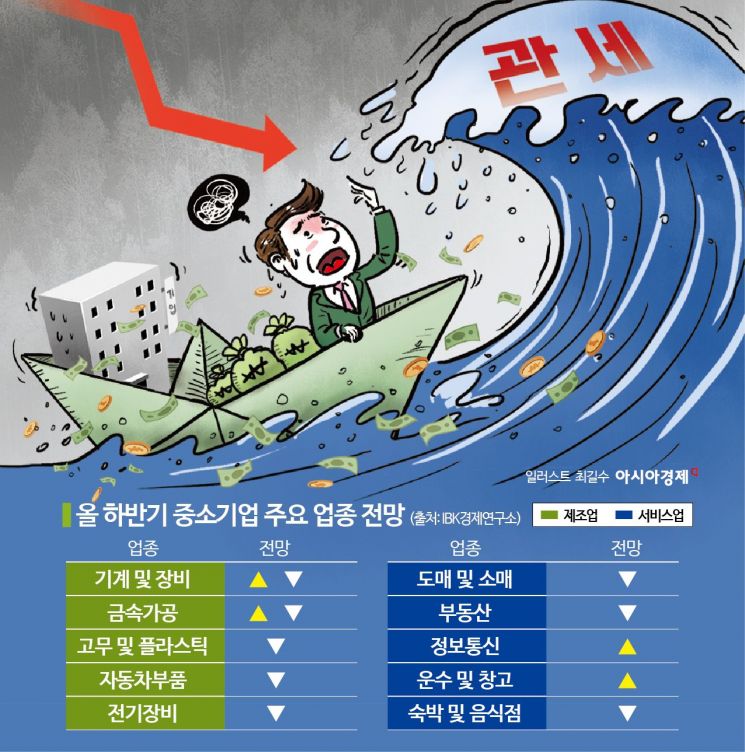
There are growing expectations that the prolonged downturn in the small and medium-sized enterprise (SME) sector will continue in the second half of this year, as both domestic and overseas demand are expected to decline. As a result, investment sentiment is likely to weaken, and concerns over financial soundness may lead to a reduction in funding supply.
According to the financial sector on July 14, the IBK Economic Research Institute under Industrial Bank of Korea recently stated this in its "Economic Environment Outlook for the Second Half of 2025." The institute first diagnosed that as economic volatility increases, the momentum for a performance rebound?especially in exports?is weakening. For example, the production growth rate of small and medium-sized manufacturing companies has shown increased volatility, fluctuating repeatedly from the first quarter of last year through the first quarter of this year. While production in the SME service sector has remained relatively stable compared to manufacturing, the institute noted that it appears to be in a period of stagnation rather than recovery. The growth rate was 1.9% in the first quarter of last year, maintained through the second quarter, but then dropped to -0.1% in the third quarter, 0.3% in the fourth quarter, and -0.2% in the first quarter of this year. Regarding export growth, the rate showed a recovery trend in the four quarters of last year at 0.1%, 1.1%, 1.5%, and 2.1%, but slowed to 0.7% in the first quarter of this year.
The institute forecasts that weak domestic and external demand, along with the full-scale impact of tariffs, will further increase downward pressure on the economy. In particular, it expects poor business performance, especially among industries and related partners affected by U.S. tariffs. The institute analyzed that the direct export dependency of SMEs on the U.S. was 16.8% in the first quarter of this year, making the U.S. the top single export destination. When indirect exports are also considered, the actual scale of damage is expected to be significant. Among these, for automobile parts?a key SME export item?the combined export share to the U.S. and Mexico was 37% last year, and the scale of indirect exports exceeded twice that of direct exports, suggesting that SMEs in this sector will be hit even harder. The institute emphasized that "for the majority of SMEs that cannot transfer costs or invest overseas, business impacts are inevitable."
The domestic market for SME service industries is also expected to face significant difficulties. The institute stated, "Due to the prolonged slump in the construction sector and delayed improvement in domestic demand, it will take time for business sentiment to recover in self-employed intensive sectors such as accommodation, food service, and real estate leasing."
By industry, in manufacturing, machinery and equipment, and metal processing may see some positive factors, but volatility remains high. The machinery and equipment sector is expected to see increased facility investment due to strong performance in upstream industries such as semiconductors and shipbuilding, but demand could be dampened by automobile tariff issues. In metal processing, despite the shipbuilding boom, weak construction and increased uncertainty in automobile exports are expected to reduce demand for metal materials. Rubber and plastics, automobile parts, and electrical equipment are projected to remain sluggish due to poor export performance in major upstream industries and slow recovery in domestic demand. In the service sector, information and communications and transportation and warehousing are expected to show positive prospects as growth in information and communications technology (ICT) and digital content continues. However, the outlook is bleak for wholesale and retail, real estate, accommodation, and food service sectors, as sluggish domestic demand and stagnant consumption are expected to lead to declining sales.
Due to the economic downturn, funding supply for SMEs is also expected to decrease. The institute predicted, "Growth in SME lending will slow due to concerns over financial soundness stemming from increased credit risk." Although financial authorities are making efforts to prevent a contraction in funding supply, such as easing bank capital regulations, these measures are insufficient to offset the burden on financial institutions to manage risks in vulnerable sectors such as the self-employed. As a result, the institute expects that, for the time being, SME loans will be supplied mainly through policy finance. While demand for SME operating funds is likely to increase due to the economic downturn, demand for facility investment funds is expected to slow as investment sentiment weakens amid economic uncertainty.
© The Asia Business Daily(www.asiae.co.kr). All rights reserved.
![Clutching a Stolen Dior Bag, Saying "I Hate Being Poor but Real"... The Grotesque Con of a "Human Knockoff" [Slate]](https://cwcontent.asiae.co.kr/asiaresize/183/2026021902243444107_1771435474.jpg)















