Low Clearance Rate for Crop Theft
"Stricter Penalties Needed for Prevention"
"Where did my angelica go!"
Danbi Kim (40), who has been growing crops with her family for three years in an urban garden along Anyangcheon in Geumcheon-gu, Seoul, recently had her cherished angelica stolen. After someone took one of her planted angelica roots, she was debating whether to dig up the rest, but within a week, the thief came back and pulled out the remaining ones by the roots. Her garden is not in a quiet rural area, but rather in an open space right next to a bike path in the city. Kim said, "I even put up a note saying I was growing them with my two-year-old daughter, but I can't understand how someone could be so shameless," adding, "I think they tasted the angelica, liked it, and came back to steal the rest."
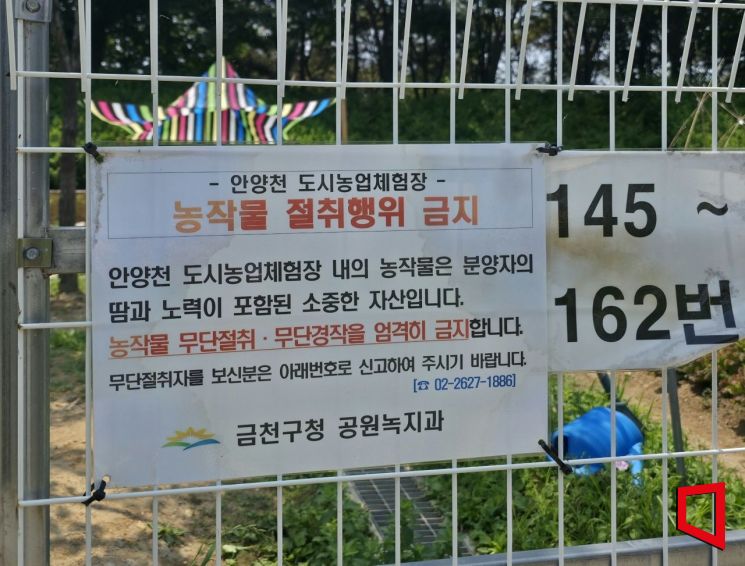 A warning sign posted right in front of the garden of Danbi Kim (40), whose angelica was stolen. Photo by Youngchan Choi
Theft of crops in urban areas is causing distress for city farmers. These crimes are not happening in remote rural areas with few people, but openly in urban spaces where many people pass by.
According to the National Police Agency on July 12, between 2019 and 2023, there were a total of 2,665 cases of agricultural product theft, but only 1,156 cases were solved, resulting in a clearance rate of 43.3%. It is difficult to catch perpetrators of agricultural theft because it is hard to distinguish who owns the crops, and the reporting rate is also low.
On this day, at the Jeonju Lee Clan Hampung-gun burial site in Dongjak-gu, Seoul, banners asking people not to damage the trees and flowers were hung in several places. The clan association has repeatedly experienced people picking fruit from trees planted for residents' enjoyment or digging up valuable saplings.
 A banner reading "It's more beautiful when viewed together, please do not pick flowers and trees. Criminal action will be taken if caught" is hung in front of the clan association's garden where the peonies were stolen. Photo by Youngchan Choi
A representative of the clan association managing the burial site said, "Recently, someone entered a restricted area and picked all the plums. Last year, we planted peonies worth 150,000 won each, but someone dug them up with a shovel." He added, "It's fine to take fruit that has fallen to the ground, but please don't damage the trees and flowers while picking. We have all the CCTV footage, but we have no plans to report it." The site where the crops were stolen was right in front of the building used as the clan association office, and there was a walking path nearby, making it an open area.
Theft of crops, which often occurs in everyday life, is a clear crime. If you are caught stealing crops grown by someone else, you can face up to six years in prison or a fine of up to 10 million won. If two or more people work together to steal, it can constitute aggravated theft. Local governments have also put up notices near gardens prohibiting unauthorized picking of crops, but the effect has been minimal.
Experts advise that sentencing guidelines for crop theft should be revised to enhance deterrence. Kim Dowoo, a professor in the Department of Police Administration at Kyungnam University, said, "Most cases of crop theft are first-time offenses and the damages are small, so even if caught, most offenders receive suspended indictments or fines. However, there are also habitual thieves who target expensive crops professionally, so it is necessary to increase the severity of punishment."
© The Asia Business Daily(www.asiae.co.kr). All rights reserved.
![Clutching a Stolen Dior Bag, Saying "I Hate Being Poor but Real"... The Grotesque Con of a "Human Knockoff" [Slate]](https://cwcontent.asiae.co.kr/asiaresize/183/2026021902243444107_1771435474.jpg)
















