KOSPI Surpasses 3,200 for the First Time in 3 Years and 10 Months
KOSDAQ Also Reclaims the 800 Level
SK Hynix Breaks Through 300,000 Won
Policy Momentum and Liquidity Fuel Stock Market Rally
The KOSPI surpassed the 3,200 mark for the first time in 3 years and 10 months, once again reaching its yearly high. The KOSDAQ also reclaimed the 800 level. Policy momentum and abundant liquidity are supporting the stock market rally.
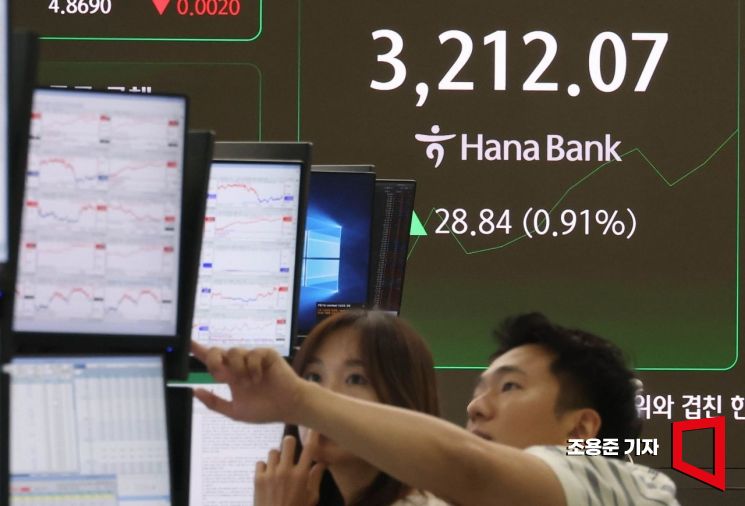 On the 11th, as the domestic stock market capitalization surpassed 3,000 trillion won for the first time in history and the KOSPI index broke through the 3,200 mark for the first time in 3 years and 10 months, reaching an all-time high, the KOSPI index was displayed on the monitor in the dealing room of Hana Bank in Jung-gu, Seoul. On this day, the KOSPI opened at 3,186.35, up 3.12 points (0.10%) from the previous session. 2025.7.11 Photo by Cho Yongjun
As of 9:55 a.m. on July 11, the KOSPI was trading at 3,185.10, up 1.87 points (0.06%) from the previous day. On this day, the KOSPI opened higher and broke through the 3,200 mark, rising as high as 3,216.69, but gains have since narrowed and the index is moving sideways. This is the first time the KOSPI has surpassed 3,200 during trading hours since September 7, 2021 (3,200.07). The KOSDAQ was at 801.34, up 3.64 points (0.46%).
The strong performance of the U.S. stock market the previous day, with the S&P 500 and Nasdaq indices both reaching all-time highs, also had an impact.
Leading stocks showed strength, driving the KOSPI past the 3,200 mark. SK Hynix rose as high as 306,500 won during trading, surpassing the 300,000 won level for the first time since its rebranding as SK Hynix in 2012, setting a new all-time high. Samsung Electronics was trading at 62,200 won, up 1.97% from the previous day.
Domestic policy momentum and abundant liquidity are cited as factors behind the market rally. Na Jeonghwan, a researcher at NH Investment & Securities, analyzed, "Despite the impact of U.S. tariffs, the KOSPI continues to hit new highs for the year. Policy momentum, such as the government's push to make share buyback cancellations mandatory through amendments to the Commercial Act, is a positive for stock prices, but above all, there is abundant idle capital in the market." He pointed to strong foreign investor buying, individual investors' deposits (65 trillion won), and a surge in the principal amount set in domestic equity funds as evidence that ample liquidity is supporting the market. Na predicted, "Funds will continue to flow into sectors and stocks with policy-driven or other upward momentum."
If individual investors' buying intensifies, the market uptrend is expected to gain even more momentum. Cho Junki, a researcher at SK Securities, said, "The domestic stock market has been outperforming overseas markets. If there is a massive inflow of individual buying, the upside could widen significantly regardless of fundamentals."
As rotational trading continues, there are opinions that attention should be paid to sectors that were previously left out of the rally. Lee Sunghoon, a researcher at Kiwoom Securities, noted, "A distinctive feature of the domestic stock market recently is that while traditional leading sectors such as shipbuilding and defense are maintaining strong trends, rotational trading is also proceeding rapidly into other sectors. Last month, during the KOSPI and KOSDAQ rally, healthcare was one of the most neglected sectors. Given the current rapid rotation, it is time to focus on healthcare stocks with individual earnings momentum in order to catch up."
Lee Kyungmin, a researcher at Daishin Securities, also emphasized, "Rather than chasing rising sectors, it is more effective to manage risks and respond with rotational trading focused on undervalued and neglected stocks," adding that "healthcare, semiconductors, and secondary batteries are representative sectors."
As the KOSPI continues to set new yearly highs, securities firms are raising their forecasts. IBK Investment & Securities raised its upper range forecast for the KOSPI this year from 3,100 to 3,400, and Korea Investment & Securities revised its second-half KOSPI band from 2,600-3,150 to 2,900-3,550. Kim Daejun, a researcher at Korea Investment & Securities, said, "We applied a 12-month forward price-to-earnings ratio (PER) of 11.5 times to the upper end of the index. If we factor in improved sentiment and policy effects, the index is highly likely to reach that level." He added, "In particular, rather than the third quarter, which faces various negative factors, we should keep in mind the possibility of the index rising further in the fourth quarter, when interest rate cuts and improved supply-demand conditions are expected."
© The Asia Business Daily(www.asiae.co.kr). All rights reserved.
![Clutching a Stolen Dior Bag, Saying "I Hate Being Poor but Real"... The Grotesque Con of a "Human Knockoff" [Slate]](https://cwcontent.asiae.co.kr/asiaresize/183/2026021902243444107_1771435474.jpg)











