Checking the Type of Air Conditioner Is Essential
Keep Inverter Air Conditioners Running
Turning Fixed-Speed Models On and Off Is More Efficient
As record-breaking heatwaves have led to increased air conditioner usage, consumers are also becoming more concerned about their electricity bills. As a result, various "tips" for avoiding electricity bill shocks while using air conditioners are being shared on social networking services (SNS) and other platforms. However, the abundance of conflicting advice is causing confusion. Common claims include that it is better to keep the air conditioner running continuously rather than turning it on and off, and that using the dehumidification mode is more efficient than cooling mode. There are also posts where people claim to have received lower electricity bills by using specific methods and present their actual electricity bills as "evidence."
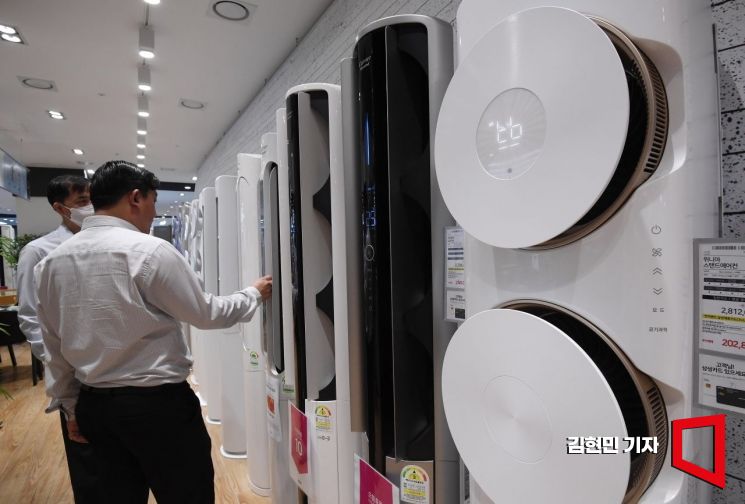 With record-breaking heatwaves increasing air conditioner usage, consumers are also growing increasingly concerned about their electricity bills. Photo by Hyunmin Kim kimhyun81@
On July 10, Yonhap News conducted a fact check regarding electricity bills and air conditioner usage amid the ongoing heatwave. One of the most common questions about air conditioner electricity usage is whether it is more cost-effective to turn the unit on and off or to keep it running continuously. To lower your electricity bill, you should first check what type of air conditioner you have. Most units released before 2011 are "fixed-speed (older models)," while those released after 2011 are mostly "inverter (newer models)." Inverter models are labeled "inverter" or "INVERTER" on the outdoor unit. For fixed-speed air conditioners, it is more efficient to turn the unit off once the desired temperature is reached. This is because the outdoor unit shuts off at the target temperature, but when the indoor temperature rises again, the outdoor unit operates at maximum output, consuming a lot of electricity.
On the other hand, for inverter air conditioners, it is better to keep the unit running. Once the desired temperature is reached, the outdoor unit operates at a lower output to maintain the temperature. Initially, you can set the target temperature lower to quickly cool the room, then raise it to a moderate level around 26 degrees Celsius to reduce electricity costs. Using an air conditioner together with a fan to circulate air quickly, or regularly cleaning the air filter and outdoor unit to improve cooling efficiency, can also help. Since cold air sinks, it is effective to set the airflow direction upward when using a standing air conditioner.
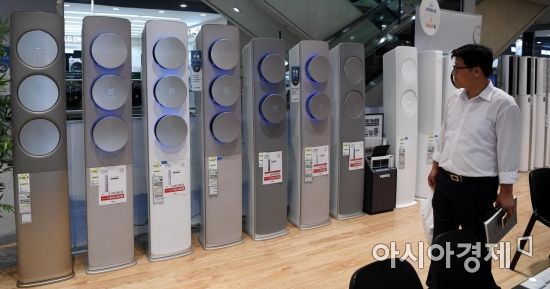 As the record-breaking heatwave and tropical nights continue, air conditioner sales are soaring. Photo by Hyunmin Kim kimhyun81@
Whether dehumidification mode is more advantageous for saving electricity than cooling mode depends on the environment. On humid days, cooling mode can remove moisture more quickly. Dehumidification mode requires longer operation to remove moisture, which can increase power consumption. If the humidity is low, dehumidification mode may be more efficient. Overheating of the outdoor unit can also lead to increased power consumption. Covering the outdoor unit with a sunshade to block direct sunlight or spraying water around it to lower the temperature can help improve cooling efficiency.
Electricity bill discount programs are also worth utilizing. If you enroll in the "Residential Energy Cashback" program operated by Korea Electric Power Corporation, you can receive a discount of 30 to 100 won per kWh on your next month's bill if you save more than 3% of electricity compared to the average for the same month over the past two years. For small business owners, it is important to avoid "open-door cooling," which means operating air conditioners while keeping the doors open. According to the Korea Energy Agency, this can increase power consumption by up to three to four times compared to cooling with the doors closed. Installing insulation strips on windows or door gaps to prevent cold air from escaping is also a good idea. In conclusion, inverter air conditioners should be kept running, while fixed-speed models should be turned on and off as needed. Choosing an air conditioner appropriate for the room size and using auxiliary devices are effective ways to save on electricity bills. Additionally, regularly cleaning the air conditioner filter to improve cooling efficiency should not be overlooked.
However, experts explain that when it comes to air conditioners, there is no single "correct answer" that applies to every household, as factors such as daily temperature, humidity, and the layout of each home can vary. Generally, if you are leaving the house for a short period, it is better to leave the air conditioner on, and when humidity is high, using the dehumidification function rather than the cooling mode can help you use the air conditioner more efficiently, according to experts.
© The Asia Business Daily(www.asiae.co.kr). All rights reserved.
![Clutching a Stolen Dior Bag, Saying "I Hate Being Poor but Real"... The Grotesque Con of a "Human Knockoff" [Slate]](https://cwcontent.asiae.co.kr/asiaresize/183/2026021902243444107_1771435474.jpg)















