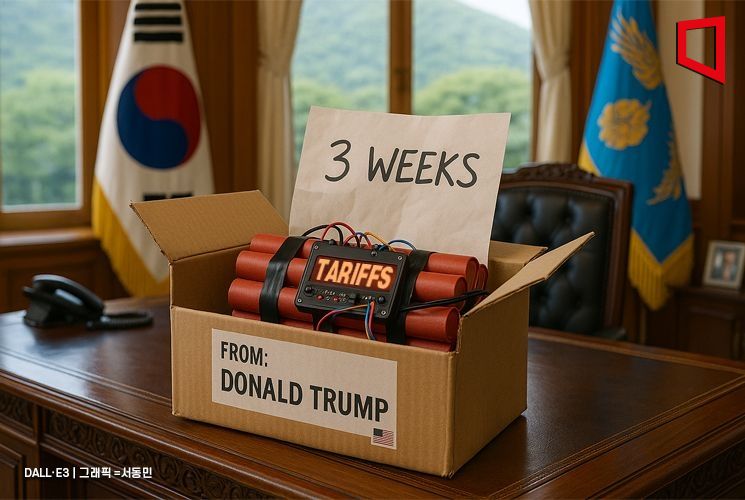
On July 11, Korea Investment & Securities stated that regarding the reciprocal tariffs announced by U.S. President Donald Trump, it cannot rule out the possibility that if the two countries fail to reach an agreement by August 1, a 25% reciprocal tariff could take effect. However, the market views this as a type of negotiation pressure event, and there is a consensus that its ripple effect is unlikely to be prolonged.
Kim Kimyung, a researcher at Korea Investment & Securities, explained this in a report titled "Understanding Trump's Policies" released on the same day, stating, "The Korean government believes that upholding national interests is more important than reaching a quick agreement."
First, Kim pointed out that President Trump postponed the effective date of the reciprocal tariffs from July 9 to August 1, stating, "Rather than immediately enforcing reciprocal tariffs, which would also burden the U.S. economy, the intention is to secure more time for trade negotiations." He predicted, "The countries subject to the reciprocal tariffs will accelerate negotiations to reach an agreement by August 1."
He said, "It is possible that if an agreement is not reached by August 1, the 25% reciprocal tariffs could take effect." However, he also judged, "Even if the reciprocal tariffs are implemented after August 1, the market sees them as an event intended to pressure tariff negotiations, considering the burden on the U.S. economy, and thus the ripple effect is unlikely to be prolonged."
The report released that day is notable for re-examining the Trump administration's policies, including tariffs, from the perspective that the restoration of U.S. manufacturing is a major policy goal. Kim summarized President Trump's policies for restoring domestic manufacturing as "not only compensating for the fiscal deficit through the imposition of tariffs, but also establishing entry barriers for U.S. manufacturing, inducing lower oil prices and interest rates to secure cost competitiveness for U.S. manufacturing, and promoting corporate profitability and investment attraction through the permanent reduction of corporate taxes."
Regarding interest rate policy, he assessed that there is not much time left, as it is necessary for the manufacturing revival policy to be firmly established before the midterm elections in November next year. Kim stated, "President Trump is attempting to lower interest rates not only as a response to the expansion of the fiscal deficit and the burden of national debt interest, but also for the purpose of reviving manufacturing." However, he added, "Contrary to President Trump's wishes, the base rate remains on hold."
Currently, the market expects the Federal Reserve (Fed) to begin cutting rates from September, with two rate cuts expected by the end of the year. Referring to the minutes of the June Federal Open Market Committee (FOMC) meeting released the previous day, Kim said, "It does not appear easy for rate cuts to accelerate within this year as President Trump wishes." He further predicted, "If things do not go as he wants, next year, rate cuts could proceed very quickly through a change in the Fed chair."
He evaluated that the dollar-won exchange rate, which has been stuck in the mid-to-high 1,300 won per dollar range, could move downward in the future. Kim explained, "To restore U.S. manufacturing, it is necessary to normalize the overvalued dollar compared to fundamentals." He added, "If it becomes certain that the bond market is functioning properly and the inflow of foreign capital remains stable, the exchange rate could become a negotiation issue to secure the competitiveness of U.S. manufacturing." In this case, he explained, the direction of the dollar-won exchange rate would likely be further downward.
He further stated, "In the absence of information related to exchange rate negotiations, the dominant factor affecting the exchange rate is the difference in monetary policy." He added, "Considering the difference between Korea, where a slower pace of rate cuts is emerging due to financial stability risks, and the U.S., where the pace of rate cuts could accelerate, the exchange rate will face some downward pressure."
Additionally, regarding oil prices, Kim stated, "The Strait of Hormuz can now be considered stabilized and outside the focus of capital markets, and furthermore, after the resumption of nuclear negotiations, there is a possibility that Iranian oil exports could be allowed." He diagnosed, "If a ceasefire between Russia and Ukraine is achieved and sanctions on Russia are lifted, the downward pressure on oil prices could increase further." He added, "There are various factors that could expand oil supply, such as the development of the large-scale, low-cost Guyana oil field, so the direction of oil prices is downward."
© The Asia Business Daily(www.asiae.co.kr). All rights reserved.
![Clutching a Stolen Dior Bag, Saying "I Hate Being Poor but Real"... The Grotesque Con of a "Human Knockoff" [Slate]](https://cwcontent.asiae.co.kr/asiaresize/183/2026021902243444107_1771435474.jpg)















