Industry Invested Hundreds of Billions: "Confusion for Both Schools and Companies"
Policy Reversed with Change in Administration... Losses Unavoidable
"Excluding Only Education from AI Industry Development"
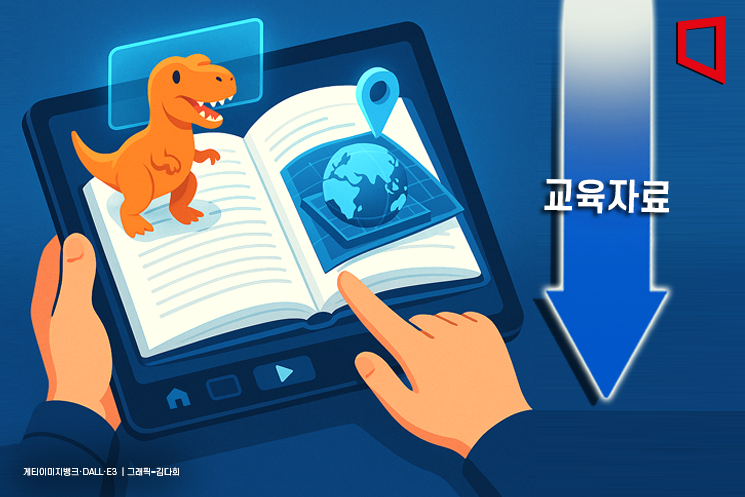
As a bill that downgrades the legal status of artificial intelligence (AI) digital textbooks from "textbooks" to "educational materials" passed the National Assembly's Education Committee, confusion in the industry has reached its peak, and opposition is intensifying. With a change in government leading to a dramatic shift in policy direction, textbook publishers and edtech companies that have invested in AI digital textbook development for years now face slim prospects of recouping their investments. Some voices in the industry say that the entire sector is effectively being pushed to the brink of shutting down operations.
According to the National Assembly and related industries on July 11, the Democratic Party of Korea and the Rebuilding Korea Party put the amendment to the Elementary and Secondary Education Act, which changes the status of AI digital textbooks to educational materials, to a vote at the full session of the Education Committee the previous day. Moon Jungbok, the Democratic Party's secretary on the Education Committee, said, "We have discussed this issue at the party level for a long time and have reached the conclusion that it can no longer be delayed."
 At the joint press conference of publishers held on the 11th at the Irum Center in Yeongdeungpo-gu, Seoul, to demand the repeal of the unconstitutional legislation on AI digital textbooks, the representatives of the publishers are shouting slogans. Photo by Yonhap News
This bill had previously been scrapped during the Yoon Suk-yeol administration after the ruling party's opposition led to a presidential veto, but it was reintroduced following the change in government and has now passed the standing committee. The ruling party plans to pass the bill at the plenary session on July 23.
The AI textbook project was a key digital transformation policy initiative of the Yoon Suk-yeol administration. Since March of last year, pilot programs were launched for third and fourth graders in elementary school, first-year middle school students, and first-year high school students, in English, mathematics, and information subjects. Plans were in place to expand this to other subjects such as science and social studies, with full-scale implementation scheduled for 2025. Based on this premise, major publishers such as Chunjae Education and Visang Education, along with numerous edtech companies, invested as much as tens of billions of won each in content development and platform construction.
However, as the government postponed the introduction of science and social studies subjects by one year and the current amendment threatens to strip AI textbooks of their textbook status altogether, momentum for adoption in schools has virtually disappeared. A representative from an edtech company said, "We trusted the government's policy and moved forward with commercialization, but the policy has been completely reversed in just a few years. The maintenance costs are considerable, and now private companies must bear all of them." Another company official added, "Due to structural limitations such as the declining birthrate, it is difficult to increase profitability, and we have already begun restructuring the development staff hired for the AI textbook project."
The change in the status of AI textbooks also has a direct impact on the budget structure. When designated as textbooks, the government provides them free of charge nationwide, but as educational materials, each school must purchase them with its own budget. This inevitably leads to a decrease in adoption rates. As of March, only 32% of the 11,932 elementary, middle, and high schools nationwide had adopted at least one subject using AI textbooks. A representative from a publishing company said, "The original purpose of introducing AI textbooks was to address educational disparities, but as the policy has changed according to political interests, confusion at the field level has only grown."
Meanwhile, textbook publishers and edtech companies held a press conference on this day to call for the withdrawal of the bill. They argued, "The government has declared its ambition to become one of the top three AI powerhouses and is pursuing the development of a 100 trillion won AI industry, but excluding AI textbooks from the education sector can only cause significant confusion among the public."
© The Asia Business Daily(www.asiae.co.kr). All rights reserved.
![Clutching a Stolen Dior Bag, Saying "I Hate Being Poor but Real"... The Grotesque Con of a "Human Knockoff" [Slate]](https://cwcontent.asiae.co.kr/asiaresize/183/2026021902243444107_1771435474.jpg)
















